
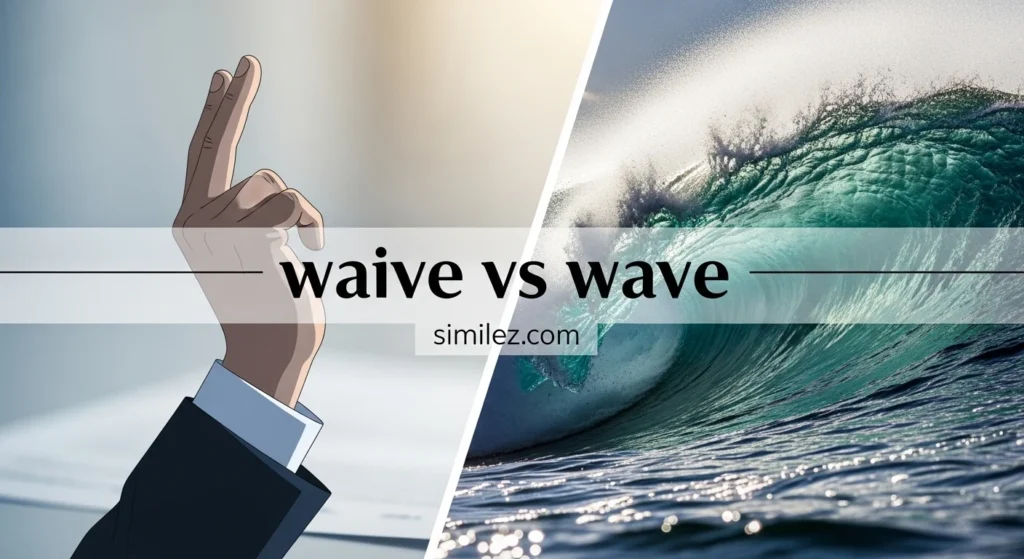
You’re standing in a crowded airport. A friend is leaving for another country. You lift your hand and smile maybe you wave goodbye.
At the same time, somewhere nearby, another traveler is speaking to an airline desk agent, asking if they can waive an extra baggage fee.
Two completely different moments. Two words that sound identical but carry entirely separate worlds of meaning.
This is where English becomes both fascinating and frustrating. “Waive” and “wave” are perfect examples of homophones words that sound the same but differ in spelling and meaning.
One belongs mostly to law, finance, and formal agreements. The other lives in motion, emotion, and everyday human interaction.
Understanding the difference is not just academic. It helps in contracts, exams, professional writing, and even daily communication.
Misusing them can change meaning entirely sometimes with legal or practical consequences.
This article breaks both words apart in detail, explores their real-world usage, emotional undertones, and common mistakes, and gives you practical memory tools so you never confuse them again.
1. Core Meaning: Waive vs Wave
At the most basic level, the difference is simple:
- Wave means to move your hand, an object, or even energy in a flowing motion.
- Waive means to officially give up a right, claim, or requirement.
Despite sounding identical, they live in completely different worlds—one physical and expressive, the other legal and procedural.
Think of “wave” as visible action. A child waves at a bus. Water waves crash on a shore. Even sound waves move invisibly through air.
Now contrast that with “waive,” which is invisible but powerful. A company may waive a fee. A court may waive a requirement. A government may waive a penalty.
Simple contrast in real life:
- You wave at your friend across the street.
- A bank waives your late payment fee.
One involves movement. The other involves permission or exemption.
The confusion happens because both words sound identical in speech. But context always reveals the meaning. If there is motion, gesture, or nature involved—it’s “wave.” If there is law, money, rules, or rights—it’s “waive.”
2. Pronunciation and Why People Confuse Them
Both words are pronounced as /weɪv/, which creates the foundation of confusion. English is full of such homophones, but this pair is especially tricky because both are extremely common in everyday life.
When spoken, there is no audible difference. Only context carries meaning. That is why learners often struggle in writing but rarely in speaking comprehension.
Why confusion happens:
- Same pronunciation
- Similar spelling pattern
- Frequent usage in different domains
- Lack of contextual awareness
For example, hearing “They waived the fee” and “They waved goodbye” sounds identical. Without written context, meaning depends entirely on situation.
Practical insight:
In professional environments like law, business, or academic writing, this confusion can be serious. A single wrong word in a contract or email may completely change interpretation.
So the real skill is not pronunciation—it is mental categorization. Train your brain to instantly associate:
- “Waive” → rules, rights, money, authority
- “Wave” → movement, gestures, nature
Once that separation is clear, confusion disappears.
3. Waive in Legal and Financial Contexts
“Waive” is heavily used in formal systems—especially law, banking, insurance, and governance. It means voluntarily giving up a right or enforcing an exemption.
Example situations:
- A court waives a procedural requirement.
- A bank waives annual maintenance fees.
- A university waives admission fees for deserving students.
In all cases, someone in authority removes an obligation.
Legal nuance:
Waiver is not casual. It is intentional and often documented. Once a right is waived, it may or may not be reclaimable depending on jurisdiction and contract terms.
For example, if a tenant waives the right to notice in a lease agreement, that decision can have long-term consequences.
Practical understanding:
Waive is about power and discretion. Someone with authority decides:
“You don’t need to do this.”
This is why lawyers pay attention to it carefully. It alters obligations and can shift liability.
In everyday life, you might not notice it, but every time a fee disappears or a requirement is relaxed, a waiver is likely involved.
4. Wave as Physical Motion and Natural Phenomena
“Wave” is far more visual and intuitive. It refers to movement that flows in a pattern.
Natural examples:
- Ocean waves hitting the shore
- Wind creating waves in wheat fields
- Sound waves traveling through air
- Light waves enabling vision
These are not random movements—they follow physics and patterns.
Human movement:
A “wave” also refers to a gesture:
- Waving goodbye
- Waving hello
- Waving for attention
Emotional layer:
Unlike “waive,” which is procedural, “wave” carries emotional visibility. It shows presence, connection, and communication without words.
When someone waves at you from a distance, it is a signal:
“I see you. I acknowledge you.”
So “wave” exists in both science and social interaction. It connects the physical world with human expression.
5. Wave in Social and Cultural Communication
Waving is one of the oldest and simplest human gestures. It transcends language barriers.
Everyday uses:
- Greeting someone
- Saying goodbye
- Signaling across distance
- Getting attention in a crowd
In many cultures, waving is polite and friendly. It replaces verbal communication when noise or distance makes speech difficult.
Subtle variations:
- Small wave: polite acknowledgment
- Big wave: excitement or urgency
- Slow wave: emotional farewell
Social meaning:
A wave can communicate warmth without words. It is often the first gesture children learn, because it is intuitive and universal.
Unlike “waive,” which belongs to institutions, “wave” belongs to human connection.
In modern digital culture, emojis like 👋 represent waving, showing how deeply embedded it is in communication.
6. Waive in Contracts and Agreements
In legal writing, “waive” is a technical term with serious implications.
Common contract usage:
- Waiving liability
- Waiving rights to claim damages
- Waiving notice periods
- Waiving service fees
Example scenario:
You sign up for a subscription and agree to waive your right to a refund after 7 days. That means you legally accept the condition.
Why it matters:
Waiver shifts responsibility. It often benefits one party while limiting another’s rights.
Important insight:
People often waive rights without realizing consequences—by clicking “agree,” signing forms, or accepting terms without reading carefully.
In legal reality, waiver is not just a word—it is a transfer of entitlement.
7. Common Mistakes and Real-World Confusion
One of the most frequent errors in writing is mixing these words.
Typical mistakes:
- “He waved the fee” ❌
- “She waived goodbye” ❌
Correct versions:
- “He waived the fee” ✔
- “She waved goodbye” ✔
Why errors happen:
- Phonetic similarity
- Fast typing or autocorrect mistakes
- Lack of contextual awareness
Real consequences:
In casual writing, mistakes are harmless. But in legal or business communication, misusing “waive” can create confusion about obligations or rights.
For example, a miswritten clause in a contract email could imply a fee was physically “waved” instead of legally removed.
Clarity is everything in professional communication.
8. Memory Tricks to Never Confuse Them
A few simple mental associations help:
1. “Wave = Water”
Think of waves in the ocean. Movement, flow, gesture.
2. “Waive = Weighing rules away”
Imagine a judge lifting a rule off a scale—removing obligation.
3. Letter clue:
- Wave has “a” like arm movement
- Waive has “i” like immunity from rules
4. Context tagging:
Train yourself:
- If money, law, or rules → waive
- If motion or greeting → wave
Over time, your brain automatically sorts them without effort.
9. Real-Life Scenarios Comparing Both Words
Scenario 1: Airport
- A traveler waves goodbye to family.
- Another traveler has excess baggage fees waived.
Scenario 2: University
- Students wave at friends across campus.
- Administration waives tuition for scholarships.
Scenario 3: Courtroom
- Lawyers waive procedural objections.
- Public outside waves at media cameras.
Insight:
Both words can appear in the same environment but mean completely different things.
This contrast is what makes them so important to master.
10. Emotional and Conceptual Differences
“Wave” carries emotion, movement, and visibility. It is expressive and human.
“Waive” carries authority, decision-making, and removal. It is structural and formal.
Emotional contrast:
- Wave → connection, warmth, farewell, greeting
- Waive → relief, exemption, permission, relief from burden
One is felt in relationships. The other is felt in systems.
Deeper reflection:
Wave is about presence. Waive is about absence of obligation.
This philosophical difference helps understand why they exist in completely different linguistic spaces.
11. Language Learning Perspective
For English learners, this pair is a classic test of contextual understanding.
What it teaches:
- Importance of context over pronunciation
- Role of grammar in meaning
- Need for semantic awareness
Learning strategy:
Instead of memorizing definitions, learners should:
- Observe real usage in sentences
- Practice writing both words in context
- Use them in daily communication
Example practice:
- “I waved at my friend.”
- “The company waived the penalty.”
Repeated exposure builds instinctive accuracy.
12. Practical Usage Tips for Clear Communication
Tip 1: Always check domain
Ask: Is this about movement or rules?
Tip 2: Read aloud mentally
Even though pronunciation is same, mental context clarifies meaning.
Tip 3: Proofread formal writing
Emails, contracts, and legal documents should be double-checked.
Tip 4: Learn through examples
Real sentences are more effective than dictionary definitions.
Tip 5: Use contrast training
Write pairs of sentences using both words daily.
This builds automatic differentiation in thinking.
Conclusion
“Waive” and “wave” are small words that carry large differences. One belongs to systems of law, rights, and decisions.
The other belongs to motion, communication, and human expression. They sound identical but operate in completely separate mental categories.
The real challenge is not pronunciation—it is awareness. Once you link “wave” with movement and “waive” with removal of obligation, confusion fades naturally.
In everyday life, both appear constantly: in greetings, in contracts, in news, and in conversations. Mastering them improves not only writing accuracy but also clarity of thought.
Language precision is not about complexity—it is about attention. And these two words are a perfect reminder that meaning always lives in context, not sound.