
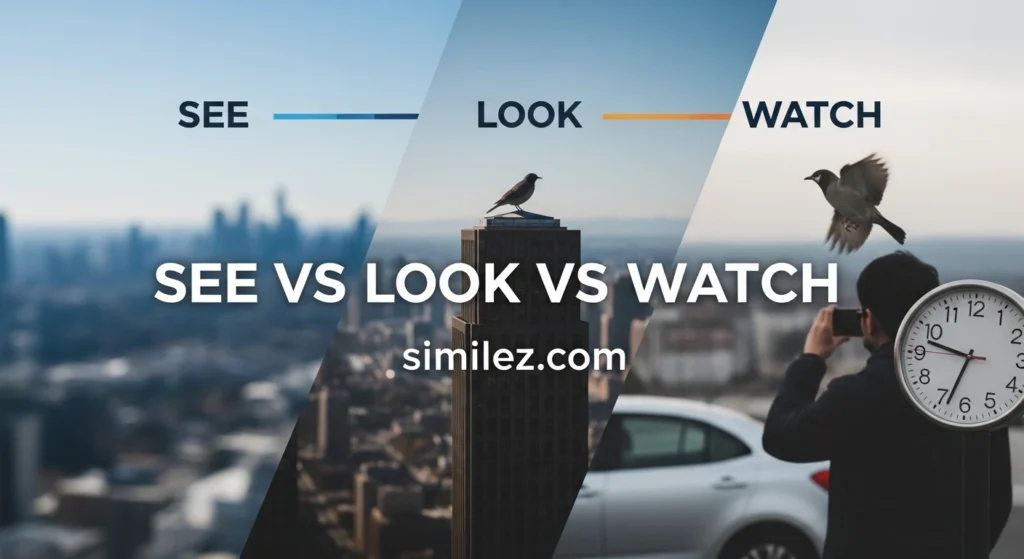
You’re sitting in a quiet room, a cup of tea in your hand. Through the window, you notice a bird land on a branch. A moment later, you turn your attention toward it.
Then, almost without realizing it, you continue observing as it hops, tilts its head, and eventually flies away.
In that simple moment, you moved through three different ways of perceiving the world: you saw the bird, you looked at it, and then you watched it.
At first glance, these verbs see, look, and watch seem interchangeable. Many learners use them casually without much distinction. But in reality, each one carries a unique meaning, intention, and emotional depth.
Understanding these subtle differences doesn’t just improve your English it sharpens how you express attention, awareness, and connection in everyday life.
This article explores these three words in depth, not just as vocabulary, but as ways of experiencing the world. By the end, you’ll not only use them correctly you’ll feel the difference.
Understanding the Core Difference
At their core, see, look, and watch differ in intention and duration.
- See is passive. It happens naturally, without effort.
- Look is active. It requires intention and direction.
- Watch is sustained attention over time.
Imagine walking down a busy street. You see dozens of people without trying. When someone calls your name, you look in their direction. If a street performer starts a show, you watch them.
These differences are not just grammatical—they reflect levels of awareness. See is automatic perception. Look is deliberate focus. Watch is engaged observation.
Understanding this hierarchy helps you choose the right word naturally, rather than memorizing rules.
“See”: The Passive Experience
See is the most basic form of visual perception. It doesn’t require effort or intention—it simply happens when your eyes are open.
Everyday Examples
- “I saw a car passing by.”
- “Did you see that flash of light?”
- “I can’t see anything in the dark.”
In all these cases, the subject isn’t actively trying. The experience is automatic.
Emotional Layer
See often carries a sense of immediacy or surprise. You didn’t plan it—it just appeared in your awareness.
For example: “I saw him at the market yesterday.” This suggests an unexpected encounter, not a planned meeting.
Insight
Using see correctly communicates natural perception. Overusing look or watch in such cases can make your sentence sound unnatural or overly deliberate.
“Look”: The Act of Directing Attention
Look introduces intention. When you look, you choose to focus your eyes on something.
Everyday Examples
- “Look at this picture.”
- “She looked at me and smiled.”
- “I looked everywhere for my keys.”
Here, attention is directed. There’s effort involved.
The Role of Prepositions
Look almost always needs direction:
- Look at something
- Look for something
- Look into something
Each changes the meaning slightly, but all retain the idea of intentional focus.
Insight
Look bridges the gap between passive seeing and active watching. It’s the moment you decide something is worth your attention.
“Watch”: Sustained and Engaged Observation
Watch goes beyond looking. It involves observing something over time, especially when there is movement or change.
Everyday Examples
- “I watched a movie last night.”
- “She watched the children playing.”
- “We watched the sunset.”
Why Movement Matters
You don’t watch something static. You watch things that evolve—actions, events, processes.
You wouldn’t say: ❌ “I watched a photo.” Instead: ✔ “I looked at a photo.”
Emotional Engagement
Watch often implies interest or involvement. You’re not just seeing—you’re following what’s happening.
The Spectrum of Attention
These three verbs form a natural progression:
See → Look → Watch
- See: awareness without effort
- Look: effort without duration
- Watch: effort with duration
Think of it like zooming in:
You see the crowd. You look at a person. You watch what they do.
This spectrum helps you intuitively choose the right word based on how deeply you’re engaged.
Real-Life Scenario Breakdown
At a Park
- “I saw a dog.” → You noticed it casually.
- “I looked at the dog.” → You focused on it briefly.
- “I watched the dog.” → You observed its actions over time.
At Home
- “I saw a message on my phone.”
- “I looked at the message.”
- “I watched a video sent in that message.”
Each step adds depth and intention.
Common Mistakes and How to Avoid Them
Mistake 1: Using “Watch” for Static Objects
❌ “I watched the painting.” ✔ “I looked at the painting.”
Mistake 2: Using “See” for Intentional Actions
❌ “I saw at the board.” ✔ “I looked at the board.”
Mistake 3: Confusing “See” and “Watch” in Media
❌ “I saw TV last night.” ✔ “I watched TV last night.”
Key Rule
If it involves effort, don’t use see. If it involves time and action, use watch.
Emotional and Psychological Nuances
These verbs also reflect states of mind.
- See suggests openness or chance.
- Look suggests curiosity or purpose.
- Watch suggests patience and engagement.
For example: “I watched him leave” feels more emotionally involved than “I saw him leave.”
The choice of verb can subtly change the emotional tone of your sentence.
The Role of Context in Meaning
Context can shift how these words behave.
Example: “See a Doctor”
Here, see doesn’t mean visual perception. It means meeting or consulting.
Example: “Watch Yourself”
This isn’t about vision—it’s a warning.
Example: “Look Here”
This is about attention, not just sight.
Understanding context prevents literal misinterpretation.
How Native Speakers Use These Naturally
Native speakers don’t think in rules—they think in patterns.
They instinctively know:
- Movies → watch
- Photos → look at
- Accidental noticing → see
This comes from repeated exposure, not memorization.
To reach that level, focus on real usage rather than isolated definitions.
Practical Tips for Mastery
1. Think in Actions
Ask yourself:
- Did it happen automatically? → see
- Did I choose to focus? → look
- Did I follow it over time? → watch
2. Practice with Daily Life
Describe your day using all three verbs.
Example: “I saw a bird, looked at it, and watched it fly away.”
3. Listen and Imitate
Pay attention to how these verbs are used in conversations, movies, and daily speech.
Cultural and Language Learning Perspective
In many languages, a single word may cover all three meanings. This makes it challenging for learners to separate them in English.
But this distinction is powerful—it allows for precision.
Instead of saying: “I saw a movie” You say: “I watched a movie”
That small change makes your English more natural and accurate.
Subtle Differences in Questions
“Did you see that?”
Implies something quick or surprising.
“Did you look at that?”
Implies intentional checking.
“Did you watch that?”
Implies following an event or show.
Each question invites a different kind of response.
Mini Story: One Moment, Three Verbs
Ali was walking home when he saw a crowd gathering. Curious, he looked in their direction. As he got closer, he watched a street magician performing tricks.
The scene didn’t change—but his level of attention did.
This is exactly how these verbs function in real life.
Why This Distinction Matters
This isn’t just about grammar—it’s about clarity.
Using the right verb:
- Makes your speech natural
- Prevents misunderstanding
- Adds emotional depth
- Reflects awareness
In professional settings, precise language builds credibility. In personal communication, it improves connection.
Advanced Insight: Attention as a Skill
These verbs also reflect how we interact with the world.
Most people only see. Some choose to look. Few take the time to watch.
In a fast-paced world, watching—paying sustained attention—is becoming rare.
Language mirrors this reality.
Conclusion
The difference between see, look, and watch may seem small, but it reveals something deeper about attention, intention, and awareness.
You don’t just use these words you experience them. You move from passive noticing to deliberate focus to meaningful observation. Each step brings you closer to understanding not just language, but how you engage with the world.
Next time you describe something you observed, pause for a second. Ask yourself: Did I simply notice it? Did I focus on it? Or did I truly follow it?
That answer will guide your word choice—and sharpen your expression.
Master these three verbs, and you’ll do more than improve your English. You’ll start seeing, looking, and watching the world with greater clarity.