
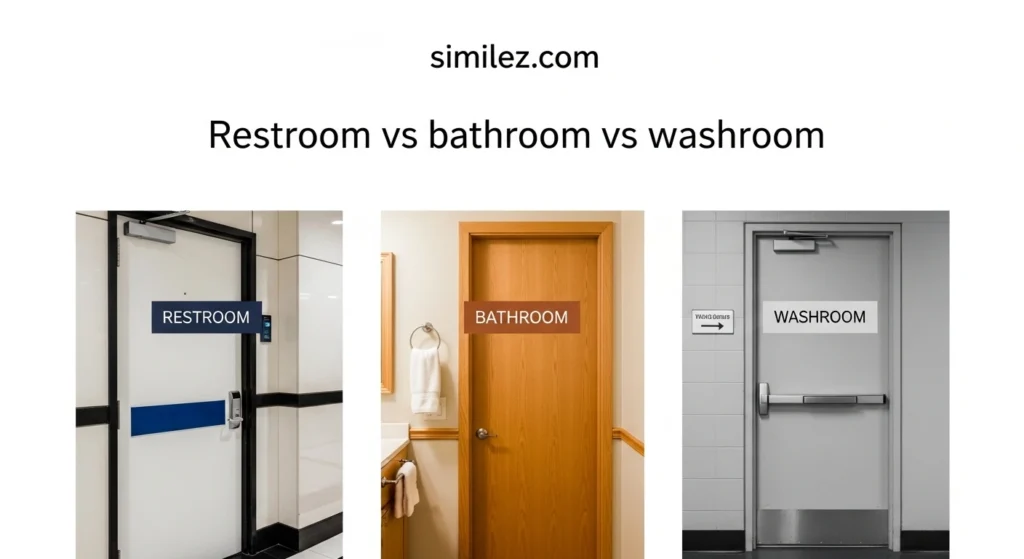
You’re in a new city, slightly anxious, scanning signs in a public building. You need a facility urgently. You spot three different signs in different corners: restroom, bathroom, and washroom.
For a split second, confusion creeps in. Are they the same? Is one more formal? Does choosing the “wrong” word make you sound out of place?
This seemingly small linguistic detail carries more weight than most people realize. These three terms restroom, bathroom, and washroom are more than just labels for a physical space.
They reflect cultural habits, regional identities, social norms, and even subtle cues about context and politeness.
Understanding their differences isn’t just about vocabulary; it’s about communicating effectively and appropriately in different environments.
Whether you’re writing professionally, traveling, or simply aiming to sound natural in conversation, knowing when and how to use each term can make a noticeable difference.
This article breaks down these terms from every angle meaning, usage, psychology, real-life scenarios, and practical application so you walk away not just informed, but confident.
Restroom, Bathroom, Washroom: What Do They Actually Mean?
At their core, all three terms refer to a place where people can relieve themselves or clean up. But their literal meanings and implied uses differ.
A bathroom traditionally refers to a room containing a bathtub or shower. It’s a term rooted in functionality—bathing.
A restroom, on the other hand, is more euphemistic. It suggests a place for rest, though in reality, it’s used primarily in public places in the United States to refer to toilet facilities.
A washroom emphasizes washing—hands, face, or basic hygiene—and is commonly used in Canada and some formal contexts elsewhere.
While the overlap is significant, the nuance lies in how these words evolved socially. Each term subtly reflects how societies prefer to talk about private bodily functions—often avoiding directness in favor of softer language.
The Cultural Lens: How Geography Shapes Language
Language is never neutral—it carries geography within it. These three terms vary significantly depending on where you are.
In the United States, restroom dominates in public spaces. Ask for a restroom in a mall or restaurant, and you’ll sound perfectly natural.
In Canada, washroom is the standard. Using “restroom” might sound slightly foreign, though still understandable.
In the United Kingdom, neither of these terms is common. Instead, people say “toilet” or “loo.” Saying “bathroom” might imply a room in a house rather than a public facility.
These regional preferences are not arbitrary—they reflect cultural attitudes toward politeness and indirectness. Americans often prefer softer, less explicit terms like “restroom,” while other cultures may be more direct.
Understanding this can prevent awkward moments and help you blend seamlessly into different linguistic environments.
Bathroom: The Most Literal and Versatile Term
Among the three, bathroom is the most straightforward. It describes a room equipped for bathing and sanitation.
Home vs Public Usage
At home, “bathroom” is universally understood. It refers to the space with a toilet, sink, and possibly a shower or bathtub.
In public settings, however, its usage varies. In the U.S., asking for a “bathroom” is acceptable, even if no bath exists. The term has broadened beyond its literal meaning.
Emotional Tone
“Bathroom” feels neutral and familiar. It doesn’t carry the same level of politeness as “restroom,” but it’s not crude either. It sits comfortably in everyday conversation.
This versatility makes it a safe choice in most situations, especially informal ones.
Restroom: Politeness Through Indirection
The term restroom is a classic example of linguistic softening. It avoids directly referencing bodily functions.
Why “Rest”?
Interestingly, people don’t actually “rest” in restrooms. The term emerged as a polite alternative in American English, reflecting a cultural preference for indirectness.
Public and Professional Contexts
“Restroom” is ideal in formal or semi-formal settings—restaurants, offices, events. It sounds courteous and socially refined.
Subtle Social Signal
Using “restroom” signals awareness of social etiquette. It’s a small but noticeable detail that can make your speech sound more polished.
Washroom: Clean, Functional, and Regionally Specific
Washroom highlights hygiene rather than relief.
Canadian Influence
In Canada, “washroom” is the default term for both public and private facilities. It feels natural and unremarkable there.
Tone and Impression
The word carries a slightly cleaner, more hygienic connotation. It subtly emphasizes washing rather than elimination, which makes it feel more neutral and less awkward.
Formal Environments
“Washroom” can also appear in formal signage, particularly in international or corporate settings, where clarity and neutrality are preferred.
Why These Differences Exist: The Psychology of Euphemism
At the heart of these terms lies a shared human tendency: avoiding direct mention of bodily functions.
This is where euphemism comes in. Words like “restroom” and “washroom” soften the reality of what happens inside.
Social Comfort
People instinctively choose language that minimizes discomfort. Saying “I need the restroom” feels more socially acceptable than being explicit.
Cultural Conditioning
Different societies develop different euphemisms based on their comfort levels with directness. This is why Americans prefer “restroom,” while others might say “toilet” without hesitation.
Understanding this helps you see these terms not just as labels, but as reflections of human psychology.
Real-Life Scenario: Ordering at a Restaurant
Imagine you’re at a formal dinner.
If you say:
- “Where is the toilet?” — It may sound too direct in American settings.
- “Where is the bathroom?” — Acceptable, but casual.
- “Where is the restroom?” — Polished and appropriate.
The choice of word subtly affects how you’re perceived. It’s not about right or wrong—it’s about context.
Professional Communication: Choosing the Right Term
In workplace communication, precision and tone matter.
Emails and Formal Speech
“Restroom” is usually the safest choice in professional American English. It maintains politeness without ambiguity.
International Contexts
If your audience is global, “washroom” may feel more neutral and universally acceptable.
Avoiding Misinterpretation
Using “bathroom” in a business context might unintentionally sound informal, depending on the audience.
The key is alignment—match your language to your audience’s expectations.
Travel Situations: Avoiding Confusion Abroad
Travel amplifies these differences.
In North America
- U.S.: “Restroom” or “bathroom”
- Canada: “Washroom”
In the UK and Europe
- “Toilet” or “loo” is standard
- “Restroom” may confuse people
Practical Tip
When in doubt, observe signage. Public signs often reflect the locally accepted term. Adapting quickly can save you unnecessary confusion.
Social Perception: What Your Word Choice Says About You
Language shapes perception.
Using “restroom” can make you sound polite and culturally aware in American contexts. “Washroom” might signal Canadian familiarity. “Bathroom” feels casual and universal.
These impressions are subtle but real. People often form judgments based on small linguistic cues.
It’s not about impressing others—it’s about communicating smoothly without friction.
Common Misunderstandings
Many people assume these terms are interchangeable everywhere. That’s not entirely accurate.
Misconception 1: They Mean Exactly the Same Thing
While similar, their usage depends heavily on context and region.
Misconception 2: One Is More “Correct”
There’s no universal “correct” term—only contextually appropriate ones.
Misconception 3: Everyone Understands All Terms Equally
In reality, some terms may sound foreign or unusual depending on location.
Recognizing these misconceptions helps you avoid awkward moments.
Everyday Conversations: What Feels Natural?
In daily life, most people default to habit.
At home, “bathroom” dominates. In public American spaces, “restroom” feels natural. In Canada, “washroom” is second nature.
Casual vs Formal
- Casual: “bathroom”
- Neutral: “washroom”
- Polite/formal: “restroom”
Being aware of these layers allows you to adjust effortlessly depending on the situation.
The Role of Context Over Definition
Context always outweighs dictionary meaning.
A “bathroom” without a bath is still called a bathroom. A “restroom” where no one rests is still a restroom.
Language evolves based on usage, not strict logic.
What matters is not literal accuracy, but shared understanding. If your audience understands you clearly and comfortably, you’ve succeeded.
Practical Guide: When to Use Each Term
To simplify:
- Use bathroom in informal or home settings
- Use restroom in formal or American public contexts
- Use washroom in Canadian or neutral formal contexts
Quick Scenario Mapping
- Restaurant in U.S.: Restroom
- Friend’s house: Bathroom
- Office email: Restroom
- Canada public place: Washroom
This isn’t rigid—it’s a flexible guideline.
A Deeper Insight: Language as Social Navigation
These terms highlight how language functions as a social tool.
They show how we navigate discomfort, respect boundaries, and adapt to cultural expectations.
Choosing between “restroom,” “bathroom,” and “washroom” isn’t just about vocabulary—it’s about awareness. It reflects your ability to read a situation and respond appropriately.
This is a subtle but powerful communication skill.
Conclusion
What begins as a simple question restroom vs bathroom vs washroom quickly reveals layers of meaning shaped by culture, psychology, and social norms. These terms may point to the same physical space, but they carry different tones, contexts, and implications.
Understanding their nuances equips you with more than just vocabulary—it gives you control over how you present yourself in different environments. Whether you’re traveling, working, or engaging in everyday conversation, the right word can make communication smoother and more natural.
In the end, clarity and context matter more than rigid rules. Pay attention to your surroundings, adapt when needed, and choose the term that fits the moment. That awareness, more than anything else, is what turns simple language into effective communication.