
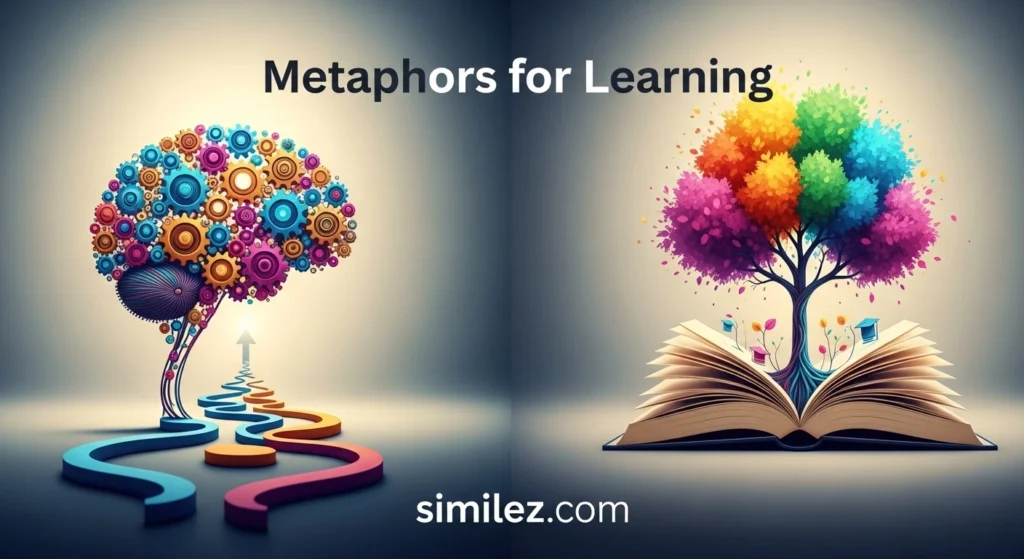
There is a moment in every learner’s life when a concept refuses to stay still. It slips away like water through fingers until suddenly, someone explains it in a way that paints a picture. Not a definition. Not a rule. A picture. And just like that, confusion collapses into clarity.
We do not merely “store” knowledge. We construct it, grow it, illuminate it. The brain prefers resemblance over abstraction. It understands algebra better when it is compared to balance scales, history better when it becomes a story of rising and falling empires, and emotions better when they are described as weather patterns passing through a sky.
This article explores how metaphors shape learning, memory, and creativity and how you can use them intentionally in study, teaching, writing, and everyday thinking.
What Are Metaphors for Learning?
Metaphors for learning are conceptual bridges. They take something abstract—like understanding, intelligence, or memory—and translate it into something physical or relatable.
Instead of saying “learning is complex,” we say “learning is a maze.” Instead of “knowledge grows,” we say “knowledge is a seed.”
These comparisons are not decorative. They are cognitive tools. They help the mind organize information, reduce complexity, and create mental models that are easier to recall.
That transformation is the essence of learning metaphors.
Why Metaphors Improve Memory and Understanding
Human memory is not built like a filing cabinet; it behaves more like a story network. Facts that are emotionally or visually meaningful are far more likely to stay.
Metaphors improve learning because they:
- Reduce cognitive load
- Create visual mental anchors
- Trigger emotional association
- Strengthen recall through imagery
For example, “revision is sharpening a blade” is easier to remember than “revision improves retention.”
Metaphors convert abstract knowledge into lived experience inside the mind. That is why they appear in religious texts, classical poetry, legal arguments, and even courtroom persuasion—because they work.
Learning as a Journey: The Road Map of Knowledge
One of the oldest and most universal metaphors is learning as a journey.
We speak of “starting points,” “milestones,” “roadblocks,” and “progress.” This is not accidental language—it reflects how people naturally structure understanding.
A student is not just acquiring facts; they are traveling through uncertainty toward clarity.
A legal trainee preparing case law, for example, often feels like navigating unfamiliar terrain—precedents are signposts, judgments are checkpoints, and arguments are routes that must be carefully chosen.
This metaphor is powerful because it implies movement. Learning is never static. It is directional.
Learning as Building a House: Constructing Knowledge Step by Step
Among the most structurally useful metaphors for learning is the idea of building a house. Knowledge is not dropped into the mind—it is constructed layer by layer.
Before anything else, a foundation must be laid. Then walls, then structure, then refinement.
This metaphor is especially useful in legal, academic, and technical learning where complexity must be managed in stages.
It reminds us: if the foundation is weak, everything collapses later.
Meaning of the House Metaphor in Education and Skill Development
The house metaphor represents stability, structure, and progression.
- Foundation = basic concepts
- Walls = intermediate understanding
- Roof = advanced application
- Interior design = mastery and refinement
If foundational principles are skipped, advanced topics become fragile and confusing.
In practice, a law student who skips understanding basic procedural law will struggle with constitutional arguments later. The structure cannot stand without its base.
This metaphor also introduces patience into learning. Houses are not built overnight. Neither is expertise.
Example Scenario: Constructing Knowledge Step by Step
Imagine a student learning constitutional law.
At first, they learn definitions: what is the constitution, what is jurisdiction, what are fundamental rights. This is excavation and foundation laying.
Next, they study landmark judgments. They begin to see how courts interpret rights. These are the walls forming.
Finally, they engage in argumentation—applying law to hypothetical cases. This is roofing and finishing.
If they attempt argumentation before understanding definitions, the structure collapses.
In real emotional terms, this often feels frustrating. But the metaphor reframes frustration as missing structural steps, not lack of intelligence.
Alternative Expressions and Variations of the Building Metaphor
The building metaphor can be expanded creatively:
- “Laying bricks of knowledge”
- “Pouring the foundation of understanding”
- “Strengthening intellectual scaffolding”
- “Reinforcing weak walls of memory”
Sensory detail strengthens it further: The imagined weight of bricks. The dust of construction. The slow, deliberate rhythm of progress.
In writing, this metaphor can be adapted to any discipline: language learning, legal reasoning, or even emotional intelligence development.
Learning as Gardening and Growth: Knowledge That Lives and Breathes
If building represents structure, gardening represents life.
Learning as gardening suggests that knowledge is organic. It grows, responds, and evolves. It cannot be forced—it must be cultivated.
Seeds represent ideas. Soil represents attention. Water represents repetition. Sunlight represents insight.
Neglect leads to withering. Care leads to expansion.
Meaning of Gardening Metaphor in Personal Development
This metaphor emphasizes timing and patience.
Not all learning is immediate. Some ideas germinate silently before becoming visible understanding.
Key implications:
- Growth is gradual, not instant
- Environment matters (study conditions, mentorship, resources)
- Weeding is necessary (removing misconceptions)
- Seasons exist (periods of rapid and slow learning)
This shifts learning from pressure to cultivation.
Example Scenario: Cultivating Skills Over Time
Consider someone learning public speaking.
At first, they plant the seed by practicing short sentences. Then they water it through repetition. Nervousness is like weeds—it must be managed, not ignored. Over time, confidence begins to grow naturally.
There is no sudden transformation. There is only gradual emergence.
Even failure becomes part of soil enrichment. A bad presentation is not wasted effort; it is compost for improvement.
This metaphor reduces anxiety because it removes the expectation of instant perfection.
Alternative Expressions and Sensory Depth of Gardening Metaphor
Variations include:
- “Planting ideas in fertile memory”
- “Cultivating intellectual soil”
- “Pruning unnecessary concepts”
- “Harvesting understanding”
Sensory layer:
The smell of wet soil after rainfall. The quiet patience of seeds underground. The slow push of green shoots breaking through surface resistance.
These sensory cues make abstract persistence emotionally relatable.
Learning as Light or Illumination: From Confusion to Clarity
The metaphor of light is one of the most powerful cognitive symbols across cultures.
Learning is often described as “shedding light,” “enlightenment,” or “seeing clearly.”
Darkness represents confusion. Light represents understanding.
This is not just poetic—it reflects how the brain experiences insight: as sudden clarity after mental struggle.
Meaning of Light Metaphor in Understanding Knowledge
The light metaphor emphasizes revelation.
- Ignorance = darkness
- Knowledge = illumination
- Insight = turning on a lamp
- Wisdom = sustained brightness
Unlike building or gardening, which suggest time and effort, light suggests immediacy. Some understanding arrives suddenly, like a switch being flipped.
In legal reasoning, this often happens when a complex case finally “clicks”—all precedents align in a single moment of clarity.
Example Scenario: From Confusion to Clarity
A student struggles with a difficult doctrine. They read it multiple times, but it remains unclear. Then, during discussion or argument, a single analogy reframes everything.
Suddenly, it makes sense. Not gradually—but instantly.
It feels like stepping into a dark room and switching on a light.
This experience is emotionally powerful because it transforms frustration into relief.
Alternative Expressions and Emotional Dimensions of Light Metaphor
Variations include:
- “Ideas illuminated in the mind”
- “Flashes of insight”
- “Mental darkness lifted”
- “Intellectual awakening”
Sensory associations:
Warm brightness. The easing of mental tension. The visual sense of shapes becoming defined after blur.
This metaphor is often used in education, religion, and philosophy because it captures transformation rather than process.
How to Use Learning Metaphors in Writing, Teaching, and Daily Life
Metaphors are not just literary tools—they are practical instruments for thinking.
In writing: They make explanations memorable and persuasive. A legal argument framed as “building a bridge between precedent and principle” is easier to follow than abstract description.
In teaching: They simplify complexity. Students retain ideas longer when they are visualized.
In daily life: They help regulate mindset. Failure becomes “soil enrichment,” not defeat. Learning becomes “construction,” not confusion.
Interactive exercises:
- Take a concept you are studying today.
- Reframe it as a house, garden, or light.
- Write one sentence using each metaphor.
- Identify which metaphor makes it easiest to understand.
Bonus practice: Replace negative self-talk (“I don’t understand this”) with metaphor-based thinking (“I am still laying the foundation here”).
This small shift reduces frustration and improves persistence.
Conclusion
Learning is not a single process. It is layered, organic, and sometimes sudden. Metaphors allow the mind to navigate this complexity without getting lost in abstraction.
Whether you see learning as a house being built, a garden being cultivated, or a dark room slowly filling with light, each metaphor gives structure to uncertainty.
Used intentionally, they become more than language devices. They become thinking frameworks—tools that shape how knowledge is acquired, retained, and applied.
FAQs
What are metaphors for learning in simple terms?
They are comparisons that help explain learning using familiar images like buildings, gardens, or light.
Why are metaphors important in education?
They improve memory, simplify complexity, and help students understand abstract ideas faster.
Can metaphors improve legal or professional learning?
Yes. They help structure arguments, retain doctrines, and make complex systems easier to manage.
Which metaphor is best for studying difficult subjects?
It depends. “Building” works for structured subjects, “garden” for long-term skills, and “light” for conceptual breakthroughs.
How can I create my own learning metaphors?
Choose an abstract idea, then compare it with something physical, emotional, or visual that behaves similarly.
Are metaphors culturally universal?
Yes, though the imagery may vary. Most cultures use nature, construction, or light-based metaphors for knowledge.