
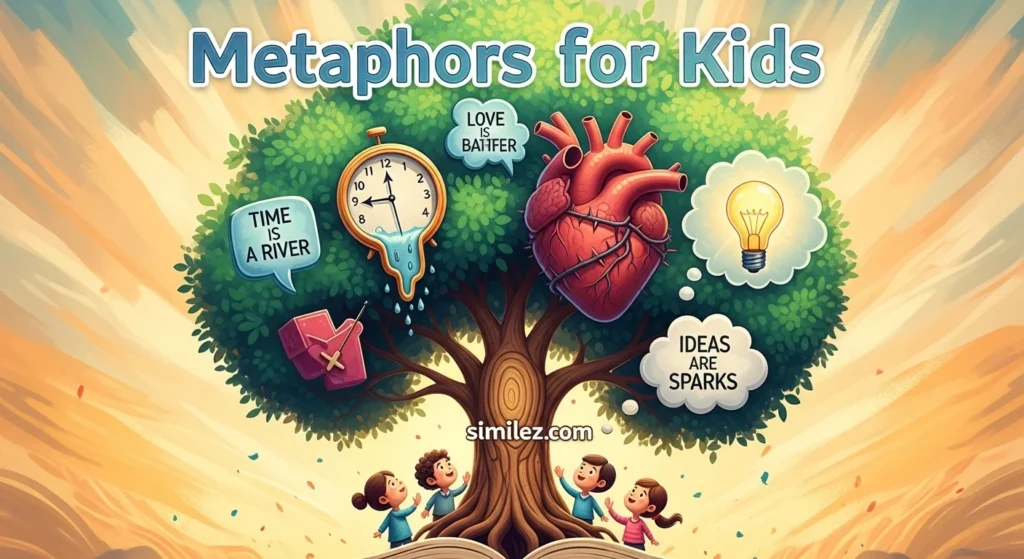
Metaphors are one of the most powerful tools in language. In simple terms, a metaphor is when we say one thing is another to help explain it better. For example, saying “the world is a stage” does not mean the world is literally a theatre it means life is like a performance where everyone plays different roles.
For kids, metaphors are not just grammar they are imagination in action. They turn ordinary ideas into colorful pictures in the mind. Instead of dry explanations, metaphors build bridges between what children already know and what they are trying to understand.
Learning metaphors early improves communication, creativity, reading comprehension, and emotional expression. It also helps children think beyond literal meanings, which is essential for storytelling, writing, and even problem-solving.
A Childhood Scene: Why Metaphors Feel Magical
Picture a child sitting by a window during rain. Instead of saying, “It is raining heavily,” the child says, “The sky is crying.”
That single sentence changes everything. Suddenly, rain is no longer just water—it becomes emotion, a story, a feeling.
Children naturally think in metaphors because their imagination is not restricted yet. They see patterns, emotions, and meaning in everything: clouds become cotton candy, shadows become monsters, and homework becomes a mountain.
This natural creativity is the foundation of metaphorical thinking. Urdu poetry also uses this beauty—where a simple line carries deep emotional layers.
Understanding Metaphors in Simple Words
A metaphor is a comparison without using “like” or “as.”
For example:
- Literal: He is very fast.
- Metaphor: He is a cheetah.
The meaning is not literal; it is symbolic. The goal is to help the listener feel the idea rather than just understand it logically.
Metaphors differ from similes:
- Simile: “as brave as a lion”
- Metaphor: “He is a lion”
Kids should learn this difference early because it sharpens both language skills and imagination.
Why Metaphors Matter in Learning and Creativity
Metaphors are not just decorative language. They are cognitive tools.
They help children:
- Understand abstract ideas (time, emotions, behavior)
- Improve storytelling skills
- Build emotional intelligence
- Strengthen memory by linking ideas visually
- Develop creativity and flexible thinking
When a child understands “anger is a fire,” they begin to visualize emotions. This helps in self-regulation. When they hear “knowledge is light,” learning becomes something bright and powerful instead of boring memorization.
In short, metaphors turn learning into experience.
Metaphor Example 1: “Life is a Journey”
One of the most common and powerful metaphors is: Life is a journey.
This metaphor helps children understand that life is not a straight line—it has paths, turns, obstacles, and destinations.
It also teaches patience. Not everything happens instantly; we travel step by step.
Breakdown of Metaphor 1: Life is a Journey
Meaning: Life is like traveling on a road with different experiences.
Example sentence: “His school years were just the beginning of a long journey.”
Alternative expressions:
- Life is a road
- Life is a path
- Life is an adventure
Sensory/emotional layer: Imagine walking on a long road under a golden sunset. Sometimes the road is smooth, sometimes rocky. That is life.
Mini storytelling: A child named Ali once thought failure meant stopping. But his teacher said, “Beta, this is just a turning point in your journey.” That shifted his entire mindset. He stopped fearing mistakes and started seeing them as part of travel.
Metaphor Example 2: “Time is a Thief”
Another strong metaphor is: Time is a thief.
It suggests that time “steals” moments from us without waiting.
This is powerful for kids because it teaches the value of time in an emotional way, not just as a rule.
Breakdown of Metaphor 2: Time is a Thief
Meaning: Time passes quickly and takes moments with it.
Example sentence: “Time is a thief; it stole my childhood before I knew it.”
Alternative expressions:
- Time flies
- Time slips away
- Time runs fast
Sensory/emotional layer: Imagine trying to hold sand in your hand. The more you try, the faster it slips away.
Mini storytelling: A girl once kept delaying her drawing practice. “Kal karungi,” she said. But exams came suddenly. She realized time had quietly taken away her opportunity. That’s how the metaphor becomes a life lesson.
Metaphor Example 3: “The Classroom is a Garden”
This metaphor transforms learning into something natural and living: The classroom is a garden.
Students are like plants, and knowledge is like water and sunlight.
It helps children see education as growth, not pressure.
Breakdown of Metaphor 3: Classroom is a Garden
Meaning: Learning is a process of growth like plants growing in a garden.
Example sentence: “The teacher nurtured every student like a gardener tends flowers.”
Alternative expressions:
- Students are seeds
- Learning is growing
- Knowledge is nourishment
Sensory/emotional layer: Imagine green leaves, soft soil, sunlight entering a classroom window. It feels calm and alive.
Mini storytelling: In a small school, a teacher told her students, “Har bacha ek phool hai.” One shy student, once afraid to speak, slowly started blooming with confidence.
How Kids Naturally Use Metaphors in Daily Life
Children use metaphors unconsciously every day.
They say:
- “I am drowning in homework”
- “My teacher is a dragon today”
- “This food is heaven”
These expressions show emotional truth, not literal meaning.
Parents and teachers should not correct these immediately. Instead, they should guide children to understand why they feel that way.
Metaphors are emotional shortcuts—fast ways to express complex feelings.
Storytelling With Metaphors: A Mini Narrative Example
Let’s combine everything into a short story:
A boy walked into school feeling “like a storm inside his chest.” He had forgotten his homework. The classroom felt like a “silent ocean,” calm but heavy. His teacher looked at him and said, “Mistakes are not walls; they are doors.”
That sentence changed everything.
The boy realized his fear was not real—it was just a cloud passing through his mind. By the end of the day, he was smiling again, as if “sunlight had returned to his thoughts.”
This is the power of metaphors—they transform emotions into understanding.
Interactive Exercises for Kids to Practice Metaphors
Here are simple activities to build metaphorical thinking:
- Object Transformation Game Pick any object and describe it as something else. Example: “The pencil is a magic wand.”
- Emotion Mapping Ask: “What is sadness like?” Possible answers: “a rainy cloud,” “a heavy stone.”
- Finish the Sentence
- “My school is like…”
- “Fear is…”
- “Happiness is…”
- Draw the Metaphor Draw “time is a river” or “anger is fire.”
These exercises help children think visually and emotionally.
Tips for Parents and Teachers Using Metaphors
Metaphors should be introduced gently and naturally.
Practical tips:
- Use metaphors in daily conversation
- Encourage children to explain their own comparisons
- Read poetry and stories together
- Avoid correcting creative expressions too strictly
- Ask “Why do you think that?” instead of “That is wrong”
Teachers can also use metaphors to simplify difficult subjects:
- Math = puzzle
- Science = discovery journey
- History = story of time
This makes learning less intimidating and more engaging.
Conclusion
Metaphors are more than language—they are a way of thinking. They help children see the invisible, understand emotions, and connect ideas in powerful ways.
When a child learns that “fear is a shadow” or “hope is a light,” they begin to understand life beyond literal definitions. That is real education.
For writing and daily communication, metaphors can be used to:
- Make speeches more impactful
- Improve storytelling on social media
- Add emotion to essays and captions
- Make conversations more expressive
Ultimately, metaphors train the mind to think creatively, feel deeply, and express clearly. In a world full of noise, they give language its soul.
FAQs
H3: What is a simple definition of a metaphor for kids?
A metaphor is when we say one thing is another to explain it better, like “the classroom is a garden.”
H3: Why are metaphors important for children?
They improve imagination, emotional understanding, creativity, and language skills.
H3: How is a metaphor different from a simile?
A simile uses “like” or “as,” while a metaphor directly says one thing is another.
H3: Can metaphors help in school learning?
Yes, they make complex ideas easier to understand by turning them into images or feelings.
H3: How can parents teach metaphors at home?
By using daily examples, storytelling, reading books, and encouraging creative comparisons.