
A faint smell of rain-soaked earth drifts through a half-open window. A kettle hums in the background. Somewhere, a door creaks not loudly, but with the familiarity of something that has always belonged.Home is not just seen; it is felt in fragments like these. It is memory stitched into air, warmth embedded in silence, and safety disguised as routine.
When we speak of metaphors for home, we are trying to capture something language can never fully contain: the emotional architecture of belonging. A house can be measured in bricks and square feet, but home exists in metaphors because it is emotional geography, not physical space.
These metaphors matter because they shape how we write, how we remember, and how we understand attachment.Whether in literature, social media storytelling, or personal reflection, metaphors for home help us translate feeling into meaning.
Home Beyond Walls: Understanding Emotional Architecture
Home is often mistaken for location. In reality, it is a psychological state.
It can be a person’s voice on a difficult day. It can be a chair that remembers your body. It can even be absence—longing for something lost but still emotionally present.
In literary terms, home functions as a symbolic anchor. Writers use it to express identity, displacement, nostalgia, and emotional security. In psychology, it aligns closely with the idea of attachment security, where familiarity creates emotional regulation.
Put simply: home is not where you live. It is what lives in you.
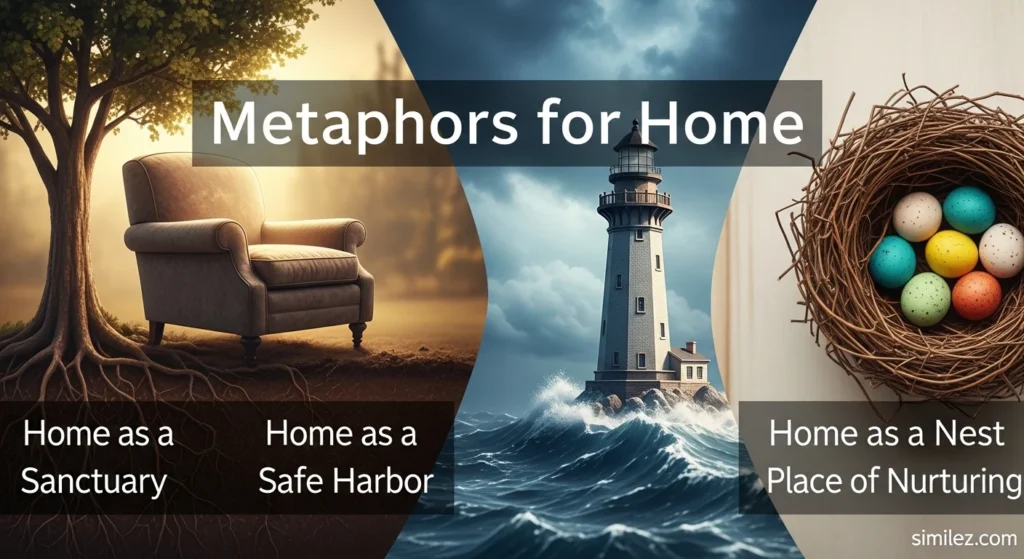
Metaphor Home as a Harbor (Introduction)
A harbor is where ships return after storms. It is not the ocean itself, but it makes the ocean survivable.
When home is imagined as a harbor, it becomes a place of return—safe, steady, and patient. It does not chase you; it waits for you.
This metaphor is especially powerful in moments of stress, migration, or emotional exhaustion.
Home as a Harbor: Meaning, Usage, and Emotional Depth
A harbor represents refuge after chaos. Similarly, home offers emotional grounding after life’s uncertainties.
Meaning: Home is a safe return point after emotional “storms.”
Example sentence: “After years of moving between cities, her mother’s voice remained the only harbor she ever needed.”
Alternative expressions:
- Home as an emotional safe dock
- Home as a resting port
- Home as a return point after storms
Sensory/emotional layer: Think of wet clothes drying near a fireplace, shoes left by the door, and silence that does not feel empty but protective.
Mini-story: A sailor returns after months at sea. The waves are still inside him—rocking, restless. But the moment he steps onto the dock, the movement slows. Not because the sea has stopped, but because he has arrived somewhere that does not demand motion.
Creative Practice: Writing Home as a Harbor
Try this exercise:
- Write five sentences describing your version of “returning home” without using the word home.
- Replace it with metaphors like dock, shore, or harbor.
- Focus on sensory detail: sound, temperature, smell.
Bonus tip: Use this metaphor in captions or personal essays when describing relief, recovery, or emotional grounding.
Metaphor Home as a Living Memory Book (Introduction)
Some homes do not just shelter life—they archive it.
In this metaphor, home becomes a book that writes itself every day. Walls are pages. Corners are footnotes. Furniture is underlined with repeated presence.
This idea resonates strongly in cultures where family history is preserved through objects, rituals, and shared spaces.
Home as a Living Memory Book: Meaning and Expression
Meaning: Home stores emotional memory across time—every mark, sound, and object becomes a record.
Example sentence: “The kitchen tiles were a living memory book, each stain and crack telling a different chapter of their childhood.”
Alternative expressions:
- Home as a story archive
- Home as a diary written in dust and light
- Home as a timeline of lived experience
Sensory/emotional detail: The faint smell of old wood. A faded curtain that has seen too many sunsets. A scratched table that remembers laughter louder than words.
Mini-cultural reference: In many South Asian households, walls carry generations—photographs, calendars, religious verses, and marks on door frames measuring children’s growth. Nothing is purely decorative; everything is narrative.
Creative Practice: Writing Memory into Space
Exercise:
- Choose one room you know well.
- Describe it as if it is a diary entry from ten years ago.
- What would the walls say if they could write?
Bonus tip: This metaphor works well for storytelling, memoir writing, and nostalgic content on social media.
Metaphor Home as a Hearth or Internal Flame (Introduction)
Before electricity, the hearth was the center of the home. It was where warmth lived, food was made, and stories were told.
In modern metaphorical language, home as a hearth represents emotional warmth, presence, and continuity.
Home as a Hearth: Meaning and Emotional Structure
Meaning: Home is the source of emotional warmth and human connection.
Example sentence: “Even across continents, his grandmother’s voice remained a hearth he could return to.”
Alternative expressions:
- Home as inner fire
- Home as emotional warmth source
- Home as a steady flame in winter
Sensory/emotional detail: Crackling wood, soft light against dark walls, the smell of cooked rice or tea, and the feeling that time slows down near warmth.
Mini-story: A child sits near a fire while adults talk softly in the background. The world outside is cold and uncertain, but inside the circle of light, nothing is missing. That circle becomes the earliest definition of safety.
Creative Practice: Writing the Hearth Metaphor
Exercise:
- Describe a moment of comfort using only warmth-related imagery.
- Avoid naming people; focus on sensation.
- Then translate it into a single sentence caption.
Bonus tip: Use this metaphor when writing about comfort, relationships, or emotional resilience.
Cultural and Literary Reflections on Home
Literature has always treated home as a contested space.
From migration narratives to poetry of exile, home is both presence and absence. Writers like Virginia Woolf and Khaled Hosseini explore home as memory, loss, and longing.
In Urdu poetry, “ghar” is often more than a structure—it is emotional belonging. The idea of watan also overlaps with home, extending it into national identity.
Home, across cultures, is never neutral. It is always emotionally charged.
Using Home Metaphors in Writing and Digital Expression
Metaphors for home are powerful tools for communication.
In writing:
- Use them to create emotional depth in essays or narratives.
- Avoid direct explanation; let imagery carry meaning.
In social media:
- “Found my harbor again after a long week.”
- “This place reads like a memory book.”
- “Back to my hearth.”
In daily communication: Metaphors can soften emotional expression, making feelings more relatable without over-explaining.
Interactive Expansion: Building Your Personal Home Metaphor System
Now combine the three metaphors:
- Harbor (safety after chaos)
- Memory book (identity over time)
- Hearth (emotional warmth)
Exercise:
Write three short paragraphs:
- A moment when you needed safety
- A place that holds your past
- A person or space that gives you warmth
Then assign each one a metaphor.
This becomes your personal emotional vocabulary system.
Advanced Creative Prompt: Designing a “Metaphorical Home”
Imagine building a home that is not physical but conceptual.
What would it contain?
- A harbor door that opens after hardship
- A memory library instead of walls
- A hearth that never goes out
Write a description of walking through it.
This exercise is useful for creative writers, poets, and even professionals in branding or storytelling, because it strengthens symbolic thinking.
FAQs
What are metaphors for home in literature?
They are symbolic expressions used to describe home as more than a physical structure—often as safety, memory, warmth, or identity.
Why are home metaphors important in writing?
They allow writers to express emotional complexity without direct explanation, making content more engaging and relatable.
Can home metaphors be used in professional writing?
Yes. They are commonly used in branding, storytelling, UX writing, and motivational content to evoke emotional connection.
What is the most common metaphor for home?
Home is often compared to safety zones such as harbors, nests, hearths, or anchors.
How can I create my own home metaphor?
Focus on your emotional experience of belonging, then compare it to something physical that shares similar qualities.
Conclusion
Home is not a fixed point on a map. It is a shifting emotional language that adapts to memory, presence, and longing.
Whether imagined as a harbor, a memory book, or a hearth, each metaphor reveals a different layer of human attachment. Together, they show that home is not something we find once—it is something we continuously reconstruct through experience, memory, and meaning.
In the end, home is not where you arrive. It is what stays with you while you move.