
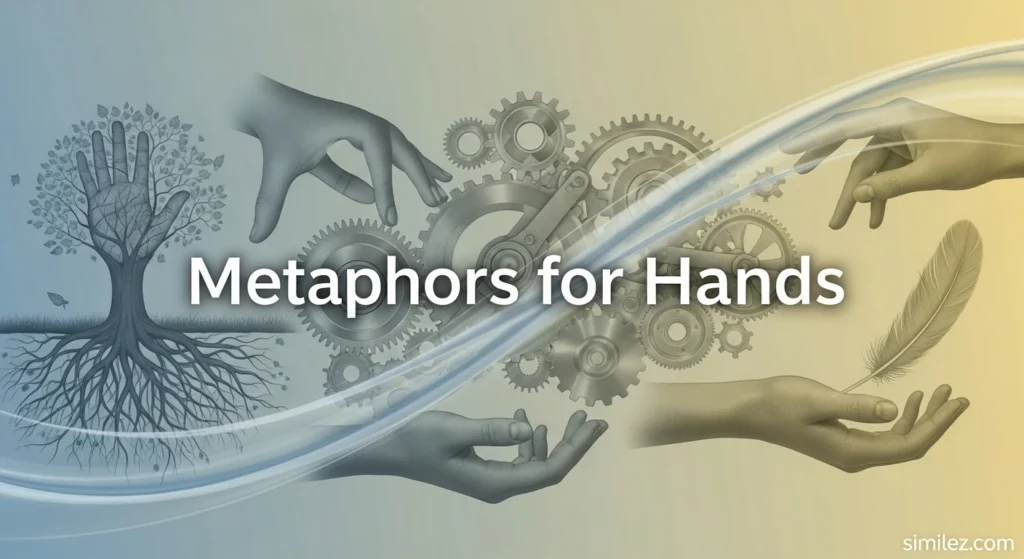
A hand rises before a word does. It pauses mid air, hesitant, expressive, already speaking in silence. Picture a crowded street at dusk: a vendor counting change, a child tugging a sleeve, an elder blessing someone with a slow, trembling gesture. No speech is needed. The hands have already told the story.
“Metaphors for hands” explore how we describe hands not just as body parts, but as carriers of meaning bridges, tools, memory, language, and emotion.
In writing, communication, and storytelling, hands often become symbols for human experience itself.
Understanding these metaphors matters because they sharpen expression. Instead of saying “he helped,” you can show meaning through imagery like “his hands rebuilt what time broke.” That shift turns plain language into living narrative.
Why Hands Carry Deep Symbolism in Language and Expression
Hands are the most visible extension of human intention. They create, destroy, comfort, and communicate. Across cultures, hands symbolize work, care, authority, surrender, and connection.
From ancient carvings to modern photography, hands consistently appear as visual shorthand for human effort. Writers rely on this instinctively because readers already “feel” the meaning of hands before it is explained.
In literature, hands are rarely neutral. They are always doing something: blessing, shaking, holding, releasing, or trembling. This makes them ideal for metaphor.
Understanding Metaphors for Hands: Meaning and Function
A metaphor for hands is a figurative expression where hands represent an abstract idea—such as power, memory, connection, or emotion.
Instead of describing literal action, the metaphor transforms hands into symbolic meaning-makers. For example:
- “Hands as bridges” suggests connection.
- “Hands as tools of memory” suggests emotional imprinting.
- “Hands as language without words” suggests non-verbal communication.
These metaphors allow writers to compress complex emotional truths into simple, vivid imagery.
Hands as Bridges Between People and Worlds
Hands often function as connectors—physically, emotionally, and socially. The metaphor “hands as bridges” captures this perfectly.
Meaning and Explanation
Hands connect gaps between individuals: a handshake, a lifted child, a hand extended in forgiveness. Like bridges, they allow passage between separate emotional or social states.
Example Scenarios
- A handshake sealing trust after conflict.
- A parent lifting a child across a riverbank.
- A stranger offering help during an accident.
Example Sentence
“His hands became bridges across years of silence, finally reconnecting what pride had divided.”
Alternative Expressions
- Hands as connectors of hearts
- Hands as pathways of trust
- Hands as crossings over distance
Sensory and Emotional Detail
There is warmth in a handshake that lingers longer than expected. There is pressure, slight hesitation, then release. The moment feels like crossing invisible ground between two people.
Mini Story Element
A woman returns to her hometown after twenty years. At the railway station, her brother does not speak. Instead, he simply extends his hand. That single gesture collapses two decades of distance more effectively than any apology could.
Hands as Tools of Memory and Emotional Imprint
Hands remember what the mind sometimes forgets.
Meaning and Explanation
This metaphor suggests that hands store experiences through repetition: writing habits, cooking family recipes, touching familiar objects. They “remember” emotionally charged actions.
Example Scenarios
- A pianist’s hands recalling a childhood melody without sheet music.
- A grandmother kneading dough the same way for 40 years.
- A soldier instinctively gripping equipment in trained motion.
Example Sentence
“Her hands carried memory like ink absorbed into fabric, never fully washed away.”
Alternative Expressions
- Hands as archives of experience
- Hands as vessels of muscle memory
- Hands as silent historians
Sensory and Emotional Detail
Think of flour dust clinging to fingers, or the faint scent of oil on mechanic’s palms. These sensations are not just physical—they are emotional timestamps.
Mini Story Element
An old carpenter returns to his workshop after years of retirement. He does not need instruction. His hands move automatically, finding tools as if greeting old friends. He realizes memory did not leave him—it simply moved into his hands.
Hands as Language Without Words
Hands speak even when silence dominates the room.
Meaning and Explanation
This metaphor frames hands as a communication system—gesture, movement, and posture replacing verbal language.
Example Scenarios
- A teacher guiding students with subtle hand signals.
- Lovers communicating across a crowded room with small gestures.
- A courtroom where restrained hand movements reveal tension.
Example Sentence
“Her hands argued louder than her voice ever could, shaping truth in the air between them.”
Alternative Expressions
- Hands as silent speech
- Hands as unspoken grammar
- Hands as emotional dialect
Sensory and Emotional Detail
A raised palm can halt chaos. A clenched fist can tighten the atmosphere instantly. The air itself feels different when hands begin to “speak.”
Mini Story Element
In a noisy protest, two friends lose verbal contact. One raises two fingers, then points to a safe exit. No words are exchanged, yet understanding is immediate. The language is entirely made of motion.
Cultural and Literary References of Hands Across Civilizations
Hands appear across myth, religion, and folklore as symbols of power and creation.
In many traditions, divine creation is depicted as “hands shaping life.” In classical art, extended hands often symbolize blessing or judgment. Even in modern cinema, close-ups of hands often mark emotional turning points.
In South Asian storytelling, hands frequently symbolize labor and dignity—farmers’ hands, artisans’ hands, and caregivers’ hands reflecting life’s struggle and beauty.
How Writers Use Hand Metaphors in Storytelling
Writers use hand imagery to anchor abstract emotion into physical detail. A trembling hand can signal fear more effectively than a paragraph of explanation.
Hands also allow pacing control. A slow gesture can stretch tension. A sudden movement can break it.
For example:
- Instead of “he was nervous,” a writer might say, “his fingers refused to stay still.”
- Instead of “she was kind,” a writer might say, “her hands always found something to fix.”
Creative Writing Exercises for Practicing Hand Metaphors
- Describe a memory using only hand actions (no emotions named directly).
- Write a scene where two characters communicate only through hands.
- Turn a daily activity (tea-making, writing, walking) into a metaphor about life using hands as central imagery.
- Replace abstract emotions (fear, love, anger) with hand-based descriptions.
These exercises train observational writing and emotional precision.
Practical Uses in Daily Communication and Social Media
Hand metaphors are not limited to literature. They can enhance everyday expression:
- In captions: “Hands full of unfinished stories.”
- In speeches: “We are extending our hands toward change.”
- In professional communication: “Our team’s hands-on approach ensures results.”
They make language more relatable and visually grounded, increasing engagement and emotional impact.
Common Mistakes When Using Hand Metaphors
- Overloading descriptions with too many metaphors at once.
- Using clichés like “hands of fate” without fresh context.
- Detaching metaphor from emotional reality.
- Forcing symbolism where simple language would be clearer.
Effective metaphors feel natural, not manufactured.
Bonus Tips for Mastering Metaphors for Hands
- Anchor metaphors in physical sensation (touch, pressure, temperature).
- Link hands to action, not just appearance.
- Use contrast: steady hands vs shaking hands.
- Observe real life closely; metaphors come from noticing, not inventing.
Advanced Variations: Expanding Hand Metaphors into Narrative Systems
Advanced writers often extend a single metaphor across an entire story. For example:
- Hands as architecture: building relationships like structures.
- Hands as weather systems: calm, stormy, unpredictable.
- Hands as timekeepers: marking change through aging gestures.
These extended metaphors create thematic depth and cohesion.
Conclusion
Hands are not passive tools of the body; they are active storytellers. Through metaphor, they become bridges, memory keepers, and silent speakers of emotion.
In writing and communication, hand metaphors transform ordinary description into layered meaning. They allow readers not just to understand, but to feel.
FAQs
What are metaphors for hands in writing?
They are figurative expressions where hands represent abstract ideas like connection, memory, or communication.
Why are hands commonly used in metaphors?
Because they are universally visible, emotionally expressive, and closely tied to human action and experience.
How can I create strong hand metaphors?
Focus on real-life observation, sensory detail, and emotional context rather than abstract imagination alone.
Are hand metaphors used in professional writing?
Yes, especially in speeches, branding, storytelling, and persuasive communication to create emotional clarity.
What is an example of a powerful hand metaphor?
“His hands rebuilt what silence destroyed” is an example showing repair, effort, and emotional depth through action.
Can hand metaphors be overused?
Yes. Overuse reduces impact. The key is precision and restraint.