
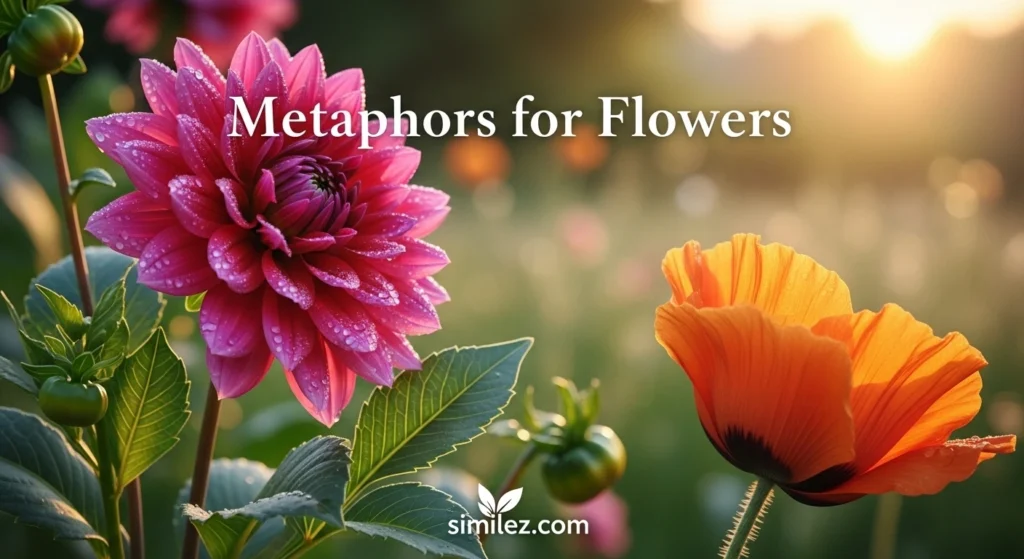
A soft morning light spills over a garden where dew clings to petals like tiny glass memories.
A rose opens slowly, not in a rush, as if it knows someone is watching. Nearby, marigolds burn like small suns, and jasmine lingers in the air like an unfinished sentence. No one speaks, yet everything is said.
Flowers have always been more than decoration. They are emotional translators. When words fail, petals take over.
That is where metaphors for flowers step in not just as literary tools, but as ways of seeing life itself through bloom, color, and fragrance.
What Are Metaphors for Flowers? A Simple Yet Powerful Idea
A metaphor is a way of describing one thing in terms of another to reveal hidden meaning. When we say “life is a journey,” we are not talking about roads. Similarly, flowers become metaphors for human emotions, experiences, and time itself.
A flower is never just a flower in literature. It becomes love, grief, hope, innocence, or even silence. Writers, poets, and storytellers have used floral imagery for centuries because it compresses complex emotions into something visible, fragile, and beautiful.
Why Flower Metaphors Matter in Writing and Life
Flower metaphors are not just poetic decoration. They are cognitive shortcuts for emotion. Instead of explaining sadness, you might say “a wilting petal in a forgotten vase.” Instead of describing joy, you might say “a garden waking after rain.”
They matter because:
- They make writing emotionally vivid.
- They help readers feel, not just understand.
- They connect human experience with nature’s cycles.
- They are universally understood across cultures.
In short, flowers speak a language older than words.
The Emotional Universe Hidden Inside a Flower
Every flower carries a dual identity. It is both biological and symbolic. A rose is a reproductive structure in botany, but in human imagination, it is love with thorns.
This duality is what makes metaphors for flowers so powerful. They transform ordinary petals into emotional architecture:
- Bloom = growth or awakening
- Wilt = loss or decay
- Fragrance = memory or longing
- Thorns = pain within beauty
Once you see flowers this way, every garden becomes a story.
Flowers as Love in Blooming Form
A rose is the most classic example of this metaphor. It doesn’t just represent love—it behaves like love.
Love, like a rose, opens gradually. It cannot be forced. It demands patience, care, and vulnerability. And just like roses, love carries risk—thorns that protect the softness inside.
Meaning and Explanation
This metaphor equates emotional intimacy with natural blooming cycles. Love is not instant; it unfolds.
Example Sentence
“His affection for her was a rose refusing to rush its bloom, unfolding only in the quiet warmth of trust.”
Alternative Expressions
- Love is a garden in spring.
- Affection is a bud learning to open.
- Desire is a petal trembling in morning light.
Sensory and Emotional Layer
Imagine the scent of roses at dusk—soft, slightly intoxicating. That is how this metaphor feels: tender but slightly dangerous.
Mini Story
A man once planted a rose bush outside his window after a heartbreak. Years later, when it finally bloomed fully, he realized he had healed too—not because time passed, but because he learned patience from watching something beautiful refuse to rush.
Flowers as Human Emotions in a Living Garden
Not all flowers represent one feeling. A garden represents emotional complexity. Every flower is a different emotional state coexisting in one human heart.
Meaning and Explanation
Here, flowers become emotional compartments—anger like wild nettles, joy like sunflowers, sadness like drooping lilies.
Example Sentence
“Her mind was a crowded garden where sunflowers of joy fought for light among weeds of doubt.”
Alternative Expressions
- Emotions are a wild botanical field.
- The heart is a garden that never sleeps.
- Feelings grow like untamed vines.
Sensory and Emotional Layer
Picture stepping barefoot into a dense garden. Some parts are warm and bright; others are shadowed and cool. That contrast is emotional realism.
Mini Story
A young poet once described his depression as an overgrown garden. He stopped fighting it and started naming each plant. Slowly, he realized even weeds had purpose—protecting soil, creating balance. His healing began with observation, not resistance.
Flowers as Time Passing and Memory Fading
Flowers live briefly. That is why they are perfect metaphors for time.
A blooming flower is the present moment. A wilting one is memory. A fallen petal is what remains.
Meaning and Explanation
This metaphor reflects impermanence. Life, like flowers, cannot stay in bloom forever.
Example Sentence
“The cherry blossoms fell like pages torn from the book of spring, each petal a second we could never retrieve.”
Alternative Expressions
- Time blooms and fades like petals.
- Memories are dried flowers in the book of life.
- Youth is a garden that cannot stay in spring.
Sensory and Emotional Layer
Think of cherry blossoms drifting in wind—beautiful, but impossible to hold. That contradiction is emotional truth.
Cultural Reference
In Japanese tradition, cherry blossoms symbolize impermanence and beauty. Their short life is not tragic but meaningful—it teaches appreciation of the present moment.
Flowers in Literature, Poetry, and Culture
From Shakespeare’s roses to Rumi’s spiritual gardens, flowers have been used as emotional codes.
- In English poetry, roses often symbolize romantic love and mortality.
- In Persian poetry, gardens represent paradise and divine love.
- In South Asian culture, jasmine is often linked with purity and memory.
Even in modern storytelling, flowers remain emotional anchors. A single daisy in a war scene can signal lost innocence without a single word of explanation.
How to Use Flower Metaphors in Writing Effectively
Using metaphors for flowers is not about decoration—it is about precision.
Tips:
- Match emotion with flower behavior (bloom, wilt, scatter).
- Avoid overloading one sentence with multiple metaphors.
- Use sensory detail (smell, texture, color).
- Keep metaphors grounded in human experience.
Strong writing does not say “beautiful flower.” It says “a flower trembling under morning light like it is afraid of being seen.”
Creative Writing Exercises with Flower Metaphors
Try these to sharpen your metaphorical thinking:
- Describe sadness without using the word “sad.” Use a flower image instead.
- Write a paragraph where each emotion is a different type of flower.
- Take a memory and turn it into a seasonal garden scene.
- Observe a real flower and write three metaphors for it.
These exercises force your mind to translate emotion into imagery.
Flower Metaphors in Social Media and Daily Expression
In modern communication, metaphors still thrive.
You might use:
- “Still blooming” to indicate personal growth.
- “Out of season” to describe emotional distance.
- “Wildflower energy” to show independence.
On platforms like Instagram or captions, flower metaphors create instant emotional resonance without long explanations.
Example caption: “Not every season is for blooming, some are for resting roots.”
Psychological Depth Behind Flower Imagery
Flower metaphors also work because they mirror human psychology. Growth, decay, cycles—these are deeply embedded in how we understand ourselves.
Psychologically:
- Blooming = self-actualization
- Wilting = burnout or sadness
- Pruning = letting go of toxic patterns
- Seeds = potential and future identity
This is why floral imagery feels universally relatable—it reflects internal states we already experience.
Common Mistakes When Using Flower Metaphors
Even beautiful tools can lose power if misused.
Avoid:
- Overuse (everything becomes a flower → loses meaning)
- Mixed metaphors (confusing emotional signals)
- Clichés without depth (“life is a rose” without context)
Instead, ground metaphors in a specific emotional situation. Precision creates impact.
Building Your Own Personal Flower Language
You don’t need to copy traditional symbolism. You can build your own.
Ask yourself:
- What flower represents my anger?
- What bloom feels like my childhood?
- What plant feels like recovery?
Over time, you develop a private symbolic system—a personal emotional vocabulary using nature.
Conclusion
Flowers do not explain themselves. They simply exist—blooming, fading, returning. That is why they are perfect metaphors for human life.
When you understand metaphors for flowers, you stop seeing petals as decoration and start seeing them as language. A language that speaks in silence, in color, in scent, and in time.
Every flower becomes a sentence. Every garden becomes a story. And every bloom becomes a reminder that beauty and impermanence are never separate—they grow from the same stem.
FAQs
What are common metaphors for flowers in writing?
Flowers often represent love, beauty, growth, innocence, memory, and impermanence depending on context.
Why are flowers used as metaphors for emotions?
Because they visually and naturally reflect human emotional cycles like growth, bloom, and decay.
Can flower metaphors be used in professional writing?
Yes, if used subtly. They are effective in speeches, branding, and storytelling when not overused.
What is the most powerful flower metaphor?
The idea of blooming and wilting as a reflection of life’s temporary nature is one of the most powerful.
How can I create my own flower metaphors?
Observe real flowers, assign them emotional meanings based on behavior, and connect them to personal experiences.