
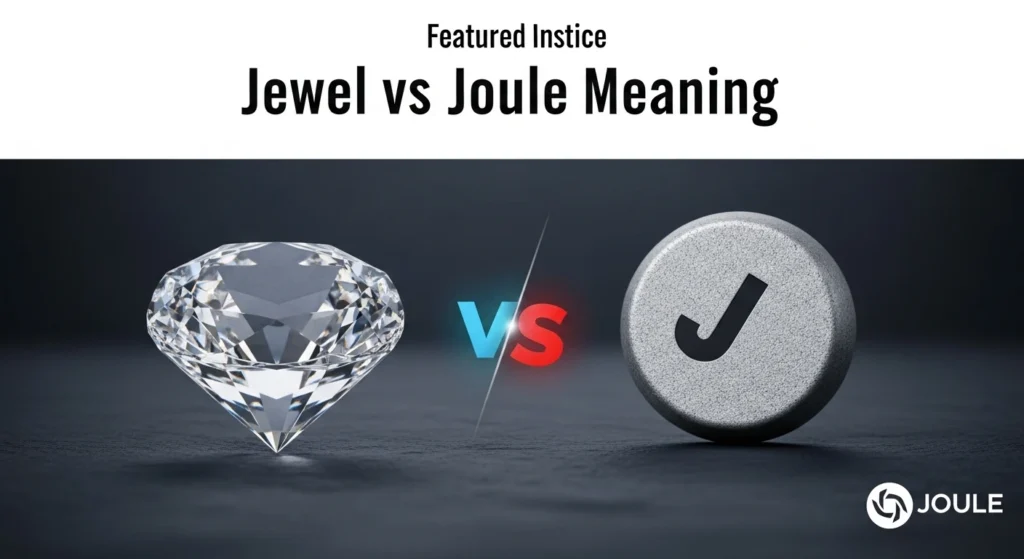
You’re standing in a quiet jewelry shop, watching a gold necklace sparkle under warm lights. The salesperson says it’s worth thousands. Later that day, you’re helping a child with homework, and they mention “joules” while solving a physics problem about energy.
The words sound almost identical jewel and joule yet they live in entirely different worlds. One represents beauty, status, and emotion; the other measures energy, motion, and the invisible forces shaping our universe.
This confusion isn’t just about spelling it reflects how language can blur meaning across disciplines. Understanding the difference between “jewel” and “joule” matters more than you might think.
Whether you’re reading, writing, studying science, or simply trying to communicate clearly, mixing them up can lead to misunderstandings that feel small but matter in context.
In this article, we’ll explore these two terms deeply not just their definitions, but their real-life significance, conceptual contrast, and the subtle lessons they offer about language, perception, and meaning itself.
What Does “Jewel” Mean?
A jewel refers to something tangible, valuable, and often beautiful—typically a precious stone like a diamond, ruby, or emerald. But its meaning goes beyond material wealth.
A jewel represents rarity, craftsmanship, and emotional significance. It might be a ring passed down through generations or a gift marking a life milestone.
In everyday language, “jewel” is also used metaphorically. You might call someone a “jewel” to express admiration or refer to a place as a “hidden jewel” to highlight its unique charm.
The word carries a sense of appreciation and emotional weight.
Think about the last time you saw something that took your breath away—a sunset, a kind gesture, or even a piece of art.
In many ways, we label such moments as “jewels” of our experience. It’s not just about physical objects; it’s about what we treasure.
So while a jewel may sit quietly in a display case, its meaning often shines brightest in human connection and sentiment.
What Does “Joule” Mean?
A joule, on the other hand, belongs to the world of science—specifically physics. It is the standard unit of energy in the International System of Units (SI). One joule measures the amount of work done when a force of one newton moves an object one meter.
That might sound technical, but in simple terms, a joule quantifies energy—something we encounter constantly, even if we don’t notice it.
1,\text{J} = 1,\text{N} \cdot 1,\text{m}
When you lift a book, turn on a light, or charge your phone, energy is being transferred—and that energy can be measured in joules. Unlike a jewel, which you can hold, a joule represents something invisible but essential.
Imagine pushing a door open. The effort you apply, the movement of the door—that interaction involves energy. That energy can be calculated in joules.
So while the word may sound similar to “jewel,” its meaning is grounded in measurement, precision, and scientific understanding.
The Core Difference: Physical Object vs Measurement Unit
At the heart of the confusion lies a simple but crucial distinction: a jewel is an object, while a joule is a unit of measurement.
A jewel exists in the physical world—you can see it, touch it, and assign emotional or financial value to it. A joule, however, is abstract. It exists only as a way to quantify energy.
This difference reflects two entirely separate domains:
- Jewel → Art, culture, beauty, and value
- Joule → Science, physics, and measurement
Think of it this way: a jewel might sit in a velvet box, admired for its brilliance. A joule, meanwhile, is quietly at work every time your body moves or your devices function.
Confusing the two is like mixing up “painting” with “temperature.” They simply operate in different conceptual spaces.
Why People Confuse Jewel and Joule
The confusion largely comes down to pronunciation. Both words are pronounced almost identically: jool. When spoken, there’s no clear distinction unless context clarifies the meaning.
In writing, however, the difference is obvious—jewel has an extra “e” and relates to luxury, while joule has a more scientific spelling.
Another reason for confusion is exposure. Most people encounter “jewel” far more often in daily life than “joule,” unless they study science. So when they hear “joule,” their brain defaults to the familiar term.
Common Scenarios of Confusion
In Education
Students often mix up the spelling in exams, especially when transitioning between language and science subjects.
In Writing
Writers sometimes mistakenly use “jewel” when referring to energy, leading to awkward or incorrect sentences.
In Conversation
Since pronunciation is identical, listeners rely entirely on context—which isn’t always clear.
Understanding this confusion helps you avoid it—and communicate more precisely.
The Emotional vs Scientific Contrast
One of the most fascinating aspects of these words is how they represent completely different human experiences.
A jewel appeals to emotion. It symbolizes love, memory, status, and beauty. It’s often tied to personal stories—engagements, celebrations, or heirlooms.
A joule, by contrast, appeals to logic. It’s a tool for understanding the physical world. It helps scientists measure how energy moves, transforms, and impacts our environment.
This contrast highlights two sides of human thinking:
- Emotional appreciation
- Analytical understanding
Both are essential. One helps us feel; the other helps us understand.
And interestingly, both can coexist. The energy required to mine, cut, and polish a jewel can be measured in joules—linking the two concepts in an unexpected way.
Real-Life Examples of Jewel
To truly understand “jewel,” it helps to see how it appears in everyday life.
Personal Value
A wedding ring is more than a piece of metal—it’s a symbol of commitment. Its value isn’t just monetary; it’s emotional.
Cultural Significance
In many cultures, jewels represent heritage and identity. Traditional jewelry often carries historical meaning.
Metaphorical Use
You might hear phrases like:
- “She’s a jewel of a person”
- “That village is a hidden jewel”
These uses show how the word extends beyond physical objects into language and expression.
In each case, the idea of rarity and value remains central.
Real-Life Examples of Joule
Now consider how “joule” operates in daily life, often unnoticed.
Everyday Energy Use
When you charge your phone, electrical energy flows—measured in joules.
Food and Nutrition
Calories in food are actually kilojoules. Your body uses this energy to function.
Physical Activity
Running, lifting, even walking—all involve energy transfer. Every movement can be measured in joules.
Technology
From light bulbs to engines, joules help engineers calculate efficiency and performance.
While invisible, joules are constantly shaping your environment.
The Role of Context in Understanding
Context is everything when distinguishing between jewel and joule.
If someone says, “This device uses 500 joules,” the scientific context makes the meaning clear. If they say, “She wore a beautiful jewel,” the emotional and visual context takes over.
But in ambiguous situations, confusion can arise.
How to Use Context Effectively
- Look at surrounding words
- Identify the subject (science vs lifestyle)
- Consider the setting (classroom vs conversation)
Context acts like a guide, helping you interpret meaning correctly.
Common Mistakes and How to Avoid Them
Mistakes usually happen in writing rather than speech.
Typical Errors
- Writing “jewel” in a physics answer
- Using “joule” in a lifestyle or fashion context
Simple Fixes
- Associate jewel with beauty and objects
- Associate joule with energy and science
A quick mental check can prevent errors: “Am I talking about something I can hold—or something I can measure?”
That single question often resolves the confusion instantly.
Deeper Insight: Language and Perception
The jewel vs joule confusion reveals something deeper about language.
Words are not just labels—they shape how we think. When two words sound the same but mean entirely different things, they challenge our ability to process meaning quickly.
This is known as a homophone—words that sound alike but differ in meaning and spelling.
Such words remind us that communication is not just about vocabulary; it’s about clarity, context, and awareness.
They also show how different fields—art and science—develop their own language systems, even when sounds overlap.
Practical Tips for Remembering the Difference
Here are a few memory tricks that actually work:
- Jewel = Extra “e” for elegance
- Joule = “ou” like “output” (energy output)
You can also create mental images:
- Picture a sparkling gem for “jewel”
- Picture a battery or lightning bolt for “joule”
Repetition helps too. The more you use each word correctly, the more natural it becomes.
When the Two Worlds Intersect
Interestingly, jewel and joule can intersect in real life.
Creating a jewel involves energy:
- Mining requires mechanical work
- Cutting and polishing require precision tools
- Transport involves fuel consumption
All of this energy can be measured in joules.
So while the words are different, the concepts can connect. A beautiful jewel is, in part, the result of energy transformations.
This intersection shows how art and science are not isolated—they often support and explain each other.
Why This Distinction Matters
At first glance, the difference may seem trivial. But in practice, it matters.
- In education, accuracy is essential
- In communication, clarity prevents confusion
- In professional settings, precision builds credibility
Imagine a legal, academic, or technical document using the wrong term—it could undermine the entire message.
Understanding small distinctions like this sharpens your overall communication skills.
Broader Lesson: Precision in Language
The jewel vs joule distinction teaches a broader lesson: precision matters.
Language is a tool. The more precisely you use it, the more effectively you communicate.
This applies everywhere:
- Writing
- Speaking
- Teaching
- Professional work
Small errors can create big misunderstandings. But small corrections can significantly improve clarity.
Mastering such distinctions is not about perfection—it’s about awareness.
Conclusion
“Jewel” and “joule” may sound identical, but they represent two entirely different dimensions of human experience.
One captures beauty, emotion, and value—something you can see and cherish. The other measures energy, motion, and the invisible forces powering our world.
Understanding the difference isn’t just about avoiding a spelling mistake. It’s about recognizing how language bridges art and science, emotion and logic.
A jewel reminds us of what we treasure, while a joule helps us understand how the world works.
When you next hear these words, you’ll notice the distinction instantly—and perhaps appreciate the subtle elegance of language itself.
In that awareness lies clarity, and in clarity lies better thinking, communication, and understanding.