
You’re walking through a quiet forest at dusk. The air is still, the path soft beneath your feet. Suddenly, you hear a faint creak behind you sharp, wooden, almost unsettling. You pause, listening.
Then, as you move forward again, the gentle sound of flowing water reaches your ears a peaceful creek winding through the trees.
Two nearly identical words. Two completely different meanings. And yet, they’re often confused.
“Creek” and “creak” are classic examples of English words that sound alike but carry entirely different images, emotions, and uses. One belongs to nature, calmness, and geography.
The other belongs to sound, movement, and often tension or age. Misusing them can subtly but significantly change the meaning of a sentence.
In this article, we’ll go beyond simple definitions. You’ll explore not just what these words mean, but how they feel, how they’re used in real life, where confusion arises, and how to master them naturally in your writing and speech.
What Does “Creek” Mean?
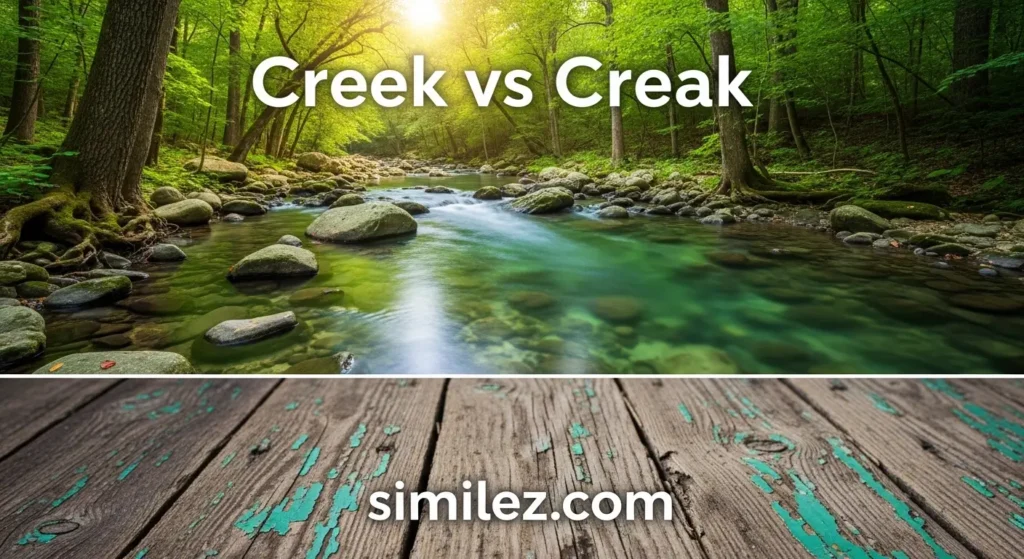
A creek is a small stream or narrow body of water, often found in natural landscapes like forests, valleys, or rural areas. It typically flows gently and is smaller than a river.
Unlike large, powerful rivers, a creek often symbolizes calmness, simplicity, and connection with nature. It’s the kind of place where people sit quietly, skip stones, or reflect.
Key Characteristics of a Creek:
- Natural water body
- Smaller than a river
- Often shallow and slow-moving
- Found in rural or wilderness settings
Example:
“We spent the afternoon sitting by the creek, listening to the water flow.”
The word evokes imagery—peace, greenery, sunlight reflecting off water. It’s not just a physical place; it carries emotional weight.
What Does “Creak” Mean?
A creak is a sound—a sharp, high-pitched noise made when something moves under pressure, often due to age, friction, or lack of lubrication.
It’s commonly associated with:
- Old doors
- Wooden floors
- Stairs
- Furniture
Unlike “creek,” which is visual and calming, “creak” is auditory and often unsettling or eerie.
Example:
“The door creaked open slowly in the dark.”
That single word adds tension. You can almost hear it.
Why People Confuse Creek and Creak
The confusion comes down to pronunciation. In many accents, creek and creak sound nearly identical.
This makes them homophones—words that sound the same but differ in meaning and spelling.
Common Reasons for Confusion:
- Similar pronunciation
- Fast typing or writing mistakes
- Lack of contextual awareness
Example of Incorrect Usage:
“We walked along the creak.” ❌ (Should be creek)
“The old bridge creeked loudly.” ❌ (Should be creaked)
Small mistake, big difference.
The Visual vs Auditory Divide
One of the easiest ways to remember the difference is this:
- Creek = something you see
- Creak = something you hear
This distinction is powerful.
When you say “creek,” your mind paints a picture. When you say “creak,” your mind produces a sound.
Memory Trick:
- Creek flows.
- Creak echoes.
This sensory difference makes it easier to choose the right word instinctively.
Emotional Impact of Each Word
Words don’t just carry meaning—they carry emotion.
Creek: Calm and Serenity
A creek often represents:
- Peace
- Nature
- Reflection
- Escape
It’s used in storytelling to create a soothing or nostalgic tone.
Creak: Tension and Suspense
A creak often represents:
- Age or decay
- Fear or suspense
- Movement in silence
It’s widely used in horror or suspense writing.
Compare:
“The creek flowed gently behind the house.” (calm) “The floorboards creaked behind her.” (tense)
Same sound. Completely different emotional effect.
Real-Life Scenarios Where the Difference Matters
Scenario 1: Writing a Story
If you’re describing a peaceful countryside:
“A creek ran through the valley.” ✔️
If you mistakenly write:
“A creak ran through the valley.” ❌
The sentence becomes confusing or meaningless.
Scenario 2: Everyday Conversation
“I heard a creak upstairs.” ✔️ “I heard a creek upstairs.” ❌
One suggests noise; the other sounds absurd.
Scenario 3: Professional Writing
In legal, academic, or formal writing, such mistakes reduce credibility.
Precision matters.
How Context Helps You Choose Correctly
Context is your strongest ally.
Ask yourself:
- Is this about water? → Use creek
- Is this about sound? → Use creak
Quick Test:
If you can replace it with:
- “stream” → creek
- “noise” → creak
You’ve got your answer.
Common Mistakes and How to Avoid Them
Mistake 1: Phonetic Spelling
Writing based on sound rather than meaning.
Mistake 2: Ignoring Context
Not analyzing the sentence before choosing the word.
Mistake 3: Overconfidence
Assuming both words are interchangeable—they’re not.
Fix:
Slow down. Read the sentence. Visualize it.
The Role of These Words in Storytelling
Writers use creek and creak strategically.
Creek in Storytelling:
- Sets peaceful scenes
- Builds atmosphere
- Represents continuity
Creak in Storytelling:
- Signals tension
- Marks movement in silence
- Creates suspense
Example:
“She followed the creek until sunset…” “Behind her, the stairs creaked…”
One leads you forward. The other makes you look back.
Linguistic Insight: Why English Has Words Like This
English is full of homophones due to its mixed origins—Germanic, Latin, French, and more.
“Creek” comes from geographical terminology, while “creak” is rooted in sound imitation (onomatopoeia).
This overlap creates richness—but also confusion.
Practical Tips to Master the Difference
1. Associate with Imagery
- Creek → water flowing
- Creak → door opening
2. Use Them in Sentences
Practice helps memory stick.
3. Read Aloud
Hearing the sentence can highlight mistakes.
4. Visual Anchoring
Imagine:
- A riverbank → creek
- A haunted house → creak
Everyday Usage in Modern Language
You’ll find these words in:
- Conversations
- Literature
- Movies
- Descriptive writing
But rarely in technical contexts.
Still, using them correctly improves clarity and expression.
Subtle Nuances Advanced Learners Notice
Advanced users of English recognize that:
- Creek can vary regionally (some places call larger streams “creeks”)
- Creak can be used metaphorically
Example:
“His knees creaked as he stood up.”
No actual sound described—just implied stiffness.
Teaching Others the Difference
If you’re explaining this to someone else:
Simple Explanation:
- Creek = water
- Creak = sound
Better Explanation:
- One flows
- One echoes
The simpler, the better.
Why This Small Difference Matters
At first glance, it’s minor.
But in communication, precision builds trust.
Using the wrong word can:
- Confuse readers
- Break immersion in writing
- Reduce credibility
Using the right word sharpens your expression.
Conclusion
“Creek” and “creak” may sound identical, but they live in entirely different worlds one in the quiet beauty of nature, the other in the subtle language of sound and movement. Understanding their difference isn’t just about spelling; it’s about clarity, imagery, and emotional tone.
When you choose creek, you invite calm, flow, and landscape into your words. When you choose creak, you introduce sound, tension, and presence. That distinction, though small, can transform how your message is received.
Language is built on details like these. Mastering them doesn’t just make you correct it makes you precise, expressive, and impactful.