
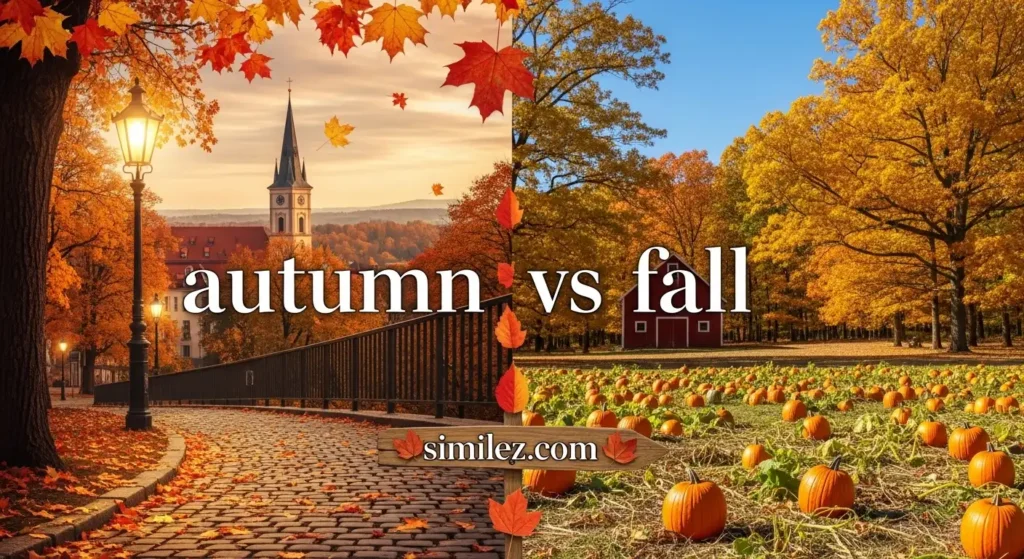
Picture this: leaves turning from green to fiery shades of amber, gold, and deep crimson. A cool breeze brushes past, carrying the faint scent of wood smoke and earth after rain.
Somewhere, a child kicks through a pile of dry leaves while nearby someone wraps a scarf a little tighter around their neck.
This seasonal shift feels familiar, almost emotional yet even its name changes depending on where you are in the world. Some call it autumn, others say fall.
At first glance, both words seem interchangeable, but they carry subtle differences in history, culture, and even emotional tone. Why do two names exist for the same season?
Does the language we use shape how we experience this transitional time of year? And beyond vocabulary, what does this season really represent in human life beyond just weather changes?
1. Autumn vs Fall: Meaning and Linguistic Origins
The words autumn and fall refer to the same season, but their origins tell different stories. Autumn comes from the Latin word autumnus, which passed into Old French and then into English during the medieval period. It carries a slightly formal, literary tone—often associated with poetry, elegance, and European traditions.
On the other hand, fall is an old English term derived from the phrase “fall of the leaf,” describing the natural process of leaves dropping from trees. Over time, it shortened to simply fall, especially in North America.
Both words describe the same seasonal transition between summer and winter, but they reflect different linguistic paths. Autumn feels refined and poetic, while fall feels direct and grounded in observation. This difference is not about correctness—it is about expression. Language shapes mood, and even seasonal words carry emotional weight.
When someone says “autumn evening,” it feels soft and reflective. When someone says “fall weather,” it feels practical and immediate. Same season, different emotional lens.
2. Why Two Names Exist for the Same Season
The existence of two names is not a contradiction but a result of historical language evolution. English has always absorbed influences from different cultures—Latin, French, Germanic roots—all shaping its vocabulary.
In medieval England, autumn became more commonly used in written and literary contexts due to French influence after the Norman conquest. However, everyday speakers still used simpler expressions like “fall of the leaf.”
When English settlers moved to North America, language naturally adapted. Over time, fall became the dominant term in the United States, while autumn remained more common in Britain and other Commonwealth countries.
This split shows how language evolves with geography and culture. Neither word replaced the other; instead, they co-existed in different regions. It is a reminder that language is not fixed—it travels, adapts, and reflects human migration and identity.
So when you hear someone say “autumn” or “fall,” you are not just hearing a word—you are hearing a piece of linguistic history shaped by centuries of movement and change.
3. Cultural Geography: Where Autumn and Fall Are Used
Language usage often maps directly onto geography. In the United States, fall is the dominant everyday term. It appears in school calendars, weather reports, and casual conversation. Saying “fall break” or “fall season” feels natural and standard.
In contrast, countries like the United Kingdom, Ireland, and much of Europe prefer autumn. It is used in formal writing, literature, and media. You are more likely to read “autumn collection” in fashion or “autumn leaves” in poetry.
H3: Regional Identity Through Language
This difference is not just linguistic—it reflects identity. Americans often prefer straightforward, functional language, while British English retains more Latin-based vocabulary. Neither is better; they simply evolved differently.
H3: Global Influence Today
In modern times, globalization has blurred these boundaries. Social media, films, and international education systems expose people to both terms. As a result, many individuals use them interchangeably, sometimes choosing based on tone rather than region.
Language here becomes flexible—almost artistic. Choosing “autumn” or “fall” can subtly change how a message feels, even if the meaning stays identical.
4. The Science Behind the Season
Beyond language, the season itself is defined by astronomical and meteorological changes. Autumn/fall occurs when Earth’s tilt reduces direct sunlight in a hemisphere, leading to shorter days and cooler temperatures.
This shift affects chlorophyll production in trees, causing leaves to change color and eventually fall. The reds, oranges, and yellows we see are pigments that were always present but hidden during summer.
Scientifically, this transition is a preparation phase for winter. Trees conserve energy, animals adapt their behavior, and ecosystems shift into survival mode. Migration patterns begin, food storage increases, and nature slows down.
This seasonal mechanism is universal—it happens regardless of whether we call it autumn or fall. The name changes, but the science remains constant. It is one of nature’s most predictable transformations, yet one of the most visually dramatic.
Understanding this helps us appreciate the season not just emotionally, but biologically. It is a system of adaptation, resilience, and balance in the natural world.
5. Visual Transformation of Nature
One of the most striking aspects of this season is its visual beauty. Trees transform from lush green to warm, glowing tones that seem almost painted by hand. Forests become landscapes of gold and rust, while city streets are covered in layers of fallen leaves.
H3: The Role of Chlorophyll Breakdown
As chlorophyll fades, hidden pigments like carotenoids and anthocyanins become visible. This chemical shift is what creates the iconic autumn/fall palette.
H3: Emotional Impact of Color Change
Humans respond strongly to color psychology. Warm tones often evoke nostalgia, comfort, and reflection. This is why many people feel emotionally connected to this season without fully understanding why.
Walking through a park in this period often feels like stepping into a slower, quieter version of the world. Even urban environments soften under this transformation.
The visual shift is not just aesthetic—it changes mood, behavior, and perception. It is nature’s way of signaling transition.
6. Emotional Symbolism of the Season
This season often symbolizes change, maturity, and letting go. Just as leaves fall, people associate it with releasing what is no longer needed in life.
It is a metaphor for transition—ending one phase and preparing for another. Many people reflect more deeply during this time, thinking about goals, relationships, or personal growth.
The difference in words—autumn vs fall—can even influence emotional framing. Autumn feels reflective and poetic. Fall feels grounded and direct. One invites introspection, the other action.
In both cases, the emotional essence remains the same: transition. It is neither fully ending nor beginning—it exists in between. That in-between space often encourages reflection and emotional recalibration.
This is why literature, art, and film frequently use this season as a backdrop for emotional storytelling.
7. Literature, Poetry, and Artistic Interpretation
Writers have long used this season as a symbol of time passing. Poets describe autumn as a metaphor for aging, wisdom, or bittersweet beauty.
English Romantic poets often used autumn to evoke melancholy and reflection. In contrast, modern American writing sometimes uses fall in more grounded, realistic narratives.
H3: Symbolism in Literature
In literature, falling leaves often represent impermanence. Nothing stays permanent—beauty changes form, but does not disappear.
H3: Artistic Expression
Painters capture golden forests, filmmakers use soft lighting, and musicians compose slow, reflective melodies inspired by this season.
The language used—autumn or fall—can subtly shift artistic tone. Autumn suggests elegance; fall suggests realism. Both enrich creative interpretation.
8. Lifestyle Shifts: Food, Clothing, and Routine
As temperatures drop, human lifestyle naturally adapts. Clothing becomes layered—jackets, scarves, and warm fabrics replace summer wear. Diets also shift toward warm foods like soups, roasted vegetables, and hot beverages.
Markets and cafés reflect this transition. Seasonal menus appear, featuring pumpkin, cinnamon, apples, and spices.
Daily routines also change. Days feel shorter, evenings arrive earlier, and people spend more time indoors. This encourages slower, more intimate social interactions.
Whether you call it autumn or fall, these lifestyle changes are universal. They show how deeply humans are connected to environmental cycles.
9. Psychological Impact and Human Behavior
Seasonal changes can influence mental state. Reduced daylight may affect mood, sleep patterns, and energy levels. Some people experience reflection or nostalgia during this period.
At the same time, many find comfort in slower rhythms. It becomes a time for reading, planning, and introspection.
The psychological response is not identical for everyone, but the pattern is widely observed. Humans are sensitive to environmental transitions, even when they do not consciously notice them.
Interestingly, the word choice can subtly influence perception. “Autumn mood” may feel softer, while “fall vibes” may feel more casual and modern.
Language shapes emotional framing more than we realize.
10. Common Misunderstandings About Autumn vs Fall
A common misconception is that autumn and fall refer to different seasons. In reality, they are identical in meaning.
Another misunderstanding is that one term is more “correct.” In truth, both are linguistically valid; usage depends on region and style.
Some also believe one is more formal or informal universally, but this is context-dependent. For example, “fall fashion collection” is common in the US, while “autumn collection” is standard in the UK fashion industry.
The key misunderstanding is treating them as opposites rather than variations of the same concept.
11. Practical Life Lessons from the Season
This season teaches adaptability. Nature prepares for change without resistance. Trees do not fight the process—they release what is no longer needed.
Humans can apply this lesson in personal life. Letting go of outdated habits, relationships, or mindsets can create space for growth.
It also teaches balance. Productivity slows, reflection increases, and energy conservation becomes natural.
Whether you call it autumn or fall, the underlying message is the same: change is not loss—it is transformation.
12. How Language Shapes Perception of Reality
Language is not just communication—it is perception framing. The words we choose influence how we interpret experience.
Saying autumn may evoke elegance, tradition, and calm reflection. Saying fall may evoke simplicity, clarity, and directness.
Neither perspective is more accurate—they are different lenses on the same reality. This shows how deeply language and cognition are connected.
In a globalized world, people often switch between both terms without realizing they are also shifting emotional tone.
Ultimately, language does not just describe the world—it shapes how we feel it.
Conclusion
Autumn and fall are not competing terms—they are two linguistic expressions of the same natural transition.
One carries poetic history rooted in Latin and European literature, while the other reflects practical English observation shaped by everyday speech. Together, they reveal how language evolves across geography and culture.
Beyond words, the season itself represents transformation in nature, emotion, and human behavior. It teaches adaptation, reflection, and release.
Whether you prefer the elegance of autumn or the simplicity of fall, the experience remains the same: a world quietly shifting between warmth and rest.