
There is a moment in almost every meaningful success story when nothing looks impressive from the outside. No applause, no spotlight, no visible progress just repetition, fatigue, and stubborn continuation.
A student revising the same page for the fifth time. A worker showing up before sunrise when the city is still half-asleep. A writer staring at a blinking cursor while doubt presses in.
Hard work rarely looks dramatic while it is happening. It looks slow. It feels heavy. That is why metaphors for hard work matter: they give shape to invisible struggle.
They turn effort into something the mind can hold, understand, and sustain.
Metaphors are not decoration. They are mental frameworks. They help us interpret persistence, discipline, and endurance in ways that make them emotionally and cognitively manageable.
Understanding Metaphors for Hard Work
A metaphor is a way of understanding one thing in terms of another. When we say “hard work is a marathon,” we are not being poetic for style—we are mapping endurance, pacing, and stamina onto effort.
Metaphors for hard work are especially powerful because effort itself is abstract. You cannot measure determination directly, but you can understand it through images: fire, mountains, storms, roads, machines, and battles.
They help in three ways:
- They simplify complex emotional experiences
- They improve motivation by creating mental imagery
- They enhance communication in writing, teaching, and leadership
In Urdu expression, you might hear: “mehnat ek safar hai” (hard work is a journey), which captures the same cognitive framing.
Why Metaphors for Hard Work Matter in Real Life
People often underestimate how much language shapes behavior. The way you describe effort changes how you experience it.
If hard work is “punishment,” you resist it. If hard work is “growth,” you endure it. If hard work is “building,” you invest in it.
This is why athletes, writers, lawyers, and entrepreneurs often rely on metaphorical thinking. It reframes exhaustion as progress. It transforms repetition into refinement.
In legal practice, for example, drafting and re-drafting arguments can feel tedious. But when viewed as “forging a case,” the process becomes structured, intentional, even strategic.
The Forge of Discipline: Hard Work as Fire and Steel
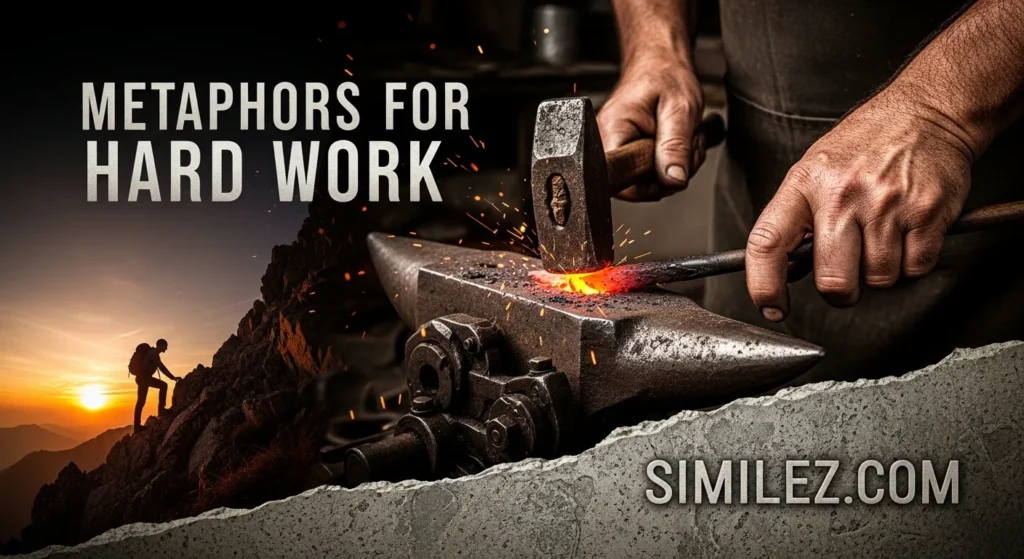
One of the most powerful metaphors for hard work is the forge. In a forge, raw metal is placed into intense heat, hammered repeatedly, and shaped into something stronger and more useful.
Hard work functions the same way.
You are not simply “doing tasks.” You are being shaped under pressure.
This metaphor appears across cultures—from ancient blacksmith imagery to modern motivational writing. The core idea remains unchanged: strength is not found; it is made under heat.
Meaning Behind the Forge Metaphor
The forge metaphor represents transformation through pressure. It suggests that discomfort is not accidental—it is necessary.
Heat represents challenges: deadlines, failures, criticism. Hammering represents repetition: practice, revision, discipline. Cooling represents reflection: recovery and learning.
Without heat, metal remains soft. Without struggle, skill remains undeveloped.
This metaphor is particularly useful for people in long-term professions where mastery is gradual rather than immediate.
Example Story: The Blacksmith’s Lesson
Imagine a young apprentice watching an old blacksmith. The metal looks ruined after the first heating—dark, misshapen, almost broken. But the master continues. Strike after strike, rhythm after rhythm.
The apprentice asks, “How do you know it will become strong?”
The blacksmith replies, “It becomes strong because it does not leave the fire too early.”
This story captures the essence of sustained effort. Many people quit when transformation is halfway complete, mistaking discomfort for failure.
Alternative expressions:
- “Shaped under pressure”
- “Refined in fire”
- “Built through resistance”
Alternative Expressions for the Forge Metaphor
To use this metaphor in writing or speech, you can vary its tone:
- “Life is a furnace of discipline.”
- “Skill is forged, not gifted.”
- “Pressure is the workshop of excellence.”
In daily communication, especially professional contexts, this metaphor can be softened or intensified depending on audience. In motivational writing, it becomes poetic; in leadership communication, it becomes strategic.
The Marathon of Effort: Hard Work as Long-Distance Running
Another widely used metaphor is the marathon. Unlike a sprint, a marathon is not about explosive speed. It is about pacing, endurance, and psychological stability over time.
Hard work is rarely about intensity alone. It is about sustainability.
This metaphor is particularly relevant in modern careers, education systems, and long-term legal or business cases where results take months or years.
Meaning Behind the Marathon Metaphor
A marathon teaches three core principles of effort:
- You cannot exhaust all energy at the beginning
- You must manage fatigue intelligently
- You must continue even when progress feels invisible
In this framing, exhaustion is not a failure—it is part of the design.
The psychological advantage is significant. It reduces burnout by normalizing slow progress.
In Urdu conceptual framing: “yeh lambi daur hai” (this is a long race) captures the essence of sustained effort.
Example Story: The Invisible Finish Line
Consider a student preparing for a high-stakes exam. The first week feels productive. The second week feels repetitive. By the third month, motivation declines sharply.
At this stage, many quit mentally, even if they continue physically.
But those who treat it as a marathon adjust pace. They reduce intensity, maintain consistency, and trust the timeline.
Months later, they realize the real victory was not the exam—it was endurance itself.
Alternative expressions:
- “Long-distance discipline”
- “Endurance over intensity”
- “Sustained performance journey”
Alternative Expressions for the Marathon Metaphor
- “Life is a long run, not a short dash.”
- “Consistency beats speed.”
- “Progress is measured in miles, not moments.”
In writing, this metaphor works well for motivational essays, productivity content, and professional development communication.
The Mountain of Hard Work: Climbing Toward Achievement
The mountain metaphor is perhaps the most emotionally vivid. Hard work is like climbing a steep mountain—step by step, with no shortcut to the summit.
The terrain is unpredictable. The air gets thinner as you ascend. The view improves slowly, almost imperceptibly.
This metaphor captures both struggle and reward.
Meaning Behind the Mountain Metaphor
Mountains represent hierarchy, difficulty, and perspective.
Base of the mountain: starting point, confusion, lack of clarity Mid-climb: fatigue, doubt, adaptation Summit: clarity, accomplishment, perspective shift
The emotional arc is crucial. You do not just reach a destination—you become someone capable of reaching it.
This metaphor resonates strongly in leadership, education, and personal growth narratives.
Example Scenario and Alternative Expressions
Imagine a junior lawyer preparing a complex case. The initial research feels overwhelming. The legal documents appear endless. Each precedent uncovered feels like another steep slope.
But gradually, structure emerges. Arguments align. Confidence builds.
Reaching the “summit” is not sudden—it is cumulative clarity.
Sensory detail: tired eyes, late-night silence, pages filled with annotations, the faint satisfaction of understanding forming like light through fog.
Alternative expressions:
- “Scaling challenges step by step”
- “Ascending toward mastery”
- “Climbing toward clarity”
Interactive Exercises, Bonus Tips, and Conclusion
To internalize these metaphors, active use is necessary.
Exercise 1: Reframe your current task using one metaphor
- Is it a forge, marathon, or mountain?
- Write 3 sentences describing your task through that lens
Exercise 2: Rewrite frustration
- Take one difficult situation and describe it as “training heat,” “long-distance phase,” or “steep climb”
Exercise 3: Daily reflection prompt
Bonus tips:
- Use metaphors in journaling to sustain motivation
- Apply them in professional communication to explain persistence without sounding abstract
- In social media writing, combine metaphor with personal experience for authenticity
Conclusion
Hard work is rarely understood in real time. It feels fragmented, repetitive, and uncertain. Metaphors restore coherence. Whether as fire in a forge, miles in a marathon, or steps up a mountain, effort becomes structured and meaningful when seen through imagery. The real advantage is not poetic—it is psychological. When you can picture your struggle, you can endure it with greater clarity and control.
FAQs
What is a metaphor for hard work?
It is a symbolic comparison that explains effort using images like fire, running, or climbing.
Why are metaphors important for motivation?
They simplify complex emotional experiences and make persistence easier to understand and sustain.
Can metaphors improve productivity?
Yes. They help structure thinking, reduce overwhelm, and improve consistency.
What is the most common metaphor for hard work?
The marathon is widely used because it reflects endurance and long-term discipline.
How can I use metaphors in writing?
Use them to describe effort, challenges, and progress in a way that connects emotionally with readers.