
Heartbreak rarely arrives politely. It does not knock; it collapses. It is the silence after a message that never comes, the sudden absence of footsteps that used to define your mornings.You wake up and something fundamental feels rearranged, like a room where the furniture has been moved in the dark.
People often struggle to describe heartbreak directly because it is not just sadness it is disruption, memory, longing, and loss layered together. This is where metaphors become essential.
Metaphors for heartbreak translate emotional chaos into images the mind can hold: shattered glass, empty houses, storm-torn skies. They give structure to something that otherwise feels shapeless.
Understanding these metaphors is not only a literary exercise. It is a practical emotional tool. It helps writers communicate depth, helps individuals process grief, and allows human experience to be shared rather than isolated.
Why Metaphors Help Us Understand Heartbreak
Emotional pain is abstract. The brain, however, understands images better than raw emotional states. When someone says “my heart is broken,” the mind automatically builds a picture fractures, cracks, something once whole now damaged.
Metaphors function as psychological bridges. They reduce emotional overload by converting it into symbolic language. Instead of drowning in feeling, the mind observes it from a slightly safer distance.
In daily life, metaphors also help communication. Saying “I feel empty” is more expressive than simply saying “I feel bad.” It invites empathy, understanding, and shared interpretation.
The Broken Glass Metaphor: Shattered Emotional Reality
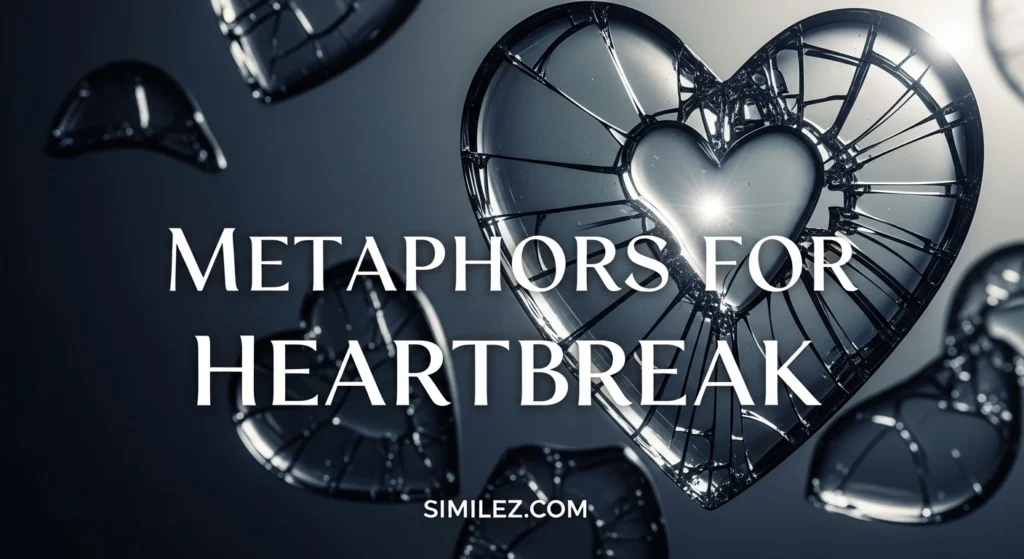
A widely used metaphor for heartbreak is broken glass. It captures suddenness, fragmentation, and irreversibility.
Meaning and Explanation
Broken glass represents a relationship or emotional bond that once felt solid but has now shattered into pieces. It suggests that even if you gather the fragments, the original form cannot be restored without visible damage.
Example Sentence
“After the breakup, her memories felt like broken glass scattered across the floor—beautiful once, but now dangerous to touch.”
Alternative Expressions
- Shattered mirror of the past
- Cracked emotional foundation
- Fragmented memories
Sensory and Emotional Details
Imagine the sound of glass breaking in a quiet kitchen at night. The sharpness, the stillness that follows, the fear of stepping forward. Heartbreak often feels like that moment frozen in time.
Mini Story
A man returns to the café where he first met his partner. The cups clink, people laugh, but inside him everything feels like shards under pressure. He realizes he is carefully walking through memories, afraid of being cut by what once made him happy.
Why This Metaphor Works
It conveys permanence. It tells us some emotional structures cannot return to their original shape. This helps readers accept closure rather than resist it.
The Empty House Metaphor: Silence After Love Leaves
Heartbreak is not always loud. Sometimes it is absence. The empty house metaphor captures this emotional void with striking clarity.
Meaning and Explanation
An empty house symbolizes a life once filled with presence, now reduced to silence and echo. It represents routine without meaning, and space without emotional warmth.
Example Sentence
“Coming home after the breakup felt like entering an empty house where even the walls remembered her voice.”
Alternative Expressions
- Hollow rooms of memory
- Silent emotional space
- Vacant inner world
Sensory and Emotional Details
You hear the refrigerator hum louder than usual. Doors close without meaning. Light falls differently in rooms that used to feel alive. The absence is not just emotional—it is architectural.
Mini Story
A woman continues making tea for two out of habit. She places both cups on the table, pauses, then silently removes one. The house does not protest, but it does not comfort her either.
Cultural Reference
In many literary traditions, especially modern Urdu and English poetry, empty rooms often symbolize lost companionship and unresolved longing. The house becomes a reflection of internal emotional architecture.
Why This Metaphor Works
It captures slow realization. Unlike broken glass, which is sudden, the empty house reflects gradual emotional awareness of loss.
The Storm Passing Metaphor: Emotional Turbulence and Recovery
Not all heartbreak metaphors focus on destruction. Some focus on transition. The storm metaphor represents emotional intensity followed by eventual calm.
Meaning and Explanation
Heartbreak is seen as a storm—violent, overwhelming, but temporary. It suggests that emotional chaos will eventually pass, leaving clarity behind.
Example Sentence
“The breakup hit like a storm, but she told herself even storms do not last forever.”
Alternative Expressions
- Emotional turbulence
- Thundercloud phase of grief
- Weathering emotional weather
Sensory and Emotional Details
Thunder inside the chest. Rain behind the eyes. Wind that shakes identity. Then, slowly, silence returns—not immediate peace, but absence of chaos.
Mini Story
A young student fails a relationship during exam season. Every night feels like rain hitting glass windows. Weeks later, he notices sunlight returning without effort. The storm did not ask permission to leave—it simply moved on.
Why This Metaphor Works
It introduces hope without denial. It validates pain but frames it as temporary, helping emotional regulation and resilience.
Cultural and Literary References to Heartbreak Metaphors
Across cultures, heartbreak is consistently described through physical imagery. In Urdu poetry, it often appears as burning, distance, or broken stars. In English literature, it is frequently rain, winter, or fractured objects.
Shakespeare described emotional suffering through illness and decay. Modern poets often lean toward urban imagery—empty streets, unread messages, silent phones.
These shared metaphors suggest a universal truth: human beings process emotional pain through physical analogy.
How Metaphors Shape Healing and Memory
Metaphors do not just describe heartbreak—they shape how it is remembered. If heartbreak is seen as destruction, recovery feels like rebuilding. If it is seen as weather, recovery feels like waiting.
This framing matters. It influences emotional recovery strategies:
- Destruction metaphors encourage reconstruction and closure.
- Weather metaphors encourage patience and endurance.
- Space metaphors (empty house) encourage acceptance and adjustment.
Thus, metaphors are not just language tools—they are cognitive frameworks.
Writing Your Own Heartbreak Metaphors (Interactive Exercises)
To create personal metaphors, start by identifying emotional texture rather than events.
Try this exercise:
- Write one sentence describing how heartbreak feels physically in your body.
- Replace emotional words with objects or environments.
- Refine until it reads like an image rather than explanation.
Example transformation: “I feel heavy and slow after the breakup.” becomes “My thoughts move like wet clothes hanging in winter wind.”
Another prompt:
- If your heartbreak were a place, what would it look like?
- If it were weather, what kind?
- If it were an object left behind, what would it be?
Write three versions. Compare which feels most accurate emotionally.
Using Heartbreak Metaphors in Poetry and Storytelling
Metaphors are powerful tools in creative writing because they compress emotional complexity into imagery.
In poetry, they create rhythm and emotional resonance. In storytelling, they reveal character psychology without exposition.
Instead of writing: “He was very sad after the breakup,”
you might write: “He carried silence like a second coat he could not take off.”
This form of expression allows readers to feel rather than simply understand.
Social Media Expression: Short Metaphors That Go Viral
Modern platforms reward brevity and emotional clarity. Short metaphors for heartbreak often perform well because they are instantly relatable.
Examples:
- “I am learning to live in rooms you no longer enter.”
- “My silence has your shape.”
- “We ended, but my habits did not get the memo.”
These expressions work because they compress emotional truth into shareable language. They also invite interpretation, which increases engagement.
Psychological Perspective on Heartbreak Imagery
From a psychological standpoint, metaphors help regulate emotional intensity. They externalize internal experience, allowing individuals to “observe” rather than fully absorb pain.
This is similar to narrative therapy, where individuals reframe life events as stories rather than raw emotional states.
Heartbreak metaphors also activate the brain’s visual processing centers, which can reduce emotional overwhelm and increase reflective thinking.
Turning Pain Into Creative Expression
Many artists, writers, and musicians convert heartbreak into structured creativity. This is not romanticizing pain; it is organizing it.
Metaphors are the raw material for this transformation. They allow emotional chaos to become rhythm, structure, and meaning.
A broken relationship becomes a narrative arc. An empty house becomes a setting. A storm becomes a song.
This process does not erase pain, but it changes its form.
Common Mistakes When Using Emotional Metaphors
While metaphors are powerful, they can lose impact if overused or mixed without clarity.
Common issues include:
- Mixing incompatible images (storm + machinery + architecture in one line)
- Over-explaining the metaphor instead of letting it stand
- Using clichés without personal variation
- Forcing emotional intensity rather than allowing subtlety
Effective metaphors are precise, not excessive.
Bonus Tips for Daily Life and Communication
Metaphors can improve not only writing but also emotional communication.
Practical uses:
- Journaling: describe daily emotional state as weather or landscape
- Conversations: use imagery to explain feelings without escalation
- Reflection: track emotional changes through recurring metaphors
Over time, you may notice consistent patterns in your imagery, which can reveal emotional processing stages.
Conclusion
Heartbreak is not only an emotional event—it is a linguistic challenge. The mind struggles to articulate what it feels, and metaphors become the bridge between silence and expression.
Broken glass shows us rupture. Empty houses show us absence. Storms show us transition. Together, they form a vocabulary for emotional experience that is both universal and deeply personal.
Learning to use these metaphors does not remove pain. It gives it shape. And once something has shape, it becomes easier to understand, share, and eventually transform.
Frequently Asked Questions
What are metaphors for heartbreak used for?
They help translate emotional pain into visual or symbolic language, making it easier to understand, express, and process complex feelings.
Why do writers use metaphors for emotional pain?
Because emotional experiences are abstract. Metaphors create imagery that allows readers to feel the experience rather than just read about it.
Can metaphors help in healing heartbreak?
Yes. They support emotional distancing and reflection, which can reduce overwhelm and improve emotional clarity.
Are heartbreak metaphors culturally universal?
Yes, although imagery varies. Some cultures use weather, others use objects, space, or nature, but the underlying emotional logic is shared.
How can I create my own metaphors for heartbreak?
Focus on physical sensations, environments, or objects that reflect your emotional state, then translate feelings into imagery.
If you want, I can also convert this into SEO blog format with keywords, meta description, and internal linking structure for publishing.