
There are moments in life when silence feels heavier than sound. A long night where thoughts echo louder than words, and the future seems blurred, like a road swallowed by fog.Yet even in such moments, something subtle persists a quiet resistance inside the human spirit.
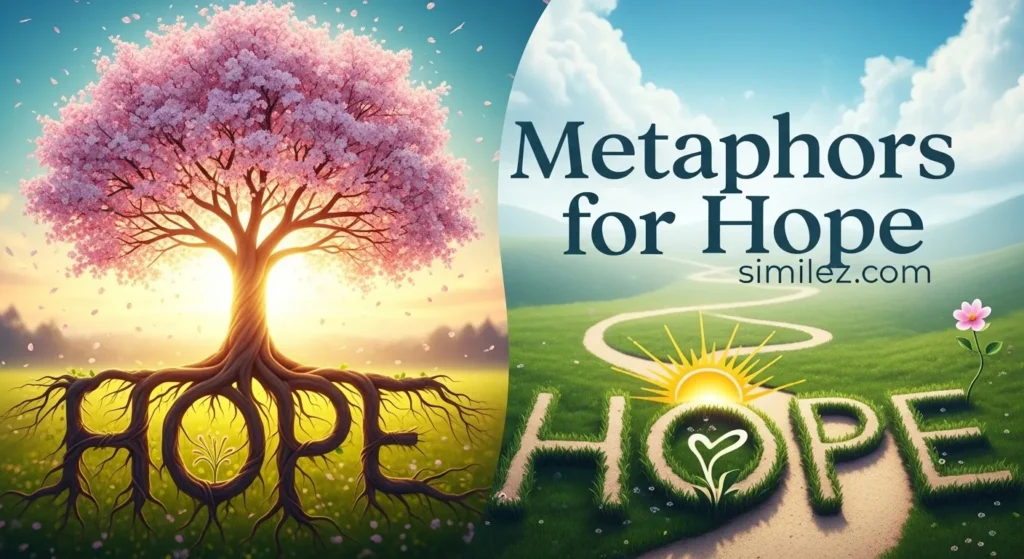
Hope is not always loud or dramatic. Often, it survives as imagery in our mind: a small flame in wind, a crack in a wall letting light pass through, or a seed buried deep in winter soil.These are metaphors for hope powerful symbolic expressions that help us understand, feel, and hold onto optimism when reality feels unstable.
Metaphors for hope matter because they translate an abstract emotion into something visible, tangible, and emotionally accessible. When words fail, imagery speaks. When logic weakens, symbolism sustains.
Understanding Metaphors for Hope in Literature and Life
Metaphors for hope are figurative expressions that compare hope to something concrete—light, nature, movement, or resilience.
In English literature, hope is often described as “light in darkness.” In Urdu poetic tradition, it is often expressed as “roshni ki kiran” or “subah ki pehli kiran,” emphasizing renewal and rebirth.
These metaphors are not decorative language only; they are cognitive tools. They shape how we process hardship, grief, uncertainty, and recovery.
In psychological terms, metaphors help the brain reframe emotional experiences. Instead of seeing failure as an endpoint, metaphor allows it to be seen as a “bend in the road.”
Why Metaphors for Hope Are Important in Emotional Resilience
Hope is not abstract comfort—it is a survival mechanism.
When individuals face trauma, financial instability, loss, or failure, literal explanations often fall short. Metaphors step in to bridge emotional gaps.
For example:
- Hope as a “bridge” implies transition, not permanence.
- Hope as a “seed” implies growth, not immediacy.
- Hope as a “lantern” implies guidance, not certainty.
In Urdu expression, “umeed ka chiragh” reflects how fragile yet essential hope can be.
Such metaphors:
- Reduce emotional overwhelm
- Encourage long-term thinking
- Strengthen resilience narratives
- Help in storytelling, therapy, and communication
Metaphor Hope as a Seed in the Soil
One of the most powerful metaphors for hope is the seed.
A seed looks inactive. It is buried, hidden, seemingly lifeless. Yet within it exists a full system of growth waiting for the right conditions.
Meaning and Explanation
Hope, like a seed, often requires time, patience, and invisible growth. Just because nothing is visible does not mean nothing is happening.
Example Sentence / Scenario
A student who repeatedly fails exams may feel defeated, but every study session is a seed planted for future success.
Alternative Expressions
- Hope is a hidden forest
- Hope is underground growth
- Hope is patient becoming
Sensory and Emotional Detail
Imagine soil after rain—dark, heavy, and quiet. Beneath it, life is stretching upward without being seen. This silence is not emptiness; it is preparation.
Mini Story
A farmer in a drought season continues to plant seeds despite uncertainty. Neighbors laugh, but he knows something they don’t: the earth remembers effort. When rain finally returns, his fields are the first to turn green.
Metaphor Hope as a Light in Darkness
Light is perhaps the most universal metaphor for hope across cultures and religions.
Meaning and Explanation
Hope does not eliminate darkness; it makes navigation possible within it.
Example Sentence Scenario
A person going through depression may not see full recovery immediately, but a single supportive conversation feels like a light turning on in a dark room.
Alternative Expressions
- Hope is a lantern in fog
- Hope is dawn before sunrise
- Hope is a candle against night wind
Sensory and Emotional Detail
Think of a dim room. You cannot see everything clearly, but a small flame creates a circle of visibility. That circle is enough to take the next step.
Cultural Reference
In many traditions, dawn symbolizes renewal. In Urdu poetry, “subah ka ujala” often represents divine mercy and emotional restart.
Mini Story
During a blackout in a small village, a child holds a lantern while searching for lost livestock. That small light does not remove darkness, but it prevents panic and guides action.
Hope as a Bridge Over Uncertainty
A bridge connects two points separated by distance or danger. It is not the destination; it is the passage.
Meaning and Explanation
Hope acts as a psychological bridge between current hardship and future possibility.
Example Sentence / Scenario
A migrant worker sending money home despite hardship is walking a bridge built of hope toward a better future for their family.
Alternative Expressions
- Hope is a pathway over chaos
- Hope is a crossing over broken ground
- Hope is a structure between now and tomorrow
Sensory and Emotional Detail
Imagine standing on a bridge during fog. You cannot see the other side, but the structure beneath your feet holds firm. Trust replaces visibility.
Mini Story
A patient undergoing long treatment believes recovery is uncertain. Each hospital visit becomes a step across a bridge—slow, repetitive, but directed toward life.
Mini Storytelling Hope in Everyday Struggles
A young teacher in a low-income school faces daily challenges: lack of resources, exhausted students, and uncertain outcomes. Yet she continues.
Why?
Because she sees her work as planting seeds, lighting candles, and building bridges all at once.
One of her students, once failing badly, later becomes the top performer in the district. Years later, he returns and says: “You were the light I could not see at the time.”
That is how metaphors for hope operate in real life—they are not just language; they become lived reality.
Cultural and Literary Perspectives on Hope
Across cultures, hope is never described in a single dimension.
- In English literature, it is often “the thing with feathers” (Emily Dickinson).
- In Urdu poetry, it appears as “umeed ka diya” or “subah-e-nau.”
- In Persian tradition, hope is linked with renewal after hardship.
- In modern storytelling, it becomes survival through adversity.
These metaphors reflect a universal truth: human beings need symbolic structures to endure uncertainty.
Using Metaphors for Hope in Writing and Communication
Writers use metaphors for hope to:
- Create emotional depth
- Build relatability
- Strengthen narrative imagery
Instead of saying “things will improve,” a writer may say:
- “The storm will pass.”
- “The soil is already preparing for spring.”
- “A light is waiting behind the clouds.”
This shift transforms plain statements into emotional experiences.
Social Media and Modern Expression of Hope
In digital communication, metaphors for hope are especially powerful because attention spans are short but emotions are strong.
Examples:
- “Still planting seeds.”
- “Holding onto light.”
- “Walking through fog, not blind—just patient.”
These expressions resonate because they compress deep emotional meaning into simple imagery.
Hope in Daily Life Practical Application
Metaphors are not just literary tools; they are mental frameworks.
When facing stress:
- Think of problems as storms (temporary, passing)
- Think of progress as planting seeds (gradual growth)
- Think of setbacks as fog (visibility issue, not direction loss)
This reframing changes emotional response patterns and improves decision-making.
Create Your Own Metaphor for Hope
Take a moment and complete these prompts:
- Hope is like ______ because ______
- In my current situation, hope feels like ______
- If hope had a sound, it would be ______
- If hope had a color, it would be ______
Write without overthinking. The goal is emotional honesty, not perfection.
Reframe a Difficult Experience
Choose a current challenge and rewrite it using metaphor:
- Instead of “I am stuck,” write: “I am in winter soil before spring.”
- Instead of “I am lost,” write: “I am in fog, not off the road.”
- Instead of “nothing is working,” write: “seeds are still underground.”
This exercise builds cognitive resilience through language restructuring.
Bonus Tips for Using Hope Metaphors Effectively
- Keep metaphors simple and relatable
- Avoid overly complex symbolism in emotional contexts
- Use nature-based imagery for universality
- Repeat metaphors consistently for stronger emotional framing
- Combine Urdu and English expressions for cultural depth
Example blend: “Umeed ka diya still burns inside the storm.”
Conclusion
Metaphors for hope are not literary decoration; they are emotional infrastructure. They help individuals interpret suffering, navigate uncertainty, and sustain psychological endurance.
Hope becomes manageable when it is seen as something concrete: a seed, a light, a bridge. These images do not deny difficulty—they make it survivable.In both language and life, what we choose to call hope determines how we carry it.
FAQs
H3: What are metaphors for hope in simple terms?
They are symbolic expressions that describe hope using familiar images like light, seeds, or bridges.
H3: Why are metaphors important for emotional strength?
They help people understand and manage difficult emotions by turning abstract feelings into visual ideas.
H3: Can metaphors for hope be used in daily conversation?
Yes. Simple phrases like “there is light ahead” or “this is just a phase” are common metaphorical expressions.
H3: How do writers use metaphors for hope effectively?
Writers use them to create emotional depth, connect with readers, and express complex feelings in relatable ways.
H3: What is the strongest metaphor for hope?
There is no single strongest metaphor; however, “light in darkness” is the most universally recognized across cultures.
If you want, I can convert this into a publish-ready blog format (SEO title tags, meta description, keyword clusters, and internal linking structure).