
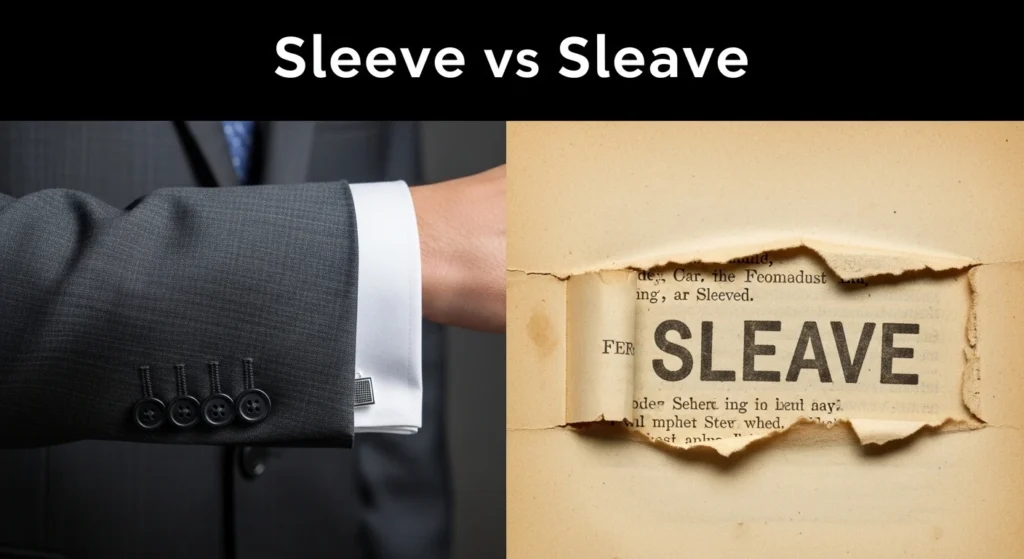
A small spelling difference can completely change meaning or erase meaning altogether. Imagine you are reading a fashion article describing a “long flowing sleeve,” but somewhere else you see “sleave of silk threads.”
At first glance, both words look almost identical, yet they belong to completely different worlds. One belongs to clothing, style, and everyday human life; the other belongs to old textile vocabulary that most modern readers have never even encountered.
This confusion between “sleeve” and “sleave” is more common than people think, especially for learners of English or even native speakers who rely on intuition rather than precision.
A single extra letter silently shifts a word from fashion design to historical fabric terminology. And that small shift can affect understanding in writing, exams, communication, and even professional contexts.
This article breaks down the two words in depth what they mean, where they come from, how they are used, and why people confuse them. You will also see real-life examples, memory techniques, and linguistic insights that make the difference crystal clear.
By the end, you will not only distinguish “sleeve” vs “sleave” confidently, but also understand how language evolves in subtle yet powerful ways.
H2: Basic Meaning of Sleeve vs Sleave
At the most fundamental level, the difference is simple but important.
Sleeve is a very common modern English word. It refers to the part of a shirt, coat, or dress that covers the arm. For example: “This shirt has long sleeves.” In Urdu, we usually say “baazu” ya “aasteen”.
On the other hand, sleave is rare and mostly archaic. It refers to untwisted silk or a loose, tangled mass of thread. It is not used in everyday conversation and mostly appears in historical or literary contexts.
H3: Everyday Usage vs Rare Usage
- Sleeve → Everyday clothing, fashion, uniforms, jackets
- Sleave → Old textile term, rarely used today
In practical terms, if you are writing emails, essays, legal documents, or content, you will almost always need “sleeve” and not “sleave.”
This difference matters because one is active language, while the other is dormant language. In Urdu terms: “Sleeve zinda lafz hai, jabke sleave purana aur kam istemal hone wala lafz hai.”
H2: Etymology and Language Roots
Understanding where words come from helps remove confusion.
Sleeve originates from Old English “slyfe” or “slēf”, related to garments covering the arm. Over time, spelling standardized into “sleeve.” It became part of everyday clothing vocabulary as tailoring and fashion evolved.
Sleave, however, comes from Old English “slefan” or related textile terminology. It referred to loose silk fibers that were not yet spun into thread. This word gradually faded as textile terminology modernized.
H3: Why Two Similar Words Exist
Historically, English had many regional dialects. Words were spelled differently before standard dictionaries existed. Over centuries:
- “Sleeve” became standardized in fashion language
- “Sleave” survived only in specialized historical writing
So the similarity is not coincidence—it is linguistic evolution splitting two separate meanings.
In simple Urdu explanation: “Dono lafz purani English se aaye hain, lekin waqt ke sath ek modern ban gaya aur doosra almost khatam ho gaya.”
H2: Sleeve in Fashion and Daily Life
The word “sleeve” is deeply connected to clothing and human expression. Every shirt, kurta, coat, or uniform uses sleeves as a basic structural element.
Sleeves are not just functional—they are cultural. In different societies, sleeve styles represent tradition, identity, and even status.
H3: Functional Role of Sleeves
Sleeves protect arms from:
- Sunlight
- Cold weather
- Dust or environment
They also contribute to comfort and mobility.
H3: Fashion and Style Dimension
Sleeves define fashion aesthetics:
- Full sleeves → formal, traditional
- Half sleeves → casual and practical
- Bell sleeves → decorative and artistic
In Urdu fashion descriptions, we often hear: “lambi aasteen elegant lagti hai” or “short sleeve shirt casual hoti hai.”
So “sleeve” is not just a word—it is a design element that affects how we present ourselves.
H2: Sleave as a Forgotten Textile Term
Unlike sleeve, sleave belongs to an older world—early textile production.
It referred to loose, unspun silk fibers. These fibers were not yet organized into strong thread, meaning they were raw and fragile.
H3: Industrial Context
In ancient textile practices:
- Silk was processed in stages
- Raw fibers (sleave) were cleaned and aligned
- Then spun into usable thread
This word reflects early craftsmanship, where fabric-making was manual and labor-intensive.
H3: Why It Disappeared
Modern textile terminology replaced “sleave” with more technical terms like:
- fiber
- filament
- raw silk
So today, even textile professionals rarely encounter “sleave.”
In Urdu understanding: “Sleave ek purani textile term hai jo ab modern industry mein use nahi hoti.”
H2: Pronunciation Confusion Between Sleeve and Sleave
One reason people mix these words is pronunciation similarity.
Both are pronounced almost identically:
- Sleeve → /sliːv/
- Sleave → /sliːv/ (same sound in many accents)
This makes them homophones in spoken English.
H3: Why Sound Creates Confusion
When words sound identical:
- Learners rely on spelling guesswork
- Writing errors increase
- Context becomes essential for meaning
For example, if someone says: “He repaired the sleeve of silk,” context is needed to understand whether it refers to clothing or textile fibers.
H3: Urdu Learner Challenge
For Urdu speakers, both may sound like “aasteen” in everyday context, so the distinction becomes purely academic.
H2: Common Mistakes in Writing and Exams
Many learners mistakenly write “sleave” instead of “sleeve” due to spelling uncertainty.
H3: Why Mistakes Happen
- Similar pronunciation
- Lack of exposure to rare word forms
- Overgeneralization of spelling patterns
- Typing errors
H3: Academic Consequences
In exams or professional writing:
- “Sleeve” mistake is minor but noticeable
- “Sleave” misuse can look like vocabulary confusion
- Marks may be deducted in language tests
In legal or professional drafting (important for clarity), incorrect spelling can reduce credibility.
Simple rule: If you mean clothing, always use “sleeve.”
H2: Real-Life Communication Confusion
Language confusion is not just theoretical—it happens in real communication.
Imagine:
A tailor writes: “I will fix the sleave of your shirt.”
The client may pause and think: what is sleave?
Or a student writes in essay: “The sleave of the jacket was torn.”
This creates unnecessary doubt.
H3: Workplace Example
In professional environments:
- Fashion designers must use correct spelling
- Textile engineers may rarely encounter “sleave”
- Communication clarity depends on precision
H3: Everyday Misunderstanding
In casual conversation, most people will not notice the difference, but in writing it becomes obvious.
H2: Evolution of English and Word Survival
Languages evolve like living systems.
“Sleeve” survived because it is actively used. “Sleave” faded because its function disappeared from daily life.
H3: Survival of Useful Words
Words survive when:
- They are frequently used
- They adapt to modern life
- They remain culturally relevant
H3: Death of Rare Words
Words disappear when:
- Industry changes
- Technology replaces old concepts
- Simpler alternatives take over
Urdu analogy: “Jo lafz zindagi mein use hotay hain woh bach jate hain, jo nahi hotay woh purani kitaabon mein reh jate hain.”
H2: Memory Tricks to Never Confuse Sleeve and Sleave
To permanently avoid confusion, use simple mental tricks.
H3: Trick 1 — Clothing Rule
“Sleeve has double ‘e’ like ‘tee-shirt sleeves’.”
More letters = modern clothing usage.
H3: Trick 2 — Ignore Sleave in Daily Life
Think: “If I never wear it, I don’t need it.”
Since “sleave” is not used in modern communication, you can safely deprioritize it.
H3: Trick 3 — Association Method
- Sleeve → shirt → arm → everyday
- Sleave → silk → ancient → museum
This mental mapping makes recall automatic.
H2: Literary and Historical Usage Insights
“Sleave” appears in older English literature and poetry. It is often used to describe delicate textures or poetic imagery of silk threads.
H3: Symbolic Meaning in Literature
In literature:
- Sleave = fragility, softness, entanglement
- Sleeve = identity, clothing, human presence
Writers used such words to create imagery.
H3: Modern Literary Decline
Modern writers avoid “sleave” because:
- Readers may not understand it
- Simpler alternatives exist
- It feels archaic
H2: Educational Importance for ESL Learners
For English learners, especially Urdu speakers, this distinction is a useful lesson in precision.
H3: Language Learning Insight
Key takeaway:
- Do not rely only on sound
- Always confirm spelling and meaning
- Context determines correctness
H3: Practical Advice
When unsure:
- Use dictionary check
- Prefer common usage words
- Avoid rare archaic terms unless required
In Urdu guidance: “English seekhnay mein sirf sunna nahi, likhna aur verify karna bhi zaroori hai.”
H2: Quick Comparison Without Confusion
To summarize conceptually:
- Sleeve = modern, functional, clothing-related
- Sleave = historical, textile-related, rarely used
One belongs to everyday life; the other belongs to linguistic history.
Conclusion
The difference between “sleeve” and “sleave” may look like a small spelling detail, but it reflects something much larger: how language evolves, simplifies, and adapts to human use. “Sleeve” lives in our daily wardrobes, conversations, and fashion choices.
Sleave,” on the other hand, exists mostly in historical memory, describing a textile world that no longer defines modern life.
Understanding this distinction is not just about vocabulary it is about precision in communication. When you write or speak correctly, you avoid confusion and strengthen clarity.
In practical terms, “sleeve” is the word you will almost always need, while “sleave” is something you may only encounter in old texts or linguistic study.
Language rewards accuracy. And once you internalize this difference, you will never confuse them again.