
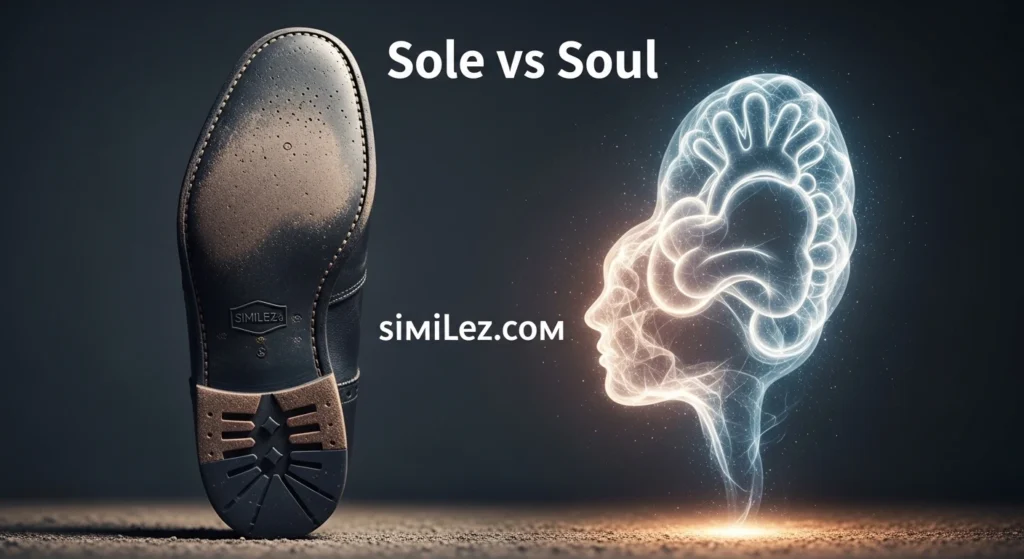
You’re walking through a crowded street. A signboard flashes “Sole Comfort Shoes,” while a nearby café plays a song about “searching for the soul.” Your brain barely notices the difference both words sound identical, yet they carry completely different worlds inside them.
One belongs to the physical ground beneath your feet, the other to something invisible that moves your emotions.
This is the strange beauty of language: a single sound can split into entirely different meanings depending on context. “Sole” and “soul” are classic examples of this confusion.
One small vowel shift separates the physical from the spiritual, the measurable from the meaningful.
Understanding the difference is not just about spelling it’s about clarity in communication, deeper awareness of language, and even a reflection of how humans separate body and inner essence.
In everyday writing, speech, law, literature, and emotional expression, these two words often get mixed, leading to misunderstandings that are sometimes humorous and sometimes significant.
This article breaks them down in depth so you never confuse them agai and more importantly, so you understand what each one represents in human experience.
1. Meaning of Sole vs Soul: The Core Distinction
At the most basic level, “sole” and “soul” are homophones—words that sound the same but differ in meaning and spelling.
“Sole” refers to something physical or singular. It can mean the bottom of a foot, the bottom part of a shoe, or something alone or exclusive. It belongs to the material, measurable world.
“Soul,” on the other hand, refers to the non-physical essence of a person. It is associated with emotions, consciousness, identity, and spirituality. It is the inner self that cannot be seen but is deeply felt.
To understand the distinction simply: “sole” is what supports you physically when you walk, while “soul” is what defines you internally when you feel, think, and reflect.
In daily communication, confusion between these words can change meaning entirely. Writing “my sole hurts” is correct if you mean your foot, but “my soul hurts” expresses emotional pain. One is medical or physical; the other is psychological or spiritual.
The difference is small in spelling but massive in interpretation, making this pair one of the most important examples of precision in English vocabulary.
2. Linguistic Roots and Why Confusion Exists
The confusion between “sole” and “soul” is not accidental—it comes from the evolution of English pronunciation and spelling inconsistencies.
English is a language built from Latin, French, and Germanic roots. Over centuries, pronunciation evolved faster than spelling, leaving behind words that sound identical but are written differently. “Sole” comes from Old French “sole” (foot bottom or single), while “soul” traces back to Old English “sāwol,” meaning spirit or life essence.
Phonetically, both words converge into the same modern pronunciation /soʊl/, which creates natural confusion for learners and even native speakers.
Why the Brain Mixes Them
- They are homophones
- Context often changes quickly in speech
- Visual spelling differences are subtle
- Both words are short and simple
In spoken English, no one can distinguish them without context. That is why misunderstanding often happens in writing when people rely on sound instead of meaning.
From a linguistic perspective, this is a perfect example of how English prioritizes usage over consistency. The language evolves organically rather than logically, which makes mastering such pairs essential for clarity.
3. “Sole” in Physical Meaning: Footwear, Anatomy, and Beyond
The most common use of “sole” is physical. It refers to the bottom part of a foot or shoe—the surface that directly interacts with the ground.
H3: Sole of the Foot
The sole of the foot is structurally designed to absorb pressure, balance body weight, and provide stability. Without it functioning properly, walking becomes painful or impossible.
H3: Sole of a Shoe
In footwear, the sole is the foundation layer. It determines comfort, durability, and grip. Shoes are often judged by the quality of their soles more than their appearance.
H3: Sole as “Only”
“Sole” also means singular or exclusive, such as “sole owner” or “sole responsibility.” Here, it shifts from physical anatomy to legal and formal language.
This dual meaning makes “sole” versatile but also context-sensitive. In legal documents, for example, “sole custody” has a precise meaning that cannot be misinterpreted.
In everyday life, “sole” remains grounded in practicality—it is about structure, support, and physical reality. Unlike “soul,” it does not deal with emotions or identity but with tangible existence.
4. “Soul” as Inner Essence: Emotion, Identity, and Consciousness
“Soul” represents the invisible core of human experience. It is often described as the seat of emotions, morality, and identity.
Philosophically, the soul is what makes a person “alive” beyond biological function. It is the reason we feel joy, grief, love, and longing.
H3: Emotional Depth
When someone says “my soul is tired,” they are not talking about physical exhaustion but emotional depletion. It reflects deep psychological states.
H3: Identity and Self
The soul is often associated with individuality—what makes each person unique beyond appearance or behavior.
H3: Spiritual Interpretation
In many traditions, the soul is considered eternal, transcending physical death. It connects human life to something greater than material existence.
Unlike “sole,” which is measurable, “soul” is abstract. You cannot touch it, weigh it, or photograph it, yet it shapes human decisions, relationships, and meaning.
This is why literature, music, and philosophy frequently revolve around the concept of the soul—it represents what cannot be physically defined but emotionally understood.
5. Everyday Confusion: Real-Life Misinterpretations
The similarity in pronunciation leads to frequent misunderstandings in daily communication.
Example 1: Text Messages
Someone writes: “My sole is broken.” This could be mistaken as emotional distress when they actually mean their shoe sole.
Example 2: Workplace Communication
A report mentioning “sole responsibility” might be misread if context is unclear, especially for non-native speakers.
Example 3: Social Media Posts
Phrases like “soul healing journey” and “sole healing shoes” can easily be confused if skimmed quickly.
These errors highlight how context is everything. In spoken language, listeners rely on surrounding words. In written communication, spelling becomes crucial.
In professional settings, such confusion can affect clarity, especially in legal, medical, or academic writing. Precision is not optional—it is necessary.
Understanding this distinction reduces miscommunication and improves both writing and comprehension.
6. Language Mistakes and Their Impact on Communication
Mixing “sole” and “soul” may seem minor, but in certain contexts it can completely alter meaning.
In legal writing, “sole authority” defines exclusive rights. Miswriting it could lead to ambiguity in contracts. In emotional writing, confusing “soul” with “sole” weakens expression and may confuse readers about intent.
Why It Matters
- Legal clarity depends on precision
- Academic writing demands accuracy
- Emotional expression relies on correct word choice
Language is not just communication—it is interpretation. A single letter can shift meaning from physical to emotional, from literal to symbolic.
In professional environments, such mistakes may reduce credibility. In creative writing, they may disrupt emotional impact.
Thus, understanding and correctly using these words is not about grammar alone—it is about preserving meaning integrity.
7. “Sole” in Idioms and Expressions
“Sole” appears in several fixed expressions that emphasize uniqueness or physical grounding.
Common Uses
- Sole survivor: the only person remaining after an event
- Sole purpose: the only reason something exists
- Sole responsibility: full ownership of duty
These expressions reinforce exclusivity. “Sole” here removes competition or plurality—it defines something as singular.
Interestingly, “sole” rarely carries emotional weight. It is functional and structural. Whether in law, business, or daily speech, it reinforces clarity and exclusivity rather than feeling or imagination.
This makes it linguistically stable compared to “soul,” which varies widely in emotional and philosophical interpretation.
8. “Soul” in Literature, Music, and Emotional Expression
“Soul” is deeply embedded in artistic expression. Writers, poets, and musicians use it to convey emotional depth.
It represents longing, love, pain, and transcendence. In literature, characters often “bare their soul,” meaning they reveal their deepest emotions.
In music, especially genres like soul music, the term reflects emotional authenticity and raw expression.
Why Artists Use “Soul”
- It conveys depth beyond words
- It connects with universal human emotions
- It transcends cultural boundaries
Unlike “sole,” which remains literal, “soul” is metaphorical. It allows expression of what cannot be physically described.
This is why it remains one of the most powerful words in human language—it gives voice to the invisible parts of human experience.
9. Psychological Interpretation: Body vs Inner Self
From a psychological perspective, “sole” and “soul” can be interpreted as two layers of human existence.
“Sole” represents the physical body—the part that interacts with the external world. “Soul” represents the internal self—the part that processes emotion, memory, and identity.
Dual Structure of Human Experience
- Physical layer: movement, sensation, survival
- Emotional layer: meaning, attachment, consciousness
When people say they feel “disconnected,” it often means a gap between these two layers. They may function physically (sole) but feel emotionally detached (soul).
Psychology often explores this balance. Mental well-being depends on alignment between physical actions and inner emotional state.
This conceptual separation helps explain why humans seek meaning beyond survival—we are not just physical beings but emotional and reflective ones.
10. Cultural and Philosophical Perspectives
Different cultures interpret “soul” in unique ways. Some see it as immortal, others as symbolic of consciousness.
In Eastern philosophy, the soul is often linked to karma and rebirth. In Western thought, it is associated with individuality and moral essence.
“Sole,” however, remains culturally neutral. It is practical and universal, used across languages without deep philosophical variation.
Key Contrast
- Soul: metaphysical, spiritual, emotional
- Sole: physical, practical, structural
This contrast reflects how humans separate material reality from meaning-making systems. One belongs to science and structure; the other to belief and interpretation.
Together, they represent the duality of human understanding—body and essence, matter and meaning.
11. Real-Life Scenarios: Stories That Clarify the Difference
Imagine a student saying, “My sole is exhausted after running.” This refers to physical pain in the foot.
Now imagine the same student saying, “My soul is exhausted after exams.” This reflects emotional burnout.
Scenario Comparison
- Sole pain: physical injury, treatable with rest or care
- Soul pain: emotional stress, requiring reflection or support
In relationships, someone might say, “You touched my soul,” meaning emotional impact, not physical interaction.
These scenarios show how context determines meaning. Without context, interpretation becomes uncertain.
Understanding this distinction improves communication in relationships, education, and professional environments. It prevents misreading intentions and enhances emotional intelligence.
12. Lessons from the Distinction: Clarity in Thought and Language
The difference between “sole” and “soul” teaches more than vocabulary—it teaches precision in thinking.
Clear language reflects clear thought. Confusing words leads to confused communication, which affects relationships, decisions, and understanding.
Key Lessons
- Context is essential in communication
- Small spelling changes can shift meaning entirely
- Emotional and physical concepts must be distinguished clearly
In a broader sense, this distinction reminds us that humans live in two worlds simultaneously: the physical world we walk on and the emotional world we carry within.
Mastering such differences improves not just language skills but also awareness of how meaning is constructed.
13. Final Synthesis: Body and Essence in One Language System
“Sole” and “soul” represent two extremes of human existence—one grounded in physical reality, the other in inner experience. Yet both are necessary to understand how language mirrors life itself.
The sole supports movement, stability, and interaction with the world. The soul represents identity, emotion, and meaning. One cannot function meaningfully without the other in human experience.
Together, they show how language encodes both material and immaterial aspects of life. Understanding them is not just about spelling accuracy—it is about recognizing how deeply words shape perception.
In the end, mastering “sole vs soul” is less about grammar and more about awareness: knowing when we speak of the body and when we speak of the essence behind it.
Conclusion
The distinction between “sole” and “soul” may appear minor, but it reveals something far larger about language and human understanding. One word anchors us to the physical world feet on the ground, structure, function.
The other lifts us into the unseen realm of emotion, identity, and meaning. Confusing them can distort communication, but understanding them deepens clarity in thought and expression.
Language is not just a tool; it is a reflection of how we divide reality into tangible and intangible experiences. Recognizing this difference sharpens both writing and awareness. In everyday life, precision in words leads to precision in meaning and ultimately, clearer human connection.