
A man stands in the rain outside a closed office door. Papers in his hand are damp, ink bleeding slightly into unreadable blur. Inside, someone has already said “no.” Outside, the world continues as if nothing important has happened.
This is failure not always dramatic, rarely cinematic, often quiet. And yet, human beings rarely understand failure in raw form. We translate it. We reshape it into language that makes it bearable.
Failure is not just an event. It is an interpretation. When we say “I hit a wall,” or “I fell short,” or “everything collapsed,” we are not describing reality literally we are constructing meaning.
Understanding metaphors for failure is useful because language does not just describe experience; it shapes how we recover from it. The metaphor you choose can either trap you in shame or guide you toward rebuilding.
Emotional Landscape: How Failure Feels Before It Speaks
Before language forms, failure is physical.
It sits in the chest like a heavy object. It alters posture. It makes rooms feel slightly smaller. Time becomes slower, almost sticky.
In Urdu expression, people sometimes say: “dil pe bojh hai”—there is a weight on the heart. This is not poetic exaggeration; it is psychological accuracy expressed through metaphor.
Failure begins as sensation, not sentence. Only later do we wrap it in language so we can survive it.
Why Metaphors for Failure Matter in Thinking and Writing
Metaphors are not decoration. They are cognitive tools.
When you call failure “the end,” your mind stops exploring. When you call it “feedback,” your mind continues. This is not positivity—it is structure.
Writers, lawyers, negotiators, and leaders all rely on metaphorical framing. A case is not just lost or won; it is “built,” “weakened,” “dismantled,” or “tested.”
Metaphors for failure matter because they determine whether a setback becomes a verdict or a lesson.
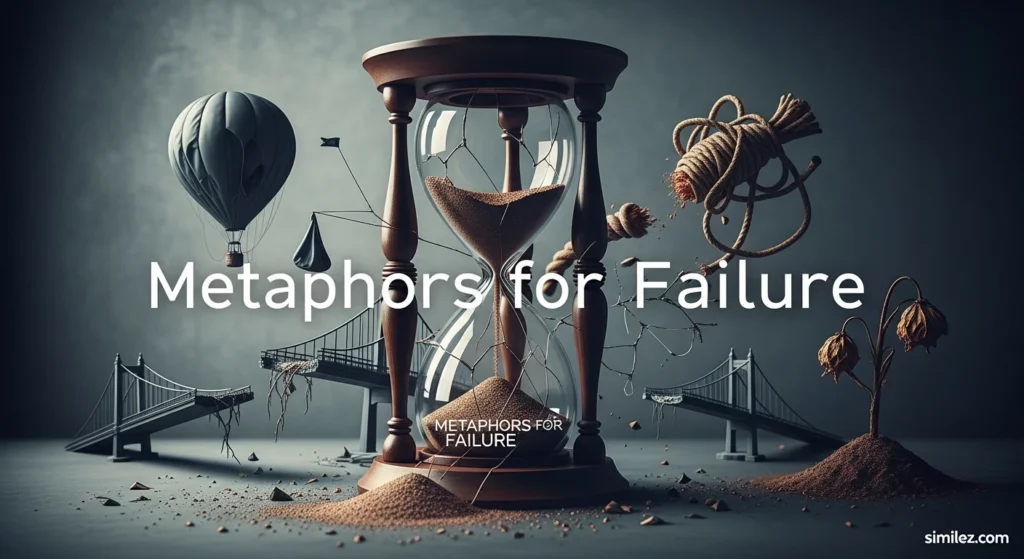
The Broken Bridge: Metaphor for Interrupted Progress
A bridge connects two points. When it breaks, the journey does not end—it becomes impossible in its current form.
Failure as a broken bridge means progress has been interrupted, not erased.
Meaning:
- Something you relied on no longer holds
- The path forward requires reconstruction, not retreat
Example sentence: “The partnership failed, not because the destination was wrong, but because the bridge between trust and execution collapsed.”
Alternative expressions:
- “Structural breakdown”
- “Connection failure”
- “Interrupted pathway”
Sensory/emotional layer: You can almost hear the hollow echo of footsteps stopping mid-crossing.
This metaphor is powerful in professional contexts, especially when discussing projects, careers, or relationships.
The Seed in Dark Soil: Metaphor for Latent Growth
Not all failure is visible decay. Some failure is burial.
A seed placed in soil looks inactive. It appears gone. Yet underground, unseen processes begin.
Meaning: Failure can be a necessary concealment stage for transformation.
Example sentence: “What looked like rejection was actually a seed placed in the dark soil of preparation.”
Alternative expressions:
- “Hidden incubation”
- “Silent growth phase”
- “Unseen development cycle”
Sensory/emotional layer: Stillness, darkness, damp earth, quiet pressure of something becoming.
Mini cultural reference: Many Sufi traditions describe hardship as purification—“imtehan se nikharta hai insaan” (a person is refined through trials).
This metaphor reframes failure as potential energy, not final loss.
The Cracked Mirror: Metaphor for Fragmented Identity
A mirror reflects identity. When it cracks, the reflection is not destroyed—it is fragmented.
Meaning: Failure can distort self-perception without eliminating self-worth.
Example sentence: “After the failed exam, he no longer saw himself clearly; it was as if the mirror of confidence had cracked into uneven pieces.”
Alternative expressions:
- “Fragmented self-image”
- “Distorted reflection”
- “Broken self-narrative”
Sensory/emotional layer: Light splitting unevenly, distorted faces, uncomfortable recognition.
This metaphor is particularly relevant in personal failure—academic, emotional, or identity-based setbacks.
Literary and Cultural References to Failure Metaphors
Literature has always treated failure as symbolic architecture.
In Shakespearean tragedies, failure is often a “fall”—not just from status, but from internal balance. In Eastern storytelling, failure is frequently cyclical, part of karma or growth cycles.
Modern cinema often frames failure as “burnout,” “system crash,” or “fall from grace.”
Across cultures, the same truth appears: Failure is rarely just an ending. It is a transformation point.
Even in everyday Urdu storytelling, phrases like “kismat ne saath nahi diya” (fate did not support) externalize failure to make it emotionally survivable.
Mini Storytelling: A Life Rewritten After Collapse
A young lawyer prepares for the most important case of his career. Weeks of research, sleepless nights, arguments rehearsed in empty rooms.
He loses.
The judgment is brief. No dramatic language. Just finality.
For weeks, he avoids conversations. Friends call it “setback,” but that word feels too soft, too incomplete.
Then, slowly, he reframes it. Not as collapse—but as redirection. Not as dead end—but as broken bridge requiring a new route.
Two years later, he argues a stronger case in a higher court. The earlier failure is not erased. It is integrated.
Failure did not end the story. It edited the structure.
Rewriting Your Failure Narrative
Take one personal setback and describe it using three different metaphors:
- As a physical structure (bridge, wall, road, building)
- As a natural process (storm, seed, erosion, fire)
- As a technological system (glitch, shutdown, reboot)
Then answer:
- Which version feels most emotionally accurate?
- Which version gives you forward motion instead of stagnation?
This exercise trains cognitive flexibility. You are not changing facts—you are changing interpretation architecture.
Metaphor Journaling Practice
Write a short paragraph daily beginning with:
“Today my failure feels like…”
Do not correct it. Do not filter it.
Examples:
- “a door that keeps closing softly”
- “a script missing its final page”
- “a train that changed tracks without warning”
Over time, patterns emerge. You begin to see how your mind constructs meaning under pressure.
This is emotional data, not just writing practice.
Common Mistakes in Using Failure Metaphors
One common error is over-romanticizing failure.
Not all failure is growth. Some of it is simply loss that must be acknowledged without immediate transformation narrative.
Another mistake is using metaphors that permanently imprison meaning:
- “I am finished”
- “This is the end of everything”
Such framing eliminates agency.
A balanced metaphor acknowledges pain without freezing identity. Language should carry you forward, not bury you in interpretation.
How to Create Your Own Metaphors for Failure
Effective metaphors come from observation, not invention.
Look at:
- Physical environments (roads, buildings, weather)
- Daily objects (phones, mirrors, machines)
- Natural cycles (seasons, decay, growth)
Then map emotional experience onto them.
Ask:
- What does this failure resemble in motion?
- Is it sudden or gradual?
- Is it reversible or structural?
Good metaphors are not dramatic—they are precise.
Bonus Tips for Writers, Social Media, and Daily Use
For writers: Use metaphors consistently throughout a narrative. Do not switch frameworks randomly; coherence builds emotional depth.
For social media: Short metaphors perform better than explanations:
- “Not a collapse. A recalibration.”
- “Broken bridge, not broken future.”
For daily life: Be conscious of your internal language. You are always narrating yourself, even silently.
Your vocabulary becomes your emotional environment.
FAQs
What are metaphors for failure?
They are figurative expressions that describe failure in symbolic terms rather than literal definitions.
Why do we use metaphors for failure?
Because raw failure is emotionally difficult to process; metaphor gives structure and meaning.
Can metaphors change how we handle failure?
Yes. Cognitive framing directly affects resilience and decision-making.
Are negative metaphors harmful?
If they permanently define identity or eliminate agency, they can reinforce stagnation.
How can I improve my use of metaphors?
By observing real-world systems and mapping emotional experiences onto them consistently.
Conclusion
Failure is not a single definition. It is a shifting narrative built through language.
A broken bridge can be rebuilt. A seed can remain unseen and still grow. A cracked mirror can still reflect truth, even if fragmented.
What matters is not whether failure occurs—it inevitably does—but how it is described afterward.
Because the metaphor you choose becomes the path you walk next.