
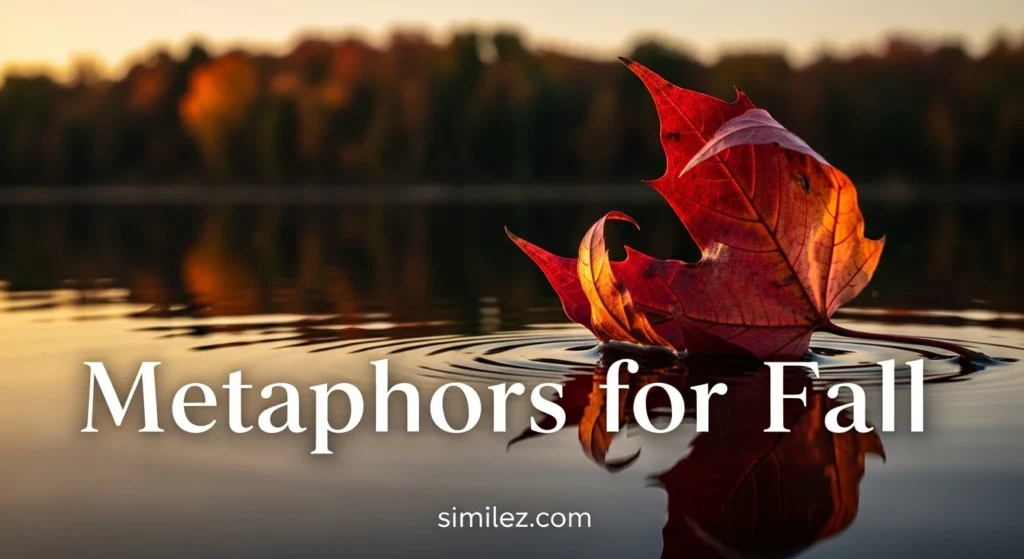
There is a moment in autumn when the world feels like it is quietly exhaling. Leaves loosen their grip on branches not with drama, but with certainty. Streets become layered in amber, gold, and rust like time itself has decided to slow down and show its texture.
You walk through a park, and every step sounds like paper being crumpled gently beneath your feet.
The air carries a faint chill, not sharp enough to hurt, just enough to remind you that change has arrived. Somewhere in that sensory shift lies the emotional power of fall metaphors language that turns a season into meaning.
Metaphors for fall are not just poetic ornaments. They are cognitive tools that help us interpret transition, aging, beauty, and endings.
Writers, poets, marketers, and storytellers use them to give emotional depth to otherwise ordinary descriptions. This article explores how fall becomes language, symbol, and story.
What Are Metaphors for Fall? Understanding Seasonal Symbolism
Metaphors for fall are figurative expressions that compare autumn to ideas beyond the literal season. Instead of describing falling leaves as a natural process, we might say “the trees are letting go of their memories.” This transforms observation into meaning.
In Urdu literary tradition, autumn is often associated with melancholy and reflection—“khizaan” becomes a symbol of emotional and existential transition. In English literature, fall often represents maturity, closure, or quiet beauty.
At its core, a fall metaphor connects nature with human experience: aging, endings, wisdom, and release.
Why Fall Metaphors Matter in Writing and Communication
Fall metaphors matter because they compress complex emotional states into relatable imagery. Instead of explaining sadness, loss, or transformation, writers can show it.
For example:
- Saying “life entered its autumn” immediately signals a stage of reflection or decline.
- It allows readers to feel before they analyze.
In communication, metaphors shape perception. A business might describe a “fall season reset” instead of “end-of-quarter restructuring.” A poet might describe heartbreak as “trees shedding trust.”
Language becomes more than description—it becomes experience.
Autumn as a Dying Flame (Fading Fire of Life)
One of the most powerful fall metaphors is autumn as a dying flame. The idea suggests that summer is a roaring fire, while fall is the final glow of embers—still warm, but slowing down.
Meaning/Explanation: This metaphor represents decline, aging, or the winding down of intensity. It is not violent; it is gradual and dignified.
Example sentence: “Her youth was a bright fire, but autumn had turned it into a steady, thoughtful glow.”
Alternative expressions:
- “The fire of summer softens into autumn embers.”
- “A life cooling into its golden dusk.”
- “Flames of passion settling into ash and warmth.”
Sensory/Emotional detail: Imagine sitting near a fireplace after midnight. The crackle is gone. Only soft red light remains. That quiet warmth is autumn in emotional form.
Mini storytelling: An old painter in a small European town no longer paints bold landscapes. Instead, he paints sunsets that look like memories. Critics say his work has entered its autumn phase. He smiles—because he knows fire does not vanish; it simply learns to rest.
Fall as a Falling Curtain (Theater of Endings)
Fall can also be imagined as a curtain slowly descending at the end of a play.
Meaning/Explanation: This metaphor frames autumn as closure, completion, or the final act of a cycle.
Example sentence: “As October arrived, it felt like the curtain of the year was gently closing.”
Alternative expressions:
- “The stage of summer dims into autumn’s final act.”
- “Nature lowers its curtain in silence.”
- “The year bows out in golden light.”
Sensory/Emotional detail: Think of theater lights fading, applause softening, and actors stepping off stage. There is no sadness—only completion.
Mini storytelling: In an ancient Japanese Noh theater, performances end with a slow exit, no abrupt endings. Similarly, autumn does not shout its departure; it withdraws. Trees stand like actors after the final bow.
Autumn as a Golden Archive (Library of Memories)
Another rich metaphor is autumn as a golden archive or library storing memories of the year.
Meaning/Explanation: This represents reflection, memory consolidation, and wisdom. Leaves become pages; trees become books.
Example sentence: “Each falling leaf felt like a page returning to the archive of time.”
Alternative expressions:
- “Autumn shelves the year in gold-bound volumes.”
- “Nature’s library opens its memory section.”
- “The forest becomes a living manuscript.”
Sensory/Emotional detail: Picture walking through a forest where every leaf carries a story. The crunch underfoot feels like reading forgotten chapters.
Cultural reference: In Persian poetry, seasonal change often symbolizes divine remembrance and reflection. Autumn becomes a moment when nature “recalls itself.”
Sensory Language of Fall: How the Season Feels in Words
Fall metaphors often rely on sensory language: sight, sound, smell, and touch.
- Sight: amber light, copper leaves, misty mornings
- Sound: rustling leaves, distant wind, softened silence
- Smell: earth, wood smoke, rain-soaked soil
- Touch: crisp air, cool breeze, dry leaves
When combined, these sensations create immersive metaphors like “the air turned into thin glass” or “the sky wore a faded shawl.”
Emotional Symbolism of Autumn in Human Experience
Autumn often symbolizes maturity, reflection, and acceptance. Unlike spring’s beginnings or summer’s intensity, fall is introspective.
It mirrors:
- Midlife reflection
- Endings of relationships
- Completion of cycles
- Acceptance of change
In psychological terms, autumn metaphors align with cognitive processing of loss and transition. They make emotional complexity easier to articulate.
Cultural and Literary References of Fall Imagery
From Shakespeare to Rumi, autumn imagery has been deeply symbolic.
- In Western literature, autumn often represents aging and wisdom.
- In Urdu poetry, “khizaan” carries emotional weight tied to separation and longing.
- In Japanese aesthetics, autumn reflects impermanence (mono no aware).
Writers across cultures use fall not just as a season but as emotional architecture.
Fall Metaphors in Poetry and Prose
Poetry thrives on fall imagery:
- “Leaves fall like unfinished thoughts.”
- “The wind writes letters no one reads.”
Prose uses fall metaphors to slow narrative pacing, often signaling introspection or transition in characters.
A story might shift from action to reflection when autumn appears, marking emotional turning points.
Fall Metaphors in Daily Life Communication
You do not need to be a poet to use fall metaphors.
Examples:
- “My energy is in its autumn phase” (feeling slower, reflective)
- “The project is entering its fall season” (near completion)
- “That relationship had a long autumn” (gradual ending)
These expressions add emotional nuance to everyday speech.
How to Create Your Own Fall Metaphors
To create strong fall metaphors:
- Identify an emotion (loss, calm, transition)
- Connect it to a fall element (leaf, wind, light)
- Extend meaning beyond description
Example: Emotion: nostalgia Fall element: falling leaves Metaphor: “Memories falling softly like leaves no one tries to catch”
Writing Exercises for Fall Metaphors
Try these:
- Describe sadness using only autumn imagery.
- Write a paragraph where time behaves like falling leaves.
- Turn a memory into a seasonal landscape.
- Replace “ending” with a fall-based metaphor in a story.
These exercises strengthen symbolic thinking and creative expression.
Bonus Tips for Writers and Social Media Use
- Use fall metaphors in captions for emotional resonance
- Keep metaphors simple for social media clarity
- Pair visuals (leaves, fog, sunsets) with short metaphor lines
- Avoid overloading; one strong metaphor is better than many weak ones
- In professional writing, use fall metaphors sparingly for tone control
Example caption: “Some endings arrive like autumn—quiet, golden, and necessary.”
Common Mistakes in Using Fall Metaphors
- Overusing clichés like “falling leaves = sadness”
- Mixing too many metaphors in one paragraph
- Forcing seasonal imagery where it does not fit
- Ignoring emotional consistency
Good metaphors feel natural, not constructed.
FAQs
What is a fall metaphor in simple terms?
It is a comparison that uses autumn imagery to represent emotions, change, or life stages.
Why is autumn often used in literature?
Because it symbolizes transition, maturity, and reflection, making it emotionally versatile.
Can fall metaphors be used in business writing?
Yes, but sparingly. They are effective for branding, storytelling, and emotional positioning.
Are fall metaphors only about sadness?
No. They can represent peace, wisdom, closure, and even beauty in change.
How do I make my fall metaphors more original?
Avoid clichés and focus on personal sensory experiences rather than generic imagery.
Conclusion
Fall metaphors endure because they reflect a universal truth—everything changes, nothing remains static. Autumn gives language a natural framework for expressing transition, whether emotional, personal, or temporal.
When leaves fall, they do not disappear; they transform the ground, the soil, the future of growth. Likewise, metaphors for fall help us understand endings not as voids, but as part of continuity.
In that sense, autumn is not just a season. It is a language we return to whenever we need to understand change with clarity and grace.