
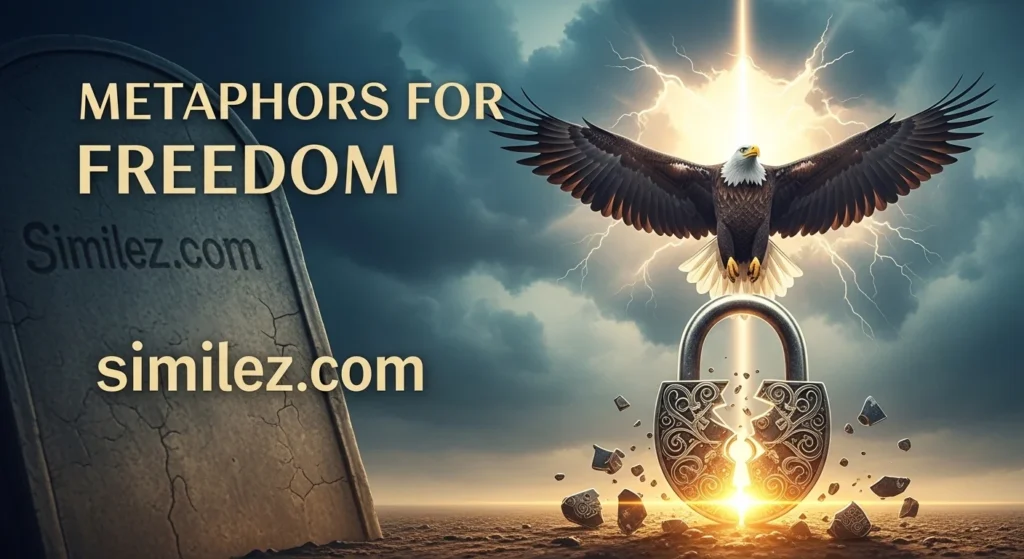
The air is still cool when the door finally swings open. No creak, no resistance just a quiet surrender of hinges that once held you back. Outside, the sky stretches wide, unclaimed and infinite.
You step forward, unsure yet exhilarated, feeling something unfamiliar settle in your chest: space. Not just around you, but within you. That sensation expansive, weightless, alive is what freedom feels like before we even have words for it.
Freedom is one of those ideas that resists simple definition. It is deeply personal yet universally understood. We reach for metaphors because literal language falls short.
Metaphors give shape to what cannot be easily measured they translate emotion into imagery, turning abstraction into something we can see, feel, and share.
Understanding metaphors for freedom is not just an exercise in creativity; it sharpens your expression, enriches storytelling, and helps you connect more deeply with others.
Whether you’re writing, speaking, or simply reflecting, these metaphors act as bridges between inner experience and outer language.
What Does Freedom Really Mean?
Freedom is not just the absence of restriction; it is the presence of possibility. It can mean independence, self-expression, release from burden, or the ability to choose one’s path.
Yet freedom is complex. For one person, it might look like quitting a job. For another, it might mean staying but setting boundaries. This complexity is precisely why metaphors matter—they allow flexibility and nuance.
Why Metaphors for Freedom Matter in Writing
Metaphors elevate ordinary writing into something memorable. Instead of stating “I felt free,” you can show it:
- “I felt like a bird finally released from its cage.”
- “It was as if chains I didn’t know I carried had quietly fallen away.”
These expressions resonate because they create imagery. Readers don’t just understand—they experience.
The Emotional Power of Freedom Imagery
Freedom often carries emotional weight: relief, joy, fear, even uncertainty. Good metaphors capture that tension. They reveal that freedom isn’t always comfortable—it can be vast and overwhelming, like standing at the edge of an ocean.
A Bird Escaping the Cage
Meaning / Explanation: This classic metaphor represents release from confinement—physical, emotional, or societal. It suggests both liberation and vulnerability.
Example Scenario: After years in a restrictive environment, she walked away, feeling like a bird escaping its cage for the first time.
Alternative Expressions:
- “Like wings rediscovered after years of stillness”
- “A sky finally within reach”
Sensory / Emotional Details: Imagine the rush of wind beneath wings, the sudden vastness of the sky, the mix of fear and exhilaration.
Mini Storytelling: Think of someone leaving a rigid system—perhaps a strict upbringing or a limiting career. The moment of departure feels both terrifying and necessary, like that first uncertain flight.
Breaking Chains
Meaning / Explanation: This metaphor symbolizes overcoming oppression, limitations, or internal barriers. It emphasizes strength and struggle.
Example Sentence: He broke the chains of doubt that had held him back for years.
Alternative Expressions:
- “Shattering invisible restraints”
- “Unfastening the weight of expectation”
Sensory / Emotional Details: The metallic snap of chains, the sudden lightness, the echo of something heavy falling away.
Real-Life Reference: Historically, this metaphor has been used in movements for justice and equality, representing liberation from systemic control.
An Open Road
Meaning / Explanation: Freedom as endless possibility, direction, and choice. The road symbolizes a journey with no fixed endpoint.
Example Scenario: With nothing tying him down, the open road became his home.
Alternative Expressions:
- “A horizon without boundaries”
- “Paths unfolding endlessly ahead”
Sensory / Emotional Details: The hum of tires on asphalt, wind rushing past, the horizon stretching endlessly.
Mini Storytelling: Picture someone embarking on a solo journey—no itinerary, no obligations. Just movement and discovery.
Freedom as a Vast Ocean
The ocean metaphor highlights both beauty and unpredictability. Freedom can feel expansive, but also overwhelming. You are free to swim anywhere—but also responsible for navigating depth and direction.
Freedom as Light Breaking Through Darkness
Light symbolizes clarity and hope. When freedom arrives, it often feels like illumination—like finally seeing what was once hidden.
Freedom as a Blank Canvas
A blank canvas represents creative freedom—the ability to shape your life or work without constraints. It can be exciting, but also intimidating.
Freedom and Cultural Narratives
Across cultures, freedom is often depicted through symbolic imagery: birds, skies, water, fire. These shared metaphors reveal a universal human longing to move beyond limits.
How to Create Your Own Metaphors for Freedom
Start with a feeling. Ask yourself:
- Does freedom feel light or heavy?
- Is it fast-moving or still?
- Does it expand or release?
Then connect that feeling to a physical image.
Example: If freedom feels quiet and steady, you might describe it as “a calm lake untouched by wind.”
Interactive Exercise: Build Your Own Metaphor
Try this:
- Think of a moment when you felt truly free.
- Write down three sensory details (what you saw, heard, felt).
- Turn those details into a comparison.
Example Prompt: “Freedom feels like ______ because ______.”
Writing Prompts for Practice
- Describe freedom as a place. What does it look like?
- Write a short paragraph where freedom is an object.
- Compare freedom to a natural element (fire, water, air, earth).
Bonus Tips for Using Freedom Metaphors
In Writing: Use metaphors sparingly but effectively. One strong image is more powerful than many weak ones.
In Social Media: Short, vivid metaphors work best. Example: “Freedom is the first breath after a storm.”
In Daily Life: Metaphors can help you articulate feelings in conversations, making your communication more impactful.
Common Mistakes to Avoid
- Overusing clichés without adding originality
- Mixing too many metaphors in one sentence
- Using metaphors that don’t match the tone
FAQs
What is a metaphor for freedom?
A metaphor for freedom is a figurative expression that represents the concept of being free using imagery, such as “a bird in flight” or “an open sky.”
Why are metaphors important in expressing freedom?
They make abstract ideas tangible, helping readers feel and visualize freedom rather than just understand it intellectually.
Can I create my own metaphors?
Yes, and it’s encouraged. Personal metaphors are often more powerful because they reflect your unique perspective.
Are some metaphors overused?
Yes, like “bird out of a cage.” However, you can refresh them with unique details or context.
How do I make metaphors more vivid?
Incorporate sensory details—sight, sound, touch—to make the image come alive.
Conclusion
Freedom is not a single image or idea—it is a shifting, evolving experience. Metaphors give us the tools to capture that movement, to express what might otherwise remain unspoken.
Whether it feels like breaking chains, walking an open road, or soaring into the sky, your version of freedom is valid—and worth expressing.
The next time you feel that quiet expansion within you, try to name it. Not with plain words, but with something richer. Something that breathes.
Because sometimes, the closest we come to understanding freedom… is in the way we describe it.