
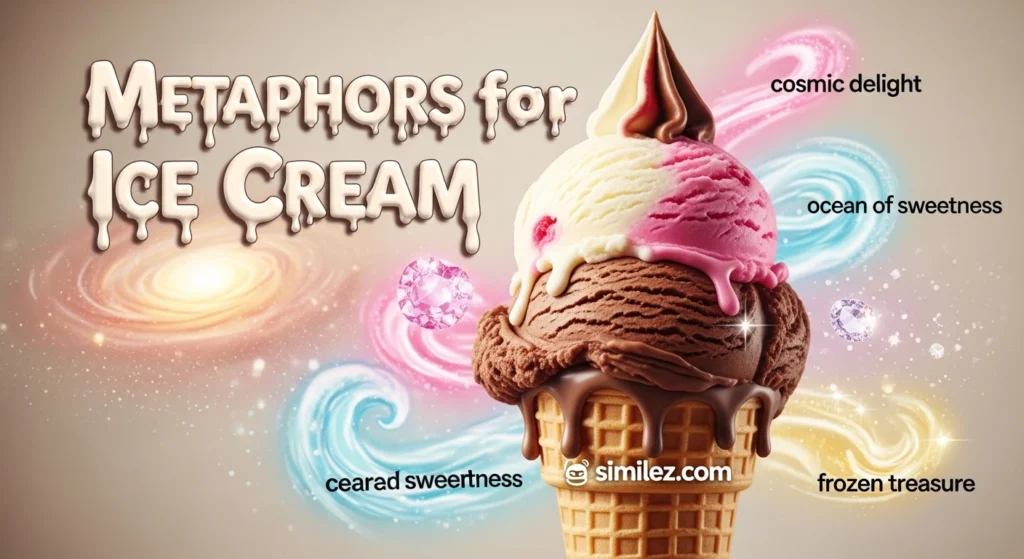
Ice cream is more than dessert. It is a sensory shortcut to emotion. One spoon can carry summer afternoons, childhood laughter, heartbreak softened by sugar, or even solitude made gentle.
Writers often borrow ice cream as a metaphor because it dissolves quickly, changes shape under pressure, and demands to be experienced in the present moment.
Think of the first bite on a hot day: cold shock, creamy softness, and instant relief. That experience is not just physical it is symbolic. Ice cream becomes a way to describe fleeting happiness, fragile beauty, or moments too delicate to hold.
In language, metaphors like these transform ordinary writing into something memorable. They allow readers to feel ideas rather than simply understand them.
Why Ice Cream Works as a Metaphor in Writing
Ice cream is structurally perfect for metaphorical use because it is temporary by nature. It melts. It changes. It disappears if ignored.
Writers use it to represent:
- Short-lived joy
- Emotional softness
- Nostalgia and childhood
- Fragility of time
Its sensory richness also helps. Few foods are as visually and emotionally evocative. You don’t just “see” ice cream—you imagine its texture, temperature, and taste instantly.
In literary terms, it functions as a “multi-sensory symbol,” engaging sight, taste, touch, and memory simultaneously.
Ice Cream as Emotional Language Symbol
Emotionally, ice cream sits at a unique intersection: comfort and impermanence. It is happiness that cannot last long, yet that is exactly what makes it meaningful.
In Urdu expression, you might say: “yeh khushi chand lamhon ki hoti hai”—this happiness lasts only moments. Ice cream embodies that idea physically.
Writers use it to express:
- Love that feels intense but brief
- Happiness that cannot be preserved
- Innocent joy that is easily lost
This duality makes it powerful in poetry, fiction, and even everyday captions.
Ice Cream as Fleeting Joy
Ice cream often symbolizes joy that is beautiful precisely because it does not last.
Meaning / Explanation: This metaphor captures happiness that is intense but temporary, like a moment of laughter, success, or connection that cannot be frozen in time.
Example Sentence / Scenario: “Her laughter was like melting ice cream under the afternoon sun—bright, sweet, and gone before I could hold onto it.”
Alternative Expressions:
- “a passing sweetness”
- “a moment that dissolves too quickly”
- “joy that cannot be preserved”
Sensory & Emotional Detail: Cold cream turning soft under heat mirrors how emotions soften and fade under reality.
Mini Story: A traveler in Lahore buys an ice cream cone on a scorching evening. Before he reaches the end of the street, it has already begun to melt, dripping onto his hand. He smiles anyway. The joy was never in finishing it—it was in those few perfect bites.
Ice Cream as Childhood Memory
Ice cream is deeply tied to childhood across cultures. It is often the first “independent pleasure” a child experiences.
Meaning / Explanation: This metaphor represents nostalgia, innocence, and the simplicity of earlier life stages.
Example Sentence / Scenario: “The memory of her mother’s voice came back like vanilla ice cream on a rainy day—soft, familiar, and impossibly distant.”
Alternative Expressions:
- “a spoonful of memory”
- “taste of old summers”
- “sweet echo of childhood”
Sensory & Emotional Detail: The creamy texture represents emotional softness; the sweetness represents innocence.
Mini Cultural Reference: In many South Asian cities, the arrival of an ice cream cart in the evening streets is still associated with childhood excitement. The bell sound alone can trigger memories decades old.
Ice Cream as Fragile Pleasure and Melting Time
Time itself is often compared to melting ice cream because it cannot be reversed once it begins to change.
Meaning / Explanation: This metaphor reflects the fragility of experience and the inevitability of change.
Example Sentence / Scenario: “Time in the hospital room felt like ice cream left in the sun—slowly collapsing into something unrecognizable.”
Alternative Expressions:
- “melting moments”
- “time slipping into warmth”
- “fragile sweetness of now”
Sensory & Emotional Detail: The dripping, sticky texture symbolizes loss of control over time.
Mini Literary Reference: Modern poets often use melting imagery to describe grief, especially when something precious is slipping away faster than expected.
Sensory Writing: Taste, Texture, Temperature in Metaphors
Ice cream metaphors succeed because they are sensory anchors. Writers use:
- Taste: sweetness = pleasure, bitterness = contrast
- Texture: creamy = comfort, icy = distance
- Temperature: cold = shock, melting = change
When combined, these elements create emotionally rich imagery.
Example: “A cold silence settled between them, like ice cream forgotten on a windowsill.”
This transforms an abstract emotion (silence) into something physically felt.
Cultural Significance of Ice Cream Around the World
Ice cream is not universal in form, but it is universal in meaning. In Italy, gelato culture emphasizes craft and patience. In the United States, ice cream often symbolizes celebration. In South Asia, kulfi carries tradition and street memory.
These cultural layers expand metaphor usage:
- Celebration → happiness
- Street food → community
- Handmade desserts → care and tradition
Across cultures, ice cream becomes a shared emotional language.
Ice Cream in Literature and Pop Culture
Ice cream appears frequently in films and literature as a symbol of emotional transition.
In cinema, a character eating ice cream alone often signals loneliness or reflection. In literature, it can mark innocence before change or trauma.
Pop culture uses it as contrast:
- Bright colors vs. emotional sadness
- Sweetness vs. internal conflict
- Childhood vs. adulthood
This contrast is what gives ice cream its narrative strength.
Interactive Writing Exercise: Create Your Own Ice Cream Metaphor
Try this structured exercise:
- Think of an emotion (love, regret, joy, anxiety).
- Match it with an ice cream property:
- melting = change
- cold = distance
- sweetness = happiness
- dripping = loss of control
- Write one sentence using that comparison.
Example: “His patience melted like ice cream left too long under the sun.”
Now rewrite it in three styles:
- poetic
- simple
- emotional
This builds metaphor flexibility in writing.
Ice Cream Metaphors in Social Media Captions
Metaphors are powerful in short-form content because they compress emotion.
Examples:
- “Some moments melt faster than ice cream in June.”
- “Sweetness that doesn’t stay—but stays with you.”
- “Happiness served cold and gone too soon.”
For engagement, keep metaphors:
- short
- sensory
- emotionally relatable
Even one strong image can outperform long text online.
Mini Story: The Ice Cream That Was Never Finished
She bought two ice creams that evening. One for herself, one for someone who never arrived. The first melted slowly while she waited. The second remained untouched, becoming more symbolic than real.
By the time she left, both had turned into sticky memory on her fingers.
Ice cream, in that moment, was no longer dessert. It was expectation, disappointment, and acceptance all at once.
Common Mistakes in Using Ice Cream Metaphors
Writers often weaken metaphors by overuse or lack of clarity.
Avoid:
- Mixing too many symbols in one sentence
- Forcing ice cream into unrelated contexts
- Over-explaining the metaphor
Weak example: “Life is like ice cream because ice cream is sweet and life is also sometimes sweet.”
Strong example: “Life melts quietly if you stop noticing it.”
Precision is what makes metaphors effective.
Advanced Techniques for Ice Cream Metaphors
To elevate your writing:
- Combine metaphors: ice cream + time + memory
- Use contrast: cold sweetness vs emotional heat
- Introduce motion: melting, dripping, freezing
- Anchor in real experience: street scenes, weather, sound
Advanced example: “The conversation froze, then melted into silence like ice cream abandoned between two summers.”
This layering creates depth and resonance.
Conclusion
Ice cream is more than a dessert image—it is a linguistic tool for expressing impermanence, emotion, and memory. Its strength lies in its physical behavior: it changes under time and temperature, just like human experience.
When used thoughtfully, it becomes a bridge between the sensory world and emotional understanding. Whether describing joy, loss, nostalgia, or fleeting moments, ice cream metaphors allow language to feel alive, temporary, and deeply human.
Frequently Asked Questions
What makes ice cream a strong metaphor in writing?
Its melting nature, sensory richness, and emotional associations make it ideal for representing change, joy, and fragility.
Can ice cream metaphors be used in professional writing?
Yes, but selectively. They work best in reflective, narrative, or descriptive contexts, not technical documentation.
How do I avoid overusing ice cream metaphors?
Use them only when the emotional or sensory match is strong. Avoid repeating the same structure or idea.
Are ice cream metaphors culturally universal?
Largely yes, because most cultures associate it with pleasure, childhood, and celebration, though specific meanings may vary.
What is the best way to practice metaphor writing?
Combine real sensory experiences with emotions, then rewrite them in multiple styles—poetic, simple, and symbolic.