
A boy stands in front of a cracked mirror in an old room. The reflection is not steady it fractures into multiple versions of him: confident, uncertain, angry, calm.Outside, rain taps softly on the window like a quiet argument with time. Inside, a question grows louder than the storm: Who am I when no one is watching?This is where identity begins not as a fixed answer, but as something felt, shaped, and constantly reinterpreted.
Identity is not just a label or a document entry. It is a lived experience. To understand something so complex, humans rely on metaphors—comparisons that help us see the invisible.
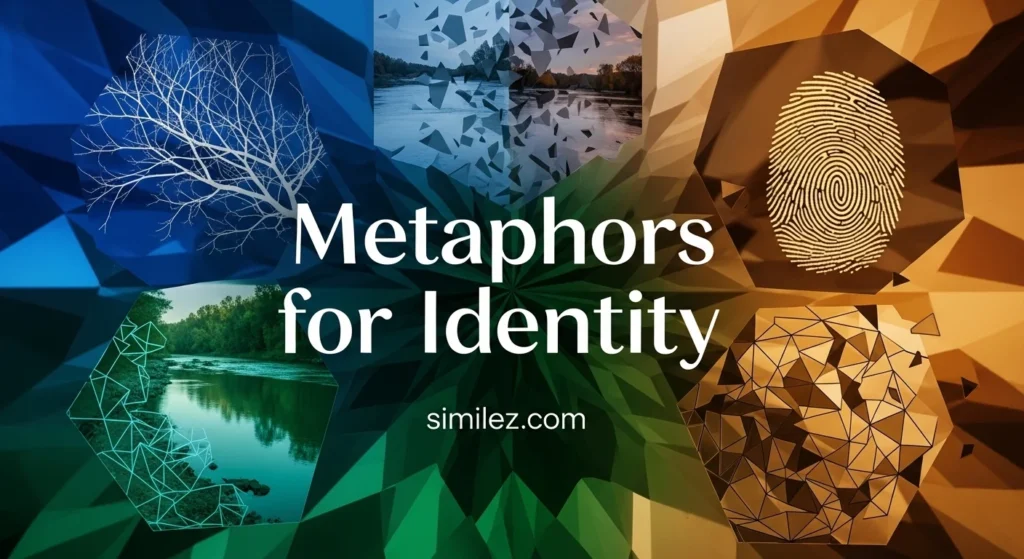
In literature, psychology, and everyday speech, identity is often described using symbolic language: a journey, a mask, a story, a river. These metaphors for identity allow us to make sense of change, conflict, and self-awareness.They matter because they influence how we interpret our past, define our present, and imagine our future.
Why Identity Metaphors Shape Self-Understanding
When we say “I am finding myself” or “I lost myself,” we are not speaking literally. We are using cognitive shortcuts that shape belief.
Metaphors help us:
- Process emotional confusion
- Express identity shifts
- Understand personal growth
- Communicate inner experiences
In Urdu expression, we might say: “Insaan apni pehchan safar mein dhoondta hai”—identity is discovered in journey, not arrival.
Identity as a Journey: The Road of Becoming
One of the most powerful metaphors for identity is the journey.
Meaning & Explanation
Identity is seen as movement over time—changing landscapes, unexpected turns, and evolving destinations. You are not static; you are traveling.
Example Sentence / Scenario
“After leaving his hometown, he realized identity is not where you stand, but the road you walk.”
Mini Storytelling
A woman travels from Lahore to a foreign city for studies. At first, she clings to old habits—language, food, silence. Over time, she starts adopting new rhythms. She realizes she is neither fully here nor there. She is in transit. Her identity becomes layered, like cities she has lived in.
Alternative Expressions
- Life path
- Self-discovery route
- Inner pilgrimage
- Journey of becoming
Sensory & Emotional Detail
Dusty roads, moving trains, suitcase wheels on uneven pavement—the sound of change is never silent.
Interactive Exercise
Write your own “identity map.” Draw three locations that shaped you and describe what version of you existed in each place.
Bonus Tip
Use this metaphor in storytelling captions or personal bios: “Still on the road to becoming.”
Identity as a Mask: The Faces We Wear
Another strong metaphor is the mask—identity as something performed.
Meaning & Explanation
We often present different versions of ourselves depending on context: family, work, friends, social media.
Example Sentence / Scenario
“She smiled in meetings, but inside she felt like she was wearing a mask that no longer fit.”
Mini Cultural Reference
In classical theater—Greek tragedies or even South Asian drama traditions—masks represent roles, not truth. A king, a fool, a lover: each character is a performed identity.
Alternative Expressions
- Social persona
- Public face
- Emotional armor
- Role-based self
Sensory & Emotional Detail
The tightness of a mask after hours. The relief of removing it at night.
Interactive Exercise
List three situations where you behave differently. Ask: Which version feels most authentic? Which feels performed?
Bonus Tip
In writing or branding, use this metaphor carefully—it adds depth when discussing authenticity and social behavior.
Identity as a River: Constant Flow of Change
Identity can also be imagined as water—fluid, shifting, never identical at two points.
Meaning & Explanation
Like a river, identity changes continuously due to experience, environment, and memory.
Example Sentence / Scenario
“He thought he knew himself at twenty, but by thirty he realized he had already become a different river.”
Mini Storytelling
An old man sits by a river in Punjab. He watches the water pass and remembers his youth. He laughs softly—not because life stayed the same, but because it never did. Yet he is still “him,” even though every cell has changed.
Alternative Expressions
- Flowing self
- Fluid identity
- Evolving consciousness
- Stream of being
Sensory & Emotional Detail
Cool water, shifting reflections, sound of current dragging leaves downstream.
Interactive Exercise
Describe yourself five years ago and now. What has “flowed away”? What remains?
Bonus Tip
Use this metaphor in reflective writing or journaling posts for social media.
Identity as a Story: The Narrative We Live
Identity is often structured like a story with chapters, turning points, and characters.
Meaning & Explanation
We interpret our lives as narratives, assigning meaning to events through storytelling.
Example Sentence / Scenario
“She re-read her past not as failure, but as the first draft of her identity.”
Mini Cultural Reference
From ancient epics like Dastan-e-Amir Hamza to modern autobiographies, human identity has always been narrated, not just lived.
Alternative Expressions
- Life narrative
- Personal mythology
- Self-authored story
- Identity script
Sensory & Emotional Detail
The rustle of old diaries, ink fading on paper, memories reorganizing themselves like chapters.
Interactive Exercise
Write your life as a short story title. Example: “The Girl Who Learned to Rewrite Her Ending.”
Bonus Tip
This metaphor is powerful for CVs, bios, and personal branding.
Identity as a House: Rooms of the Self
Identity can also be imagined as architecture.
Meaning & Explanation
Each aspect of identity is a “room”—childhood, ambition, fear, love, memory.
Example Sentence / Scenario
“He never entered the room of his childhood memories without hesitation.”
Alternative Expressions
- Inner structure
- Psychological architecture
- Emotional home
- Self-building
Sensory & Emotional Detail
Wooden doors creaking, locked drawers, dusty corners of memory.
Interactive Exercise
Draw a house and label each room with a part of your identity.
Bonus Tip
Use this metaphor in therapy writing, reflection blogs, or poetry.
Identity in Psychology: The Formation of Self
Psychology sees identity as a developmental process shaped by experience and social interaction.
Identity formation is influenced by:
- Family environment
- Cultural context
- Personal choices
- Trauma and resilience
This framework helps explain why identity is not fixed but constructed over time.
Cultural Identity: Belonging and Difference
Cultural identity refers to the sense of belonging to a group—language, tradition, religion, and shared history.
In multilingual societies like Pakistan, identity often becomes layered: local, national, and global identities coexist.
Digital Identity: The Online Self We Construct
In the digital era, identity extends to social media and online presence.
We curate:
- Profile pictures
- Posts
- Opinions
- Digital footprints
This creates a “designed self” that may differ from lived reality.
Identity Crisis: When the Metaphors Break
Sometimes metaphors collapse under pressure. Identity crisis occurs when one cannot reconcile different versions of self.
It feels like:
- Fragmentation
- Confusion
- Emotional disorientation
But it is also a transition phase, not a failure.
Identity as a Puzzle: Pieces That Don’t Always Fit
Some see identity as a puzzle—fragmented but meaningful.
Each experience adds a piece, even if it does not immediately fit.
Identity in Literature: From Shakespeare to Modern Fiction
Writers have long explored identity:
- Shakespeare’s characters often question selfhood
- Modern novels explore fragmented identity in urban life
Literature shows that identity is not just psychological but narrative and symbolic.
Identity and Memory: The Archive of Self
Memory acts as an internal archive. Without memory, identity dissolves.
We are, in many ways, what we remember—and what we choose to forget.
Identity and Society: How Others Shape Us
Identity is not formed in isolation. Society defines categories that influence self-perception.
Labels, expectations, and cultural norms shape identity boundaries.
Creative Writing Exercise: Building Your Own Identity Metaphor
- Choose one metaphor (journey, river, mask, house, story)
- Write a 10-line paragraph describing yourself using it
- Reflect on what feels accurate or limiting
This helps translate abstract identity into expressive language.
Using Identity Metaphors in Writing and Daily Life
- In writing: Use metaphors to deepen character psychology
- In social media: “Still writing my story” performs well emotionally
- In reflection: Metaphors make journaling more structured
- In communication: Helps explain complex emotions clearly
FAQs on Metaphors for Identity
What are metaphors for identity?
They are symbolic comparisons used to describe how a person understands themselves, such as identity being a journey, mask, or story.
Why are identity metaphors important?
They help people express complex emotional and psychological experiences in a simpler, relatable form.
Can identity metaphors change over time?
Yes. As life experiences change, people often shift from one metaphor (e.g., “mask”) to another (e.g., “journey”).
How can I find my own identity metaphor?
Reflect on your life experiences and choose an image that best represents your sense of self, such as water, architecture, or storytelling.
Are identity metaphors used in psychology?
Yes. Psychology often uses narrative and symbolic frameworks to explain identity development and self-concept.
Conclusion
Identity is not a fixed definition. It is a living structure made of stories, roles, memories, and transformations. Metaphors are not decorations of language—they are tools of understanding.
Whether you see yourself as a traveler, a river, a mask, or a story, the core truth remains: identity is not discovered once. It is continuously written, revised, and reinterpreted. And in that ongoing process, meaning is created—not found.