
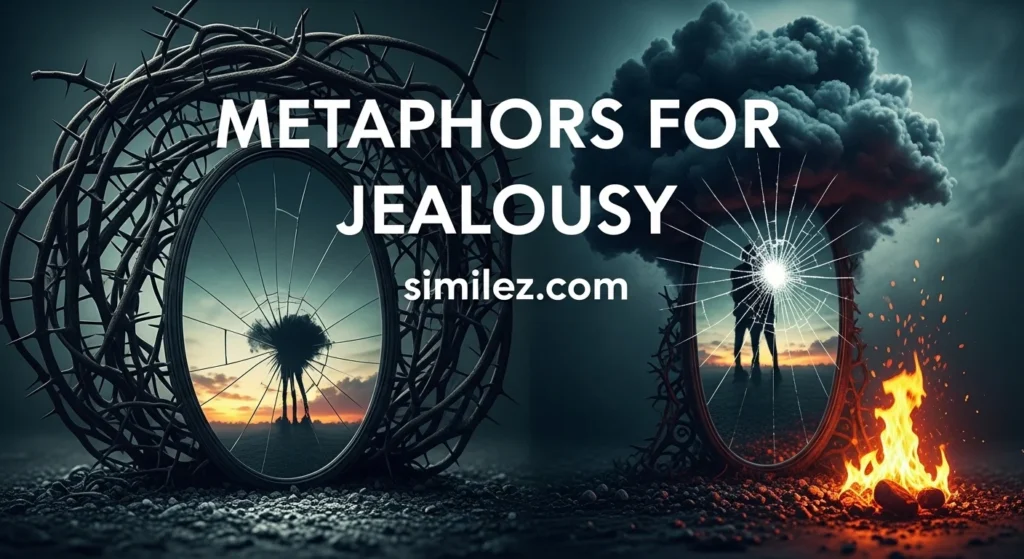
Jealousy rarely arrives quietly. It does not knock politely at the door of the mind. It creeps in like a shadow stretching too long at sunset, or like a sound you cannot fully locate but cannot ignore either.
It tightens the chest, sharpens thoughts, and turns ordinary situations into distorted reflections. That is why writers and speakers often rely on metaphors for jealousy because the emotion itself resists plain explanation.
In literature, jealousy is never just jealousy. It becomes a storm, a poison, a burning room, a green flame. Metaphors give shape to something that is otherwise internal, chaotic, and difficult to express.
This article explores how jealousy is described through imagery, why these metaphors matter, and how you can use them in writing, storytelling, and even everyday expression.
A Brief Anecdote: The Green Light in the Room
Imagine sitting in a quiet café. Two friends laugh at a table across from you. One of them leans slightly closer to the other. Nothing unusual. Yet something inside shifts. The air feels heavier. The laughter sounds sharper than it should.
You tell yourself it is nothing.
But later, when you replay the moment, it feels like a green light flickering in a dark room—small, persistent, impossible to ignore.
That is jealousy before it is named. That is metaphor before it is spoken.
What Are Metaphors for Jealousy?
Metaphors for jealousy are figurative expressions that describe jealousy through comparison. Instead of stating “I feel jealous,” language transforms the emotion into something tangible:
- a fire burning inside
- a snake coiled in the chest
- a storm rising without warning
They allow abstract emotional experiences to become visible, relatable, and expressive.
In Urdu expression, one might say: “dil mein aag lagna” (a fire in the heart), which captures the same emotional intensity through imagery.
Why Jealousy Needs Metaphors in Language and Writing
Jealousy is psychologically complex. It blends insecurity, fear, desire, and comparison. Direct language often fails to capture this layered experience.
Metaphors help in three ways:
- They make invisible emotions visible
- They intensify emotional communication
- They create shared understanding between speaker and listener
In storytelling, metaphors for jealousy are especially powerful because they allow readers to feel the emotion rather than just understand it.
Jealousy as a Green-Eyed Flame
One of the most famous symbolic expressions is “green-eyed jealousy,” originating from literary traditions, particularly Shakespearean influence. The color green here is not calm or natural—it is sickly, restless, and consuming.
Jealousy becomes a flame that does not warm but consumes.
It does not sit still; it spreads quietly.
In modern interpretation, this metaphor suggests emotional instability—something that grows when fed with imagination and comparison.
Jealousy as a Poison in the Blood
Meaning Explanation
This metaphor frames jealousy as something internal and toxic, spreading through the emotional system like a chemical reaction.
Example Sentence
“When she saw him with someone else, jealousy entered her like poison in the blood, slow and unavoidable.”
Alternative Expressions
- emotional toxicity
- internal corrosion
- slow emotional decay
- bitterness spreading inward
Sensory Emotional Detail
It feels cold rather than hot. A heaviness in the veins. Thoughts become sluggish, contaminated, repeating themselves like a broken record.
Mini Story
A man scrolls through old photos of his partner laughing with someone else. At first, he smiles. Then silence enters his expression. Within minutes, the room feels smaller, the air thicker, as if something unseen has altered the atmosphere.
This is jealousy as contamination—not loud, but deeply invasive.
Jealousy as a Storm Without Rain
Meaning / Explanation
Here jealousy is an emotional weather system—unstable, building pressure, threatening release but never fully resolving.
Example Sentence
“His jealousy was a storm without rain, thunder trapped inside his thoughts.”
Alternative Expressions
- emotional turbulence
- inner weather shift
- mental pressure front
- psychological storm
Sensory Emotional Detail
Tension in the jaw. Restless pacing. Thoughts rolling like distant thunder. No physical release, only buildup.
Cultural Reference
In many South Asian storytelling traditions, emotional conflict is often described through monsoon imagery. The storm is not destruction alone—it is anticipation, waiting, imbalance.
Real-Life Scenario
A friend sees another friend praised publicly. They smile, congratulate them—but later, silence follows. Not anger, not words. Just internal weather shifting.
Jealousy as a Mirror That Distorts
Meaning Explanation
This metaphor presents jealousy as a distortion of perception. It does not change reality—it changes how reality is seen.
Example Sentence
“Jealousy turned his mind into a broken mirror, reflecting everything in twisted fragments.”
Alternative Expressions
- distorted perception
- emotional illusion
- warped reflection
- mental distortion field
Sensory Emotional Detail
Confusion. Overthinking. Small details appearing exaggerated. A smile interpreted as suspicion. A silence interpreted as rejection.
Mini Story
A woman sees her partner laughing with a colleague. Nothing unusual. But later, that image repeats in her mind—not as it was, but enlarged, reshaped, sharpened. The mind edits reality until it no longer resembles truth.
Jealousy here is not emotion—it is interpretation gone wrong.
Jealousy in Literature and Cultural Symbolism
Across cultures, jealousy is consistently given physical identity.
- In Western literature, it is often fire, poison, or disease
- In Urdu poetry, it appears as “hasad”, a burning internal discomfort
- In classical drama, it becomes madness, unraveling reason
- In modern fiction, it is psychological fragmentation
Shakespeare famously referred to jealousy as the “green-eyed monster,” turning emotion into a creature—alive, watching, feeding.
The cultural consistency is clear: jealousy is rarely gentle. It is always active, consuming, or distorting.
Psychological Interpretation of Jealousy Metaphors
From a psychological perspective, metaphors for jealousy reflect cognitive processes:
- comparison triggers self-evaluation
- perceived threat activates emotional defense
- imagination fills gaps with worst-case scenarios
Thus, metaphors like “storm” or “fire” are not just poetic—they mirror neurological and emotional escalation patterns.
Jealousy intensifies when imagination overrides evidence. That is why metaphors often involve distortion, heat, or spread.
How Writers Use Metaphors for Jealousy in Storytelling
Writers rarely state jealousy directly. Instead, they:
- show physical reactions (tight jaw, silence, avoidance)
- use environmental imagery (storm, darkness, heat)
- embed symbolic objects (mirrors, shadows, flames)
For example, instead of writing “he was jealous,” a writer might describe:
“The room felt colder when she spoke his name.”
This allows readers to infer emotion rather than being told.
Jealousy becomes atmosphere, not declaration.
Turn Emotion Into Metaphor
Take a recent moment when you felt jealousy (even mild).
Now answer:
- If this feeling were weather, what would it be?
- If it were a physical object, what would it feel like?
- If it were a sound, what would it resemble?
Example:
- Weather: heavy fog
- Object: tightening rope
- Sound: distant, unresolved echo
This exercise trains emotional translation into imagery.
Rewrite a Jealous Thought
Original thought: “I felt jealous when they ignored me.”
Now rewrite using metaphor:
Try:
- “I felt like a shadow fading in a crowded room.”
- “Something inside me tightened like a closed fist.”
- “It was as if my presence became invisible ink.”
Repeat with different emotional intensities. Notice how metaphor changes emotional clarity.
Bonus Tips for Using Jealousy Metaphors in Writing and Daily Expression
- Avoid repetition of the same imagery (don’t always use fire or storm)
- Match metaphor intensity with emotional level
- Use sensory detail: sound, temperature, movement
- Combine metaphors subtly (storm + mirror distortion works well)
- In social media writing, keep metaphors short but impactful
- In storytelling, let metaphor evolve as emotion escalates
For example, jealousy might start as a “faint shadow” and grow into a “storm breaking through glass.”
FAQs about Metaphors for Jealousy
What is a simple metaphor for jealousy?
A simple metaphor for jealousy is “a burning flame inside,” representing emotional intensity and discomfort caused by comparison or insecurity.
Why is jealousy often described as green?
Green is associated with sickness, envy, and imbalance in literary traditions, which is why jealousy is often symbolized as green-colored emotion.
Can jealousy be described without metaphors?
Yes, but it loses emotional depth. Literal descriptions explain the feeling, while metaphors help the reader experience it.
Are jealousy metaphors the same across cultures?
Not exactly. While fire, poison, and storms are universal, cultural expressions like Urdu poetic imagery add regional emotional depth.
How can I use jealousy metaphors in writing?
Use them to replace direct emotional statements, build atmosphere, and show internal emotional conflict rather than simply stating it.
Conclusion
Jealousy is not a simple feeling—it is layered, shifting, and often contradictory. That is why literal language struggles to contain it. Metaphors give it structure without reducing its complexity.
Whether it appears as a storm, a poison, or a distorted mirror, each metaphor reveals a different angle of the same emotional truth. In writing, in speech, and in reflection, these images help transform confusion into expression.
When used carefully, metaphors for jealousy do more than describe emotion—they translate it into something visible, relatable, and deeply human.