
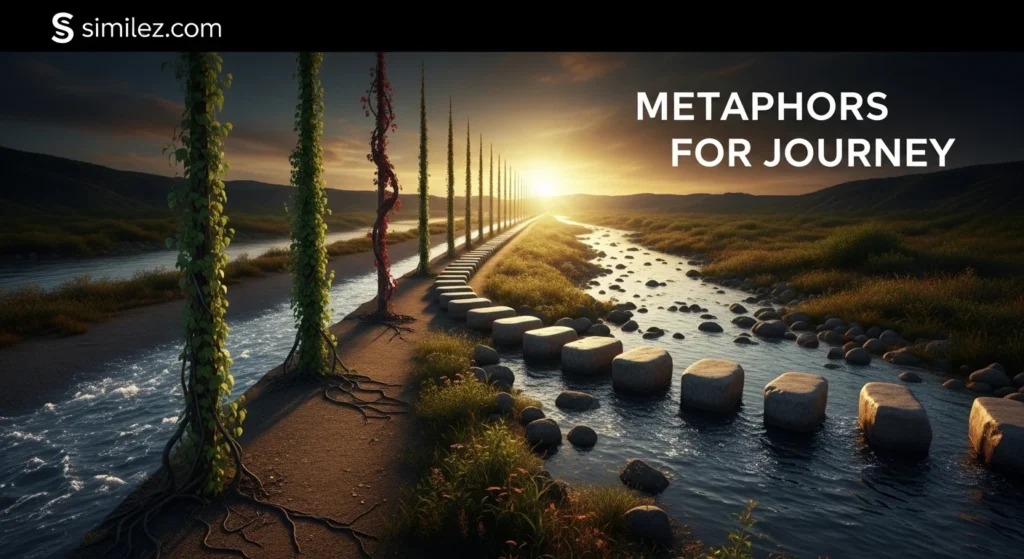
There are moments in life that do not feel like events, but like movement. A quiet morning when everything changes. A decision that tilts the ground beneath your feet. A farewell that lingers longer than expected. In such moments, we instinctively reach for language that can carry weight beyond literal meaning. We say: “I am on a journey.”
This is not accidental. Human beings understand life through motion, direction, and passage. The concept of “metaphors for journey” gives shape to invisible experiences growth, grief, ambition, failure, recovery. Instead of describing life as static, we describe it as travel.
This article explores how journey metaphors function, why they matter, and how you can use them effectively in writing, speech, and daily reflection.
The Concept of Journey Metaphors in Literature and Life
Journey metaphors are figurative expressions where life, emotions, or experiences are described as travel-related processes. This includes roads, rivers, trains, flights, and even wandering paths.
In Urdu expression, we often say: “zindagi safar hai”—life is a journey. This is not just poetic decoration; it is cognitive framing. It helps us understand change as movement rather than chaos.
Whether in literature, law, philosophy, or daily conversation, journey metaphors simplify complexity. They turn abstract emotional states into visual, relatable experiences.
Why Metaphors for Journey Matter in Communication and Writing
Without metaphors, language becomes mechanical. With them, it becomes experiential.
Journey metaphors are powerful because:
- They make abstract emotions understandable
- They create emotional continuity in storytelling
- They help audiences relate to transformation
- They provide structure to experiences that feel fragmented
In professional communication, they are also used to explain growth strategies, legal processes, or organizational change. For example, “corporate transformation journey” is now standard business language.
Life is a Road
Life as a road is one of the most universal metaphors.
Meaning
A road suggests direction, decisions, detours, and destinations. It implies that progress is linear but not always smooth.
Example Sentence or Scenario
“You may take a longer route, but every turn on this road teaches something essential.”
Alternative Expressions
- Life is a path
- Life is a highway
- Life is a winding street
- Life is a long walk with choices
Sensory and Emotional Detail
The crunch of gravel underfoot, the heat of midday sun, the fog hiding the next turn—this metaphor carries uncertainty and anticipation.
Mini Story
A young lawyer walking to court for the first time feels lost. Every corridor looks identical. Yet over time, the same corridors become familiar turns on a road once feared. What was confusion becomes confidence through repetition of travel.
Life is a River
A river does not pause. It moves whether you are ready or not.
Meaning
This metaphor represents flow, inevitability, and emotional depth. It emphasizes that life carries us forward regardless of resistance.
Example Sentence or Scenario
“She stopped fighting the current and learned to move with the river instead.”
Alternative Expressions
- Life flows like water
- Life is an ocean stream
- Time is a flowing river
- We drift through currents of change
Sensory and Emotional Detail
Cold water against skin, the sound of rushing current, the unpredictability of depth—all suggest surrender and adaptation.
Mini Story
A student fails an exam and feels stuck. But months later, that failure becomes a turning point. Like a river changing direction around rock, life reshapes itself without stopping.
Life is a Train Ride
A train journey introduces structure, stations, and shared movement.
Meaning
This metaphor highlights phases of life, encounters with people, and inevitable transitions between stops.
Example Sentence or Scenario
“Some passengers stay for a station, others travel with you for years.”
Alternative Expressions
- Life is a moving train
- We pass through stations of time
- Life is a scheduled journey
- People board and leave our journey
Sensory and Emotional Detail
The rhythm of wheels on tracks, announcements echoing in stations, the fleeting glance of strangers—this metaphor emphasizes impermanence.
Mini Story
A professional meets colleagues during a project. Years later, only a few remain in contact. The rest were temporary passengers, essential but not permanent.
Cultural and Literary References Behind Journey Metaphors
Journey metaphors appear in classical poetry, religious texts, and modern literature.
In Urdu poetry, travel often symbolizes spiritual longing. Poets like Mirza Ghalib and Allama Iqbal used movement to represent inner transformation.
In English literature, road and journey imagery dominates works from “The Odyssey” to modern novels. The journey is never just physical; it is psychological and moral.
How Journey Metaphors Shape Emotional Understanding
When people say “I am stuck,” they imply movement is blocked. When they say “I moved on,” they imply progress.
These metaphors:
- Normalize emotional change
- Reduce psychological pressure
- Frame suffering as temporary passage
- Encourage resilience through movement thinking
Emotion becomes navigable rather than overwhelming.
Practical Uses in Writing and Storytelling
Writers use journey metaphors to:
- Structure narratives (beginning, middle, end as travel phases)
- Show character development
- Create emotional depth without over-explanation
For example: Instead of writing “he changed,” one can write “he crossed a long road before recognizing himself again.”
This is more engaging and cinematic.
Using Metaphors for Journey in Social Media Content
In digital communication, journey metaphors are highly effective because they are relatable and concise.
Examples:
- “Still walking my path, even when it’s unclear.”
- “New chapter, same journey.”
- “Not lost, just exploring a different route.”
They increase engagement because they invite interpretation rather than instruction.
Creative Exercises to Practice Journey Metaphors
To master metaphors for journey, practice is essential.
Try these exercises:
- Describe your current emotional state as a place on a road
- Rewrite a past failure as a river changing direction
- Convert a relationship experience into a train journey story
- Replace abstract words like “growth” or “pain” with travel imagery
These exercises build creative fluency and emotional clarity.
Common Mistakes When Using Journey Metaphors
Many writers misuse metaphors by:
- Overloading text with repeated imagery
- Mixing incompatible metaphors (road + ocean + flight in one line without purpose)
- Using clichés without originality
- Forcing metaphors where literal language would be stronger
Effective metaphor use requires restraint and intention.
Tips for Original and Powerful Metaphor Creation
To create strong journey metaphors:
- Anchor them in sensory detail
- Connect them to personal experience
- Avoid overused phrases unless reinterpreted
- Maintain consistency in imagery
- Let metaphors evolve naturally in text
Originality often comes from specificity, not complexity.
Real-Life Applications in Communication and Motivation
Journey metaphors are widely used in:
- Career coaching (“professional journey”)
- Legal reasoning (“procedural path”)
- Education (“learning pathway”)
- Mental health discourse (“healing journey”)
They help people accept gradual progress instead of expecting instant transformation.
Conclusion
Life rarely behaves like a fixed point. It behaves more like motion—sometimes fast, sometimes slow, sometimes invisible.
Metaphors for journey give us language to survive uncertainty. They do not remove difficulty, but they make it interpretable. Whether you see life as a road, river, or train, the underlying truth remains: you are always in motion, even when it feels otherwise.
Frequently Asked Questions (FAQs)
What are metaphors for journey in simple terms?
They are expressions that describe life or experiences as travel, such as roads, rivers, or trains.
Why are journey metaphors so commonly used?
Because they make abstract life experiences easier to understand and emotionally relatable.
Can journey metaphors be used in professional writing?
Yes. They are widely used in business, law, education, and leadership communication.
What is the most common journey metaphor?
“Life is a journey” is the most universal and widely used metaphor.
How can I create my own journey metaphors?
By linking personal experiences with travel-related imagery like roads, water, stations, or paths.
Are journey metaphors culturally universal?
Yes, most cultures use travel-based imagery to explain life, though expressions differ in language and tradition.