
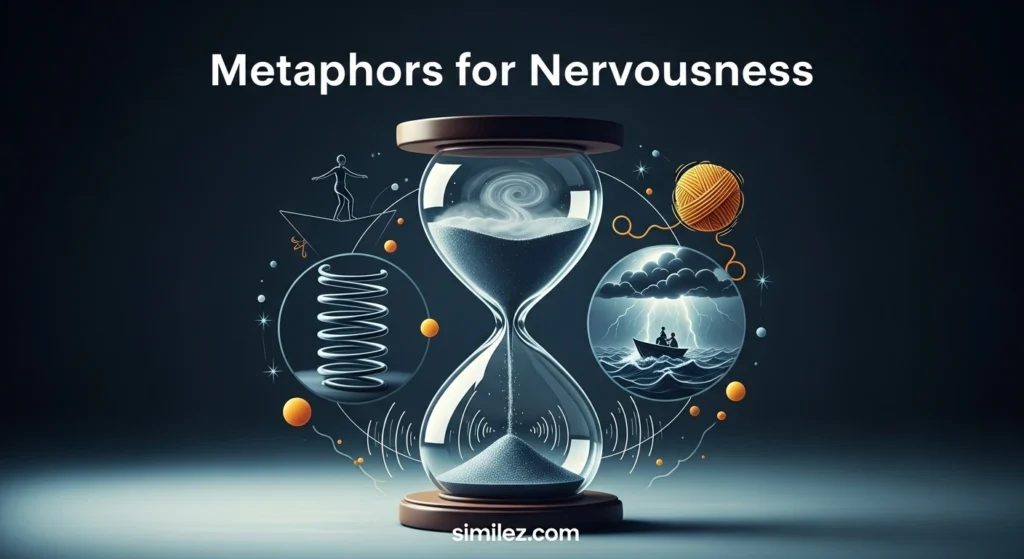
It was a quiet room. Yet my heart felt loud. That’s often how metaphors for nervousness begin in real life. They turn invisible feelings into vivid pictures we can understand.
Before a speech, your hands may shake. Your stomach may twist. Your thoughts may race like wild horses. However, nervousness is hard to explain in simple words. That is where metaphors help.
Metaphors for nervousness describe inner fear, anxiety, or tension using familiar images. For example, butterflies in the stomach or a storm inside the mind. These expressions help us understand emotions better. Therefore, they are powerful in writing, speaking, and storytelling.
In this article, you will explore how these metaphors work. You will also learn how to use them in creative and real-life communication.
What are metaphors for nervousness in simple terms
Metaphors for nervousness are comparisons that describe anxious feelings without using the word “nervous.”
Instead of saying “I am nervous,” we say something like “I feel like a shaking leaf.” This creates a picture in the reader’s mind.
These metaphors make emotions easier to understand. They also make language more expressive and human. However, they are not literal. They are imaginative.
Why metaphors for nervousness matter in writing
Writers use metaphors for nervousness to connect with readers emotionally.
Simple words sometimes fail to show deep feelings. But metaphors fill that gap.
For example, saying “his heart was a drum beating too fast” shows intensity. It helps readers feel the moment.
Therefore, metaphors improve storytelling, poetry, and even daily communication.
They also make writing more engaging and memorable.
Everyday feelings described through metaphors for nervousness
We often use metaphors for nervousness without noticing.
People say:
- “My stomach is in knots.”
- “I’m walking on thin ice.”
- “My mind is racing.”
These expressions show stress in everyday life.
However, each metaphor gives a different emotional shade. Some show fear. Others show pressure or confusion.
This makes language rich and relatable.
Metaphors for nervousness in real life situations
Nervousness appears in many situations. For example:
- Job interviews
- First dates
- Exams
- Public speaking
In these moments, people naturally use metaphors.
Someone might say, “I feel like I’m standing on a stage with no script.” Another might say, “My heart is trying to escape my chest.”
These images help express feelings when words feel weak.
Example 1: Butterflies in the stomach as metaphors for nervousness
One of the most common metaphors for nervousness is “butterflies in the stomach.”
This means a fluttery, uneasy feeling inside your belly.
It often happens before something important, like meeting someone special.
Explanation: The stomach feels light, shaky, and active, like wings moving inside.
Example sentence: “I had butterflies in my stomach before stepping onto the stage.”
Alternative expressions:
- Nervous flutter inside
- Dancing nerves in the belly
- Light, shaky stomach feeling
Sensory detail: It feels like tiny wings moving quickly, making the body alert and sensitive.
This metaphor is simple but deeply emotional. It is used worldwide.
Example 2: A tight string inside the chest
Another strong image in metaphors for nervousness is a “tight string inside the chest.”
This describes emotional tension building inside the body.
Explanation: It feels like something is pulled too tightly, ready to snap.
Example sentence: “There was a tight string inside my chest before the interview began.”
Alternative expressions:
- Pulled wire feeling in the heart
- Tight rope inside the body
- Pressed tension in the chest
Sensory detail: It creates pressure, like your breath is restricted. It feels uncomfortable and controlled.
This metaphor is often used in emotional writing and drama scenes.
Example 3: A storm inside the mind
A powerful metaphor for nervousness is “a storm inside the mind.”
This shows mental chaos and emotional overload.
Explanation: Thoughts move fast, like wind, thunder, and lightning.
Example sentence: “My thoughts became a storm before I gave my presentation.”
Alternative expressions:
- Thunder in the head
- Mind full of lightning thoughts
- Emotional whirlwind
Sensory detail: It feels noisy inside, even when everything outside is silent.
This metaphor is common in literature and poetry.
How writers use metaphors for nervousness in literature
Writers and poets use metaphors for nervousness to build emotional depth.
For example, in novels, a character’s fear may be described as a shadow growing larger.
This helps readers feel what the character feels.
However, good writers avoid overuse. They choose simple but powerful images.
Therefore, metaphors become tools for emotional storytelling.
Cultural views of metaphors for nervousness
Different cultures express nervousness differently.
In some cultures, nervousness is “fire in the heart.” In others, it is “cold hands and frozen thoughts.”
These expressions reflect cultural experiences and beliefs.
However, the emotion remains the same.
Metaphors help translate feelings across languages and traditions.
They connect human experiences globally.
Metaphors for nervousness in social anxiety moments
Social anxiety often creates strong metaphors.
People say:
- “I feel like everyone is watching me.”
- “I am shrinking inside.”
- “I am invisible but exposed at the same time.”
These expressions show internal conflict.
However, they also help people express difficult emotions.
Therefore, metaphors can be healing tools.
They turn fear into language.
How to create your own metaphors for nervousness
You can create your own metaphors for nervousness easily.
Follow these steps:
- Think of the feeling
- Compare it with nature or objects
- Focus on movement or sensation
For example: Nervousness = shaking leaves + fast heartbeat So you can say: “My nerves were like leaves in a strong wind.”
However, keep it simple and clear.
This makes your metaphor more powerful and relatable.
Tips for using metaphors for nervousness in writing and content
Here are useful tips:
- Use short and clear images
- Avoid mixing too many metaphors
- Match tone with emotion
- Use sensory words like “cold,” “tight,” or “fast”
- Keep it natural in conversation or writing
Therefore, your writing feels smooth and human.
Metaphors also improve social media posts, blogs, and storytelling.
They make content more engaging and emotional.
Interactive exercises for metaphors for nervousness
Try these creative exercises:
- Write three metaphors for your last nervous moment.
- Describe nervousness using an object in your room.
- Turn “I am nervous” into a poetic sentence.
- Compare nervousness with weather.
- Write a short story using one metaphor.
However, do not worry about perfection.
The goal is expression, not accuracy.
These exercises help improve creativity and emotional awareness.
Common mistakes when using metaphors for nervousness
Many writers make simple mistakes.
- Using too many metaphors at once
- Making metaphors too complex
- Using unclear comparisons
- Repeating the same idea
However, the best metaphors are simple.
They should feel natural, not forced.
Therefore, always revise your writing for clarity.
Improving communication using metaphors for nervousness
Metaphors for nervousness are not only for writing.
They also improve daily communication.
For example, instead of saying “I am stressed,” you can say: “I feel like I am carrying too many thoughts at once.”
This helps others understand you better.
However, choose the right situation.
In professional settings, keep metaphors simple.
In personal conversations, be more expressive.
Conclusion
Metaphors for nervousness help us express deep emotions in simple ways.
They turn invisible feelings into clear, visual images. They make writing more powerful and communication more human.
From butterflies in the stomach to storms in the mind, these metaphors connect us to shared experiences.
However, the real power lies in using them wisely and naturally.
Start noticing them in your daily life. Create your own. Use them in writing, speaking, and storytelling.
FAQs
What are metaphors for nervousness?
They are creative comparisons that describe nervous feelings using images like storms, butterflies, or tension.
Why do we use metaphors for nervousness?
We use them to express emotions clearly and make feelings easier to understand.
What is a common metaphor for nervousness?
“Butterflies in the stomach” is one of the most common metaphors.
Can I create my own metaphors for nervousness?
Yes, you can use nature, objects, or sensations to create your own unique expressions.
Are metaphors for nervousness useful in daily communication?
Yes, they help you express emotions more clearly and connect better with others.