
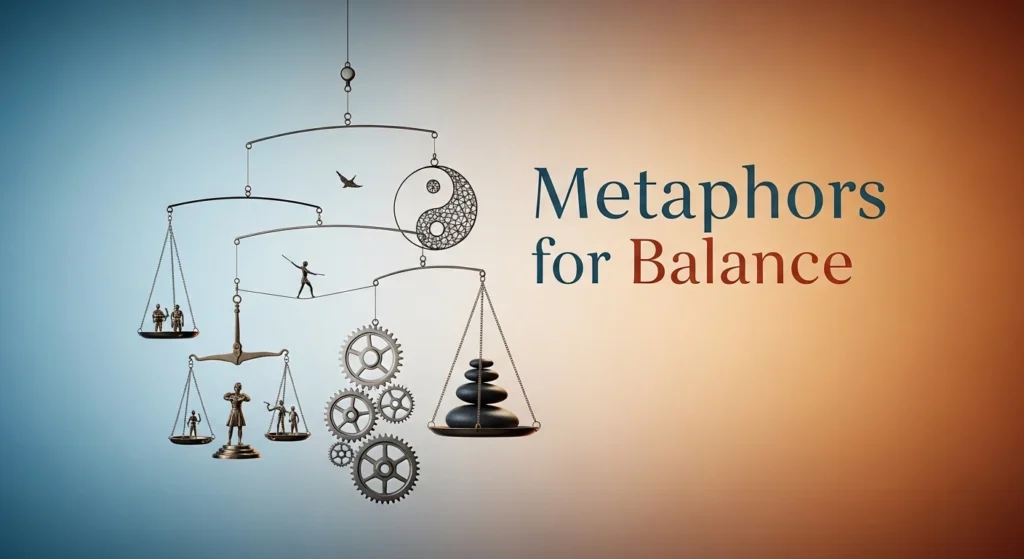
Walking a tightrope above a bustling city street, every careful step a dance between gravity and grace, perfectly captures the essence of life’s delicate equilibrium. This image mirrors our daily need to maintain balance, both emotionally and practically. Understanding metaphors for balance can help us express this concept creatively, offering insight into harmony, stability, and mindfulness.
Metaphors for balance are not just poetic devices—they shape how we communicate, understand emotions, and relate experiences. They allow us to illustrate complex states of mind, equilibrium in relationships, and the juggling act of modern life. In this article, we will explore the richness of metaphors for balance, providing examples, practical tips, and exercises to use them effectively in writing, speech, or daily reflection.
What Are Metaphors for Balance?
Metaphors for balance are figures of speech that describe equilibrium or stability through vivid imagery. Instead of saying “I am calm and collected,” a metaphor might depict a seesaw perfectly level or a boat gliding smoothly across a lake. These metaphors help make abstract ideas tangible and relatable.
Using these metaphors enriches communication. They convey feelings more powerfully than literal language. For example, “walking a tightrope of responsibilities” immediately evokes tension and precision. By weaving metaphors into language, we make our words resonate emotionally.
The Importance of Using Metaphors for Balance
Metaphors for balance add depth to our expression. They help readers and listeners visualize internal and external harmony. Writers, speakers, and content creators often rely on metaphors to engage audiences, making ideas memorable.
For instance, a manager might say, “Maintaining balance at work is like tuning an orchestra,” which immediately communicates both precision and collaboration.
Everyday Life as a Source of Metaphors for Balance
Life constantly provides imagery for balance. Observing nature, sports, or even traffic patterns can inspire metaphors. Consider a seesaw in a playground, a surfer riding a wave, or a tightrope walker in a circus—they all depict equilibrium in dynamic ways. These relatable scenes make metaphors more engaging and vivid.
Emotional Balance and Its Metaphors
Emotions often fluctuate like tides. Metaphors help us describe this fluctuation. Saying, “Her mind is a still pond,” conveys serenity, while “His emotions are a stormy sea” depicts turbulence. Such imagery allows readers or listeners to connect with feelings intuitively.
Physical Balance and Metaphors
Physical stability can serve as a metaphor for mental or emotional steadiness. Examples include “standing on solid ground” or “finding your footing.” These metaphors resonate because most people can relate to the physical sensation of balance.
Cultural References in Metaphors for Balance
Many cultures have long used metaphors for balance. In Chinese philosophy, yin and yang symbolize complementary forces creating harmony. In Japanese aesthetics, wabi-sabi reflects balance in imperfection. Incorporating such references enriches metaphors and adds cultural depth.
Literary Metaphors for Balance
Literature often illustrates balance with natural imagery. For example, poetry may describe a “tightrope of time” or “equilibrium of night and day.” Such metaphors offer a literary lens to explore life’s delicate balances, making writing more vivid and memorable.
Three Creative Metaphors for Balance
1. Walking a Tightrope
Explanation: Represents precision and focus amidst potential chaos. It conveys careful navigation through challenges. Example Sentence: “She walked the tightrope of her responsibilities, one task at a time.” Alternatives: “balancing on a wire,” “tiptoeing through duties.” Sensory Detail: Imagine the wind brushing your face, the thrill of height beneath your feet.
2. A Seesaw in Motion
Explanation: Captures the push and pull of life, illustrating that balance is dynamic, not static. Example Sentence: “Their relationship felt like a seesaw, rising and falling with each conversation.” Alternatives: “the pendulum swings,” “life’s ebb and flow.” Sensory Detail: The gentle creak of wood, the weight shifting beneath you.
3. A Boat on Calm Water
Explanation: Symbolizes serenity and controlled movement, depicting peace and steadiness. Example Sentence: “After weeks of chaos, he felt like a boat gliding across calm water.” Alternatives: “floating on still water,” “steady as a ship at anchor.” Sensory Detail: The reflection of sunlight on water, the gentle rocking of waves.
Using Metaphors for Balance in Writing
In writing, metaphors for balance enhance imagery, evoke emotions, and clarify abstract concepts. They work well in stories, essays, blog posts, and social media. Start by observing real-life situations and translate them into figurative language. Always ensure metaphors are relatable to the audience.
Tips for Creating Your Own Metaphors
- Observe nature and daily life for equilibrium-related imagery.
- Link emotions to physical experiences.
- Use familiar objects to describe abstract concepts.
For example, “Her patience was a dam holding back a river of frustration” combines physical imagery with emotional state.
Metaphors for Balance in Social Media
Metaphors make posts more engaging. Instead of saying “Stay calm,” you might say, “Find your center like a leaf floating on water.” Short, visual metaphors capture attention and are shareable.
Exercises to Practice Metaphors for Balance
Exercise 1: List 10 activities you do daily and create a balance metaphor for each. Exercise 2: Observe a natural scene and write a metaphor connecting it to emotional balance. Exercise 3: Rewrite a plain sentence using a metaphor. For example, change “I am stressed at work” to “I am balancing plates on a windy day.”
Using Sensory Details to Strengthen Metaphors
Incorporate what you see, hear, feel, or touch. Sensory details make metaphors immersive. “Her calm was like a hammock swaying gently in the breeze” adds texture beyond just saying “she was calm.”
Metaphors for Balance in Communication
Metaphors enhance understanding in conversations. Saying “I am trying to walk a tightrope between work and family” immediately conveys the challenge without lengthy explanation. They simplify complex experiences.
Common Mistakes to Avoid
Avoid overcomplicating metaphors. They should clarify, not confuse. For example, “Her inner equanimity resembled a quantum oscillation in multiversal time” is too complex. Keep imagery simple and relatable.
Bonus Tips for Writers and Creators
- Use metaphors sparingly to avoid redundancy.
- Combine metaphors with storytelling for greater impact.
- Experiment with metaphors across genres—poetry, blogs, social media.
Applying Metaphors for Balance in Daily Life
Metaphors can guide mindfulness. Visualizing yourself as a tree with deep roots can help maintain calm during stressful moments. They are tools for reflection, meditation, and communication.
Encouraging Creativity with Metaphors
Keep a metaphor journal. Write down striking images you encounter. Reflect on emotions or situations they remind you of. Over time, your collection becomes a personal toolkit for creative expression.
Conclusion
Metaphors for balance enrich language, offering clarity, beauty, and emotional resonance. They allow us to communicate abstract concepts like emotional stability, harmony, and resilience in relatable, engaging ways. By observing life, practicing creation, and applying metaphors thoughtfully, we deepen both writing and self-awareness. Embrace these tools in writing, conversation, and daily reflection to make life’s balancing acts more vivid and meaningful.
FAQs
What is a metaphor for balance?
A metaphor for balance is a figure of speech that describes stability or equilibrium using imagery, like a tightrope or seesaw.
How can I use metaphors for balance in writing?
Incorporate them to illustrate emotions, relationships, or situations. Use sensory details for vivid imagery.
Can metaphors for balance help in communication?
Yes, they make complex ideas relatable, allowing listeners or readers to grasp experiences quickly and emotionally.
What are some common metaphors for balance?
Examples include walking a tightrope, floating on calm water, a seesaw in motion, and standing on solid ground.
How do I create my own metaphors for balance?
Observe daily life or nature, connect experiences to emotions, and translate them into simple, vivid imagery.